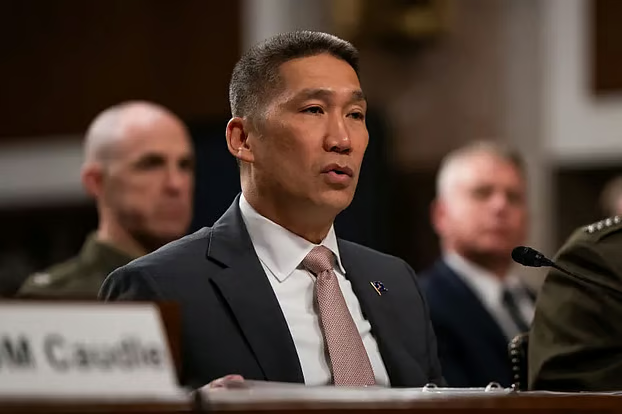
The United States is temporarily withholding the sale of $14 billion worth of arms to Taiwan. This decision was made to preserve ammunition stockpiles amidst the ongoing conflict with Iran. Hung Kao, the Acting Secretary of the US Navy, stated this during a Senate hearing yesterday, Thursday.
Just a week ago, the issue of arms sales to Taiwan featured prominently during a meeting held in Beijing between US President Donald Trump and Chinese President Xi Jinping.
Yesterday, Hung Kao said, “At this moment, we are taking a temporary pause [in arms sales] to ensure we have the necessary ammunition on hand for Operation Epic Fury—though we do currently possess adequate stockpiles.”
Hung Kao further added, “Everything is being secured. Later, should the administration deem it necessary, the sale of military equipment abroad will resume.”
Kao noted that the decision regarding whether or not to authorize these arms sales to Taiwan will be made by US Secretary of Defense Pete Hegseth and Secretary of State Marco Rubio. If approved, this would mark the largest US arms transfer in Taiwan’s history.
The conflict has currently subsided following a ceasefire agreement reached between the United States and Iran on April 8. However, no permanent treaty to end the war has yet been concluded.
The US Congress approved a new arms package for Taiwan last January. However, President Trump’s final authorization is required to implement it. If approved, this deal would surpass the record-breaking $11 billion arms sales package for Taiwan that Trump authorized last December.
Taiwanese Premier Cho Jung-tai told reporters yesterday, Friday, that his country would continue its efforts to acquire arms. This was reported by the Taiwanese media outlet FTV News.
William Yang, a Senior Analyst for Northeast Asia at the International Crisis Group, stated in a social media post that this suspension would further fuel anxiety and skepticism regarding US support for Taiwan. Consequently, it could become more difficult for the Taiwanese government to seek additional funding for defense in the future. In an interview with Fox News last week, U.S. President Donald Trump stated that he “may or may not” approve this arms package.
Trump further indicated that he might use this arms package as a “bargaining chip.” This comes despite a long-standing diplomatic convention in the United States—spanning several decades—of refraining from engaging in such negotiations with Beijing regarding arms sales.
China claims the autonomous region of Taiwan as an integral part of its own territory. It also opposes U.S. support for Taiwan.
Although the U.S. government does not formally recognize Taiwan, it is committed to assisting in the island’s defense under the provisions of the 1979 Taiwan Relations Act. This legislation was enacted shortly after Washington severed diplomatic ties with Taipei.
Trump has signaled an intention to further challenge the existing diplomatic stance regarding Taiwan. Earlier this week, he stated that he is considering speaking with Taiwan’s President, William Lai Ching-te, regarding the arms deal.
Such a move would break with four decades of U.S. diplomatic precedent, as U.S. presidents typically avoid direct communication with Taiwan’s leader. According to analysts, such an action could trigger a strong reaction from China.
However, following his victory in the 2016 election, Trump did speak by phone with Taiwan’s former President, Tsai Ing-wen. Notably, that phone conversation took place before Trump had formally taken the oath of office as President.