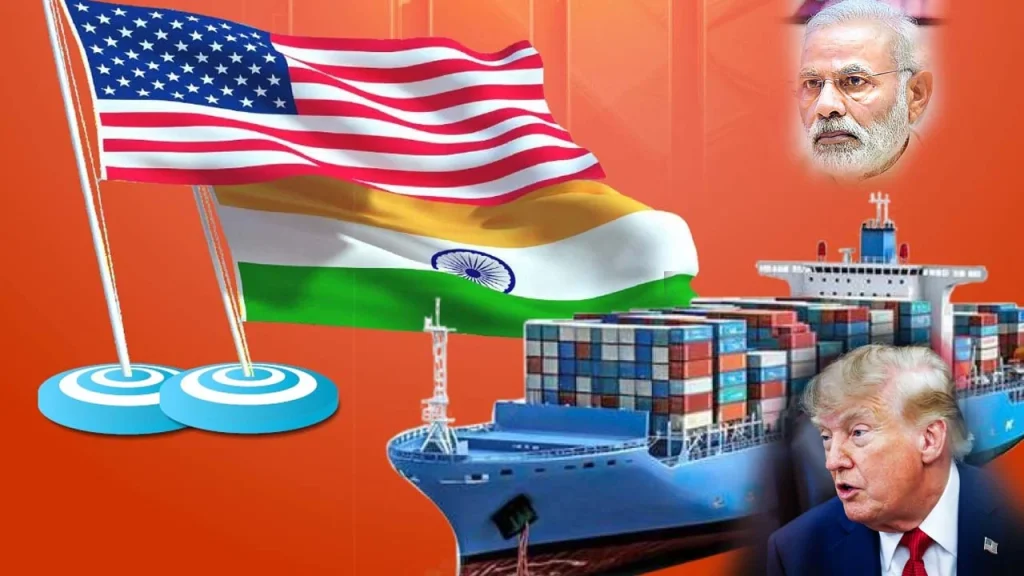
Indian exporters have expressed concern over the possibility of tariffs reaching up to 100% on goods exported from India. These fears have arisen following US President Donald Trump’s signing of the “Sanctioning Russia and Iran Act,” aimed at tightening sanctions against Russia and Iran. The Act includes provisions for imposing high tariffs on countries that import oil and gas from Russia.
Indian exporters fear that if the US imposes such high tariffs, the competitiveness of Indian products in the US market could be severely compromised. They have also warned that if tariff rates are excessively high, exports of certain products to the US could effectively come to a halt.
SC Ralhan, President of the Federation of Indian Export Organisations (FIEO), said, “We are very concerned. If the US imposes high tariffs, our exports to the country could stop completely. It is not possible for any importer to bear such high tariffs.”
He noted that many exporters in India’s engineering sector have significant business interests in the US market; therefore, Washington should consider this aspect before making any decision to impose new tariffs.
However, it is not yet possible to determine the actual impact of the new law on Indian exports, as the US has not yet provided details regarding tariff rates, the specific products affected, or the effective date of implementation.
Uncertainty: A Greater Concern Than the Tariffs Themselves
Sharad Saraf, Chairman and Managing Director of the Mumbai-based export firm Technocraft Industries, stated that uncertainty is causing more concern than the tariffs themselves. He remarked that to understand the true impact of the new decision, one must first know the tariff rates and their scope. Equally important is the nature of tariffs imposed on goods from India’s competitors, particularly China.
In Saraf’s view, the new law has created significant uncertainty regarding the existing healthy trade relationship between the two nations. Consequently, making business decisions is becoming difficult. The Trump administration might also be taking this step as a strategy to exert pressure on several countries, including India, ahead of the US midterm elections scheduled for next November.
Risk of Tariffs Up to 100 Percent
On September 18, Trump signed the ‘Sanctioning Russia and Iran Act.’ The legislation paves the way for imposing tariffs of up to 100 percent on goods from countries that are major buyers of Russian oil and gas. India and China could potentially fall under the purview of this measure. According to the act, it is supposed to come into effect within 30 days of the President’s signature. The law stipulates that tariffs of up to 100 percent may be imposed on goods from the top five buyers of Russian crude oil or natural gas, based on total volumes purchased during the 12 months prior to the law’s implementation.
Mohit Singla, Chairman of the Trade Promotion Council of India (TPCI), has described this move as a “major cause for concern” for Indian exporters. In his view, the imposition of such tariffs could have a significant negative impact on specific sectors and disrupt business relations between the two countries.
India’s Heavy Reliance on the US Market
The United States is India’s largest trading partner. During the April-August period of the 2026-27 fiscal year, India’s merchandise exports to the US rose by 6.17 percent to reach $42.8 billion. During the same period, India’s imports from the US increased by 29.6 percent to $28 billion.
In the 2025-26 fiscal year, bilateral trade between the two nations grew by 6.5 percent, reaching $140.76 billion. The trade volume in the preceding fiscal year stood at $132.2 billion; during that period, India’s exports to the US amounted to $87.3 billion, while imports totaled $53.45 billion.
Key Indian exports to the US include pharmaceuticals and biotechnology products, telecommunications equipment, precious and semi-precious stones, petroleum products, automobiles and auto parts, gold and precious metal jewelry, cotton apparel, and iron and steel products. On the other hand, India primarily imports crude oil, petroleum products, coal and coke, cut and polished diamonds, electrical machinery, aircraft and spacecraft, and gold from the United States. Additionally, various reports indicate that India’s software service exports to the US are projected to reach approximately $120 billion in the 2025–26 fiscal year. The two nations are also working towards a goal of raising bilateral trade to $500 billion by 2030.
Ongoing Tariff Disputes
A new phase of the dispute regarding US tariffs on Indian goods began on April 2, 2025. On that day, Trump announced a total tariff of 26% on Indian products—comprising a 10% baseline tariff and a 16% reciprocal tariff.
Although the reciprocal tariff component was suspended for 90 days on April 9, the 10% tariff remained in effect. Subsequently, further tariffs were imposed on Indian goods. Driven by issues surrounding India’s oil purchases from Russia, the additional levies eventually pushed the total tariff rate on most Indian products to 50%.
The two countries had agreed to reduce mutual tariffs to 18 percent in February 2026; however, that rate was never implemented. Subsequently, the United States introduced new global and India-specific tariff regimes. Most recently, new legislation enacted on September 18 has heightened concerns regarding the potential imposition of tariffs of up to 100 percent on Indian goods.
“No compromising energy security for temporary tariff relief”
The Indian think tank Global Trade Research Initiative (GTRI) believes the new US legislation could be used as a tool to pressure India into reducing oil imports from Russia.
According to GTRI founder Ajay Srivastava, India should not jeopardize its energy security in exchange for temporary tariff concessions. He argues that even if a trade agreement were signed or Russian oil purchases halted, the risk of future tariffs or other measures under US trade laws would not be entirely eliminated. Rafiq Ahmed, Chairman of the Farida Group—an Indian leather and footwear exporter—has also expressed concern over the new tariffs. With approximately 65 percent of his company’s total exports destined for the US market, any further tariff hikes there would directly impact their export operations.
Exporters note that raw material and transportation costs have already risen due to the Russia-Ukraine and US-Iran conflicts. The imposition of high US tariffs would place additional strain on Indian exporters. However, the ultimate impact will depend on the specific tariff rates the US imposes, the products covered, and the rates set for India’s competitor nations.