
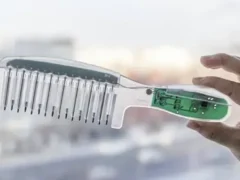







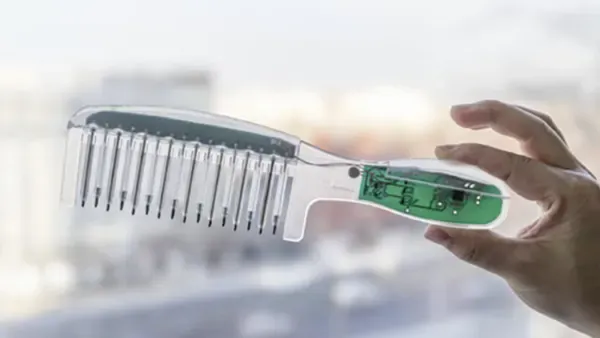
Chinese scientists claim to have developed a new technology to address the problem of baldness or hair loss. Their invention—a specialized electric comb—stimulates the hair roots, promoting rapid new hair growth.
According to the researchers, this method is significantly more effective than conventional treatments. In trials, the success rate for hair restoration reached nearly 100% within one month. However, the technology is still in the experimental stage.
Researchers at Beihang University in Beijing, China, developed this electric comb, dubbed “Detangle.” The findings of their study were recently published in the prestigious scientific journal Nature Communications.
The study, titled “Combing-triggered electrostimulation synchronizing deep delivery for rapid hair regrowth in androgenetic alopecia,” highlights the efficacy of the comb.
It notes that the experimental comb yielded better results compared to minoxidil, a common medication used to prevent hair loss.
The teeth of the “Detangle” comb are equipped with specialized electrodes of varying heights, integrated with molecules that carry medication. When the comb is used, it generates an electric field around the hair roots, which stimulates the hair follicles while simultaneously delivering the medication.
In their research, the scientists reported that the technology significantly enhanced hair restoration in a mouse model of hereditary male-pattern baldness. While conventional minoxidil treatment shows a success rate of approximately 70%, the use of “Detangle” achieved a success rate of nearly 100% within one month.
Awaiting human trials
However, there is currently no evidence to confirm whether the “Detangle” comb will be effective in humans. So far, the research has been conducted only on mice. While results from animal studies can provide an initial indication of potential efficacy in humans, they do not constitute definitive proof.
Further testing is required before clinical trials on humans can begin. These tests will evaluate the safety and effectiveness of the technology. Consequently, it may take some time before the device becomes available on the market or is ready for use in human medical treatment.