






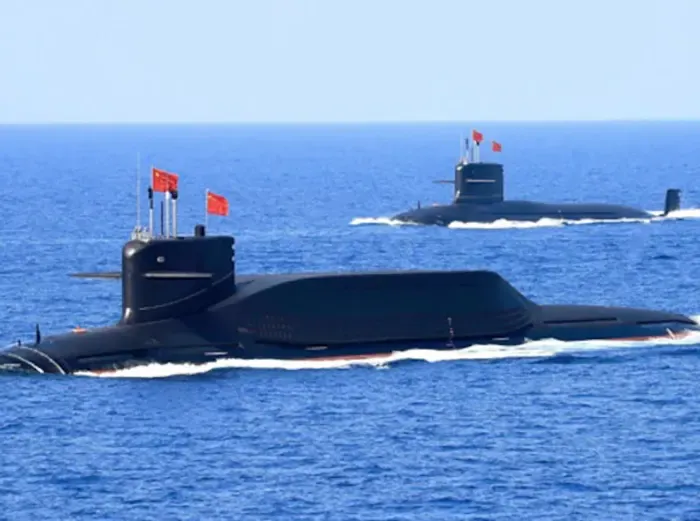
China has significantly increased its presence across maritime routes. Its navy is no longer confined to waters near its own coast; approximately 100 of its vessels now patrol Asia’s busiest shipping lanes daily. There has been a marked rise in Chinese activity—from the South China Sea to the waters near Japan and Taiwan. This growing footprint has become a major source of concern for U.S. military planners. China currently possesses more warships than the United States, and its fleet is expanding at such a rapid pace that it has become difficult for Washington to keep up. This is according to a report by NDTV.
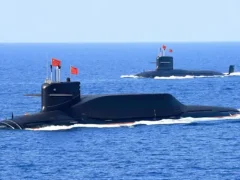
Citing official U.S. government statistics, The Wall Street Journal reports that the Chinese navy now operates over 400 warships and submarines—a total roughly 35 percent larger than the U.S. fleet. China currently operates three aircraft carriers and is in the process of constructing a fourth; Western experts speculate that this new vessel could be nuclear-powered. This represents one of the most significant naval expansions seen during peacetime in modern history.
Chinese warships are now patrolling vast maritime expanses. They conduct regular patrols in the South China Sea, around Taiwan, east of the Philippines, and off the southern coast of Japan. Chinese vessels are also frequently present in the Western Pacific and the Gulf of Aden. According to security officials, at least six Chinese naval vessels are stationed around Taiwan at any given time—a number that surges during military exercises. In the South China Sea, their presence is nearly three times greater. China is currently embroiled in territorial disputes in that region with the Philippines and Vietnam. Beijing’s objective extends beyond merely increasing its fleet size; it aims to exert control over its coastal waters and strengthen its claims in disputed territories. Furthermore, a key strategic goal is to deter U.S. military intervention in the event of any future conflict. China’s rise at sea is largely driven by its massive shipbuilding industry. China is the world’s largest shipbuilder, currently producing more than half of the world’s commercial vessels each year. Now, leveraging this same industrial capacity, the country is rapidly constructing warships. The primary architect of this transformation is Chinese President Xi Jinping. Shortly after taking office in 2013, he told Communist Party leaders that China must become a great maritime power. He invoked the voyages of the 15th-century Chinese admiral Zheng He, whose fleet reached as far as the Strait of Hormuz and the east coast of Africa—a time before China turned inward and became isolated. Xi also recalled the 19th-century Opium Wars, when Western powers attacked China by sea.
By most metrics, the Chinese Navy still lags behind that of the United States; on average, U.S. vessels are larger. However, Beijing is now building large warships at a much faster pace. According to The Wall Street Journal, China has added 71 major warships and submarines to its fleet since 2020, with 19 added in the last year alone. A significant portion of this expansion is taking place on Changxing Island, near Shanghai, where two shipyards are producing both commercial vessels and state-of-the-art warships. Satellite imagery from last May revealed extensive activity at the site. In 2023, China constructed a 40,000-ton amphibious assault ship named Sichuan, which is being described as a drone carrier. Furthermore, in June of this year, a new nuclear-powered submarine was spotted at the Jiangnan Shipyard on Changxing Island. China is shifting its focus from diesel-electric submarines toward nuclear-powered ones. U.S. officials estimate that by 2040, Chinese submarines will be conducting regular patrols in the Indian Ocean and the Arctic region. At the heart of this escalating rivalry lie the waters stretching from the Yellow Sea through the East and South China Seas. China seeks to establish control over these maritime routes, which are among the busiest in the world. Simultaneously, it is working to bring Taiwan under its control while making it increasingly difficult for the U.S. military to intervene. Washington, for its part, aims to prevent China from achieving military dominance in the region. According to military strategists, a core element of the Pentagon’s strategy is to safeguard the “First Island Chain”—a series of islands that includes Japan, Taiwan, and the Philippines. Meanwhile, Beijing continues to expand its military presence in the region. Its warships are now conducting training exercises in large formations, a move that exerts pressure on neighboring nations while also serving as preparation for any potential conflict.