



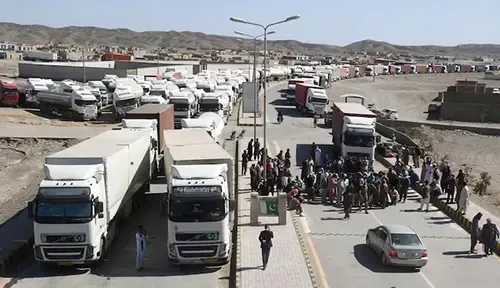
The United States has announced a plan to disrupt Iran’s overland supply routes. To this end, the US military’s Central Command (CENTCOM) has established a new task force, effectively expanding the existing US naval blockade of Iranian ports in the Strait of Hormuz. CENTCOM disclosed this information on Saturday, stating that the initiative is designed to prevent Iran from using land routes to transport advanced weaponry and other equipment. This new US move comes more than eight months into a conflict involving Israel and Iran.
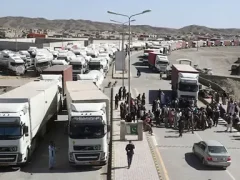
‘Task Force Iron Gate’: Based in Tampa, Florida, the unit has been designated ‘Task Force Iron Gate.’ CENTCOM Commander Admiral Brad Cooper stated that the task force will build upon the success of the existing, stringent naval blockade against Iran. The task force will operate in coordination with other US government agencies, monitoring Iran’s land borders and the Caspian Sea to intercept the flow of advanced weapons systems, dual-use technologies, sanctioned materials, and illicit revenue. Michael Mulroy, a former US Deputy Assistant Secretary of Defense for the Middle East, explained that the task force’s mandate includes identifying the origins of these weapons and determining how to interdict them. He further noted that should President Donald Trump order an expansion of the conflict, operations could primarily target economic and infrastructural assets.
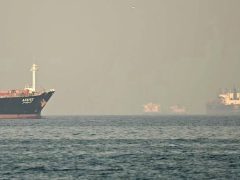
In a separate statement, CENTCOM reported that, as part of the naval blockade, a commercial cargo vessel named M/V Huda was neutralized in the Gulf of Oman. US military aircraft struck the vessel after CENTCOM forces ordered its crew to vacate specific areas of the ship. Since July, U.S. forces have diverted 147 commercial vessels and disabled five ships that failed to comply with their directives.
On Saturday, Iran’s state news agency, IRNA, reported sounds of two explosions on Qeshm Island, located in the Strait of Hormuz. Explosions were also reported in the cities of Jask, Sirik, and Bandar Abbas. A day earlier, Trump confirmed new strikes on Qeshm Island but characterized them as minor. Amidst ongoing negotiations mediated by Qatar, Trump claimed that Tehran remains interested in reaching an agreement. Meanwhile, the IRGC Navy of Iran stated that two oil tankers were damaged by mine explosions near the Strait of Hormuz on Saturday.
An investigation by Reuters revealed that, by circumventing U.S. naval blockades and Western sanctions, Iran has imported at least $2 billion worth of hardware, explosives, and heavy trucks since January 2025. These supplies entered Iran via cargo ships from Russia (crossing the Caspian Sea), trucks from Central Asia, and freight aircraft from China. According to CENTCOM estimates, however, the U.S. naval blockade has cost Iran over $25 billion in lost crude oil export revenue. Despite these challenges, Iran has maintained a firm stance. Tehran expressed jubilation following the setbacks faced by Trump’s Republican Party in the U.S. midterm elections, which saw the Democratic Party gain control of Congress. U.S. Vice President JD Vance attributed these electoral losses to the conflict with Iran. Fearing a potential escalation of the conflict following the midterm elections, mediators have intensified efforts to bring an end to the hostilities between the United States and Iran. According to Reuters, U.S. intelligence agencies believe that further attacks on Iran would neither fundamentally alter Tehran’s negotiating position nor lead to the collapse of its government.