
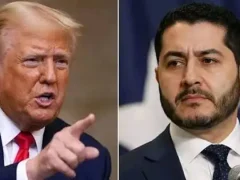


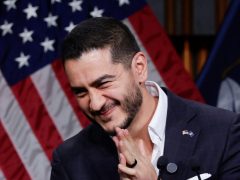


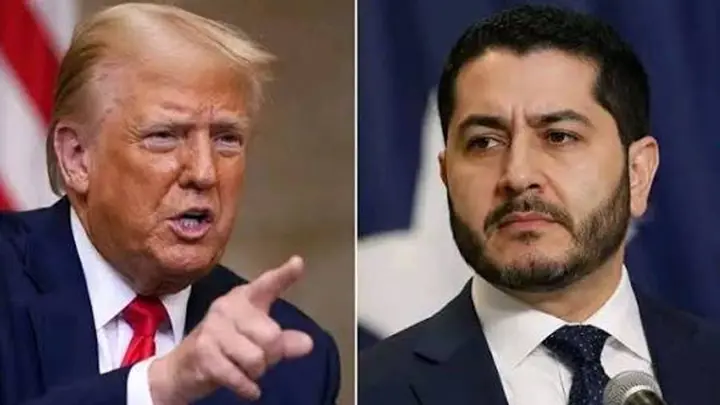
The political rivalry between U.S. President Donald Trump and Abdul El-Sayed—the first Muslim elected to the Senate from Michigan—has taken a new turn. Before the election, Trump labeled El-Sayed a “jihadist” and urged voters to prevent him from reaching the Senate. He questioned El-Sayed’s Muslim identity, his loyalty to the United States, and his stance against Israel. However, following his election victory, El-Sayed has welcomed Trump’s recent announcement regarding the potential cessation of U.S. military aid to Israel—though El-Sayed argues that halting military aid is not enough; arms sales to Israel must also be stopped.
In the U.S. midterm elections held on November 3, 42-year-old Abdul El-Sayed defeated the Republican candidate, Mike Rogers, for a Senate seat from Michigan. In doing so, he became the first Muslim in U.S. history to be elected to the Senate. He is scheduled to assume his Senate duties on January 3, 2027.
Prior to the election, Trump launched a direct, aggressive campaign against El-Sayed. At a rally in Port Huron, Michigan, on October 25, the U.S. President labeled him a “jihadist” and someone who “sides with terrorists.” He even mocked El-Sayed, suggesting that if he were to become a senator, he would have to pass through a metal detector. Invoking the September 11, 2001, terrorist attacks, Trump also called for efforts to block his entry into the Senate.
El-Sayed responded to these remarks, noting at a rally in Grand Rapids, Michigan, that it was significant enough that Trump managed to remember his full name—adding that, after November, he could simply refer to him as “Senator.” This comment was met with enthusiasm from his supporters.
Throughout the lead-up to the election, the Republican campaign specifically highlighted El-Sayed’s Muslim identity and his anti-Israel stance. Allegations were also raised regarding her ties to the Muslim Brotherhood. However, reports from the Associated Press and Reuters indicate that no evidence has been found to substantiate any such connection.
A central theme of Al-Sayed’s election campaign was the cessation of U.S. military aid to Israel. Describing Israel’s military operations in Gaza as genocide, she criticized the provision of American weapons and financial support. She argued that U.S. taxpayer money should be invested in improving healthcare, education, and the standard of living for people within the United States, rather than being spent on foreign military operations.
In an interview with NPR on November 4, following her election victory, Al-Sayed welcomed Trump’s stated intention to end the approximately $4 billion in annual military aid to Israel, remarking, “On this policy, the President is actually right.” She further emphasized that the sale of weapons to Israel—which are being used in grave acts such as genocide and apartheid—must also be halted.
Al-Sayed asserted that American citizens do not pay taxes to subsidize foreign militaries, including that of Israel; rather, those funds should be directed toward the needs of the American people. Beyond ending financial and military support, she advocates for equal rights, peace, dignity, and the right to self-determination for both Palestinians and Jews.
She also argued that the United States should not use its diplomatic standing to shield Israel from allegations of war crimes or genocide before international bodies such as the United Nations, the International Criminal Court (ICC), or the International Court of Justice (ICJ).
While there is now a partial alignment between Trump and Al-Sayed regarding the termination of military aid to Israel, their underlying political stances and the rationales behind them differ. Al-Sayed has long championed the rights of Palestinians and called for an end to U.S. arms supplies to Israel. Trump, meanwhile, has announced plans—post-election—to discontinue the roughly $4 billion in annual aid, though he has yet to provide a detailed implementation strategy. Al-Sayed’s victory also marks a historic milestone for Muslim representation in American politics. A former public health official and the son of Egyptian immigrants, he campaigned on promises to make healthcare accessible to all, reduce the influence of corporate money in politics, and lower the cost of living for ordinary people.
Following his victory, he noted that Republicans had made his name and religious identity a central focus of the campaign. However, the people of Michigan cast their votes based on their daily concerns and their vision for the future. In his view, this win serves as a rejection of Trump’s political agenda and a call to address the economic hardships faced by everyday citizens.
Al-Sayed has expressed support for a recent policy announcement regarding Israel made by Donald Trump—the very same Trump who, prior to the election, had sought to block his path to the Senate. Nevertheless, Al-Sayed has clarified that his demands go further: he calls not only for an end to financial aid but also for a halt to arms sales, alongside the assurance of equal rights for both Palestinians and Jews.