
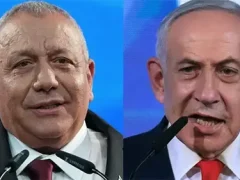



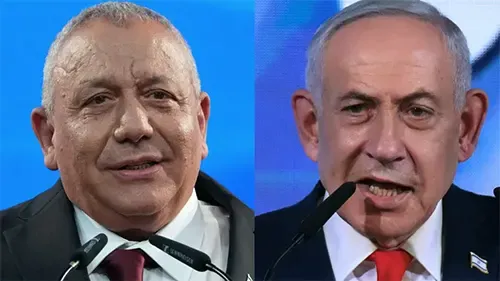
Israeli President Isaac Herzog has tasked Gadi Eisenkot—a former military chief and leader of the ‘Yeshar’ party—with forming the next government. This decision effectively sidelines long-serving Prime Minister Benjamin Netanyahu. President Herzog informed Eisenkot of his choice on Saturday evening, and the formal mandate will be conferred during an official ceremony on Sunday. Following the general election on October 27, no single faction secured a parliamentary majority; consequently, the President held consultations with various political parties to determine whom to appoint to form a government.
Approximately 67 lawmakers, including those from Arab-led parties, have pledged their support to Eisenkot, while incumbent Prime Minister Netanyahu has received the backing of only 46 lawmakers. Eisenkot will have 28 days to assemble a coalition holding at least 61 seats in the 120-member Knesset (Israeli parliament)—a period that may be extended by an additional 14 days if necessary. In the October elections, Eisenkot’s four-party alliance won 48 seats, whereas Netanyahu’s right-wing and religious coalition secured 53. Neither side, however, reached the 61-seat threshold required to form a government. Meanwhile, Arab-led parties representing Palestinian citizens achieved a record 19 seats.
Eisenkot has ruled out the possibility of forming a government in alliance with the Arab-led parties, even though such a partnership would have brought his total to 67 seats. However, if he succeeds in bringing the two hardline parties—United Torah Judaism and Shas—into his coalition, he would reach exactly 61 seats. Furthermore, should he win a vote of confidence in parliament, he could potentially form a government even with fewer than 61 seats. Reporting from Ramallah in the occupied West Bank, Al Jazeera’s Nour Odeh noted that the President’s decision followed the expected course, as Eisenkot had received the highest number of recommendations. He stated that the real challenge for Eisenkot begins now. He must secure a vote of confidence in the Knesset—all while upholding his campaign promises and navigating opposition from Netanyahu’s right-wing camp. Should Eisenkot fail, Herzog will nominate another candidate. If that candidate also fails, a third individual might garner the support of a parliamentary majority. If all efforts prove unsuccessful, new elections will be held within 90 days, during which Netanyahu will serve as interim Prime Minister.
Eisenkot led the Israeli military from 2015 to 2019. Furthermore, following the outbreak of the war in Gaza in October 2023, he served as an observer in Netanyahu’s wartime cabinet for the first eight months. Ahmad Tibi, a senior leader of the ‘Joint List’—an alliance of Arab-led parties that holds 11 seats—told Al Jazeera on Saturday that Herzog’s decision came as no surprise. They have extended their support to Eisenkot specifically to prevent the formation of a ‘national unity’ government [that would include Netanyahu]. Tibi believes that Eisenkot intends to form a minority government with external support from the Arab parties. While this may not be their ideal government, their primary objective is to bring about the downfall of the administration led by Netanyahu, Itamar Ben-Gvir, and Bezalel Smotrich.
Hours before the President’s announcement, Netanyahu warned that the formation of an opposition government backed by Arab-led parties would lead to the collapse of Israel. He claimed that a government dependent on Islamists would destroy the State of Israel from within, labeling the Arab parties as “supporters of terrorists.” In response, Tibi asserted that Netanyahu himself is the greatest terrorist in Israel and the entire region, describing him as the primary enabler of Jewish terrorism in the West Bank and Palestinian territories. Although Eisenkot may not wish to form a government in formal partnership with the Arab parties, both sides share the same goal: removing Netanyahu from power.