
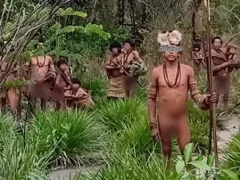







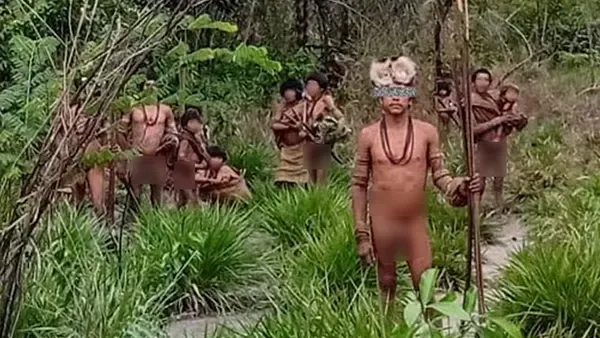
Rare images have emerged showing members of an isolated indigenous group coming out of a remote area of the Brazilian Amazon rainforest. A group of approximately 20 individuals approached a government team in search of food. This incident—their emergence into an area inhabited by others—has sparked concern, reports Reuters.
Rights activists state that the group is on the verge of losing its habitat due to the encroachment of illegal loggers, poachers, and cattle ranchers. The forest territory they inhabit is steadily shrinking.
Survival International, a UK-based organization advocating for the rights of indigenous peoples, released the images on Tuesday. The organization claims that a “historic encounter” took place on Monday between members of the indigenous Awá group and a government team in a region within the northeastern Brazilian state of Maranhão. During this encounter, about 20 indigenous individuals requested food.
The organization notes that there is no precedent for such contact with the Awá people in recent history; this may be the first such occurrence in decades. It is believed that they were forced to approach people outside their territory due to mounting pressure on their land caused by the intrusion of outsiders.
According to Survival International, an “isolated indigenous group” refers to people who avoid contact with outsiders and maintain no permanent relationship with them—though this does not mean they are entirely unaware of the outside world.
FUNAI (the National Foundation for Indigenous Peoples), Brazil’s government agency for indigenous affairs, informed Reuters that it is reviewing videos and information circulating on social media regarding contact between members of the isolated Awá group and residents of a village within the Arariboia Indigenous Territory in Maranhão.
The agency further stated that an emergency plan has been activated to manage such contact, with the primary objective of minimizing health risks to the indigenous people—specifically the danger of contracting infectious diseases through exposure to outsiders. FUNAI has stated that the Brazilian government is not attempting to establish contact with this group; its policy remains one of non-contact.
According to FUNAI, the Awá are an indigenous Tupi-Guarani community living in the northwestern part of the state of Maranhão. Some members of the group continue to live in voluntary isolation.
Closing in from all sides: The encroaching destruction
Survival International reported that it released the images at the request of an indigenous group known as the “Guardians of the Amazon,” which campaigns against illegal logging and the establishment of cattle ranches. However, Reuters noted that it could not independently verify the location or the date the footage was captured. No earlier versions of the footage could be found online prior to November 17.
Over the past few decades, isolated indigenous groups across various parts of the Amazon—the world’s largest rainforest—have faced an escalating threat from the encroachment of illegal miners, loggers, and cattle ranchers.
Caroline Pearce, director of Survival International, stated that the isolated Awá people are under extreme pressure. With outsiders entering their territory from all directions, they are being forced into an ever-shrinking portion of the Amazon rainforest, surrounded by the destruction of their environment.
According to the organization, there are 196 isolated indigenous groups across 10 countries in South America, Asia, and the Pacific region. Approximately 95 percent of these groups reside in the Amazon region, with 124 such groups located in Brazil alone.
COAPIMA, an organization representing indigenous peoples in the state of Maranhão, stated on Tuesday that this situation involving the Awá highlights the critical need for relevant government agencies to exercise extreme caution.
They argue that unplanned contact could pose a grave danger to isolated indigenous groups—most notably through the introduction of diseases by outsiders, as well as other threats to their lives and continued existence. Experts and rights activists express concern that if the destruction of forests and the encroachment of outsiders continue, it will become difficult for these communities to sustain their unique way of life and their very existence. The fact that members of the Awa community have been approaching human settlements in search of food serves as a new, alarming sign of this crisis.