

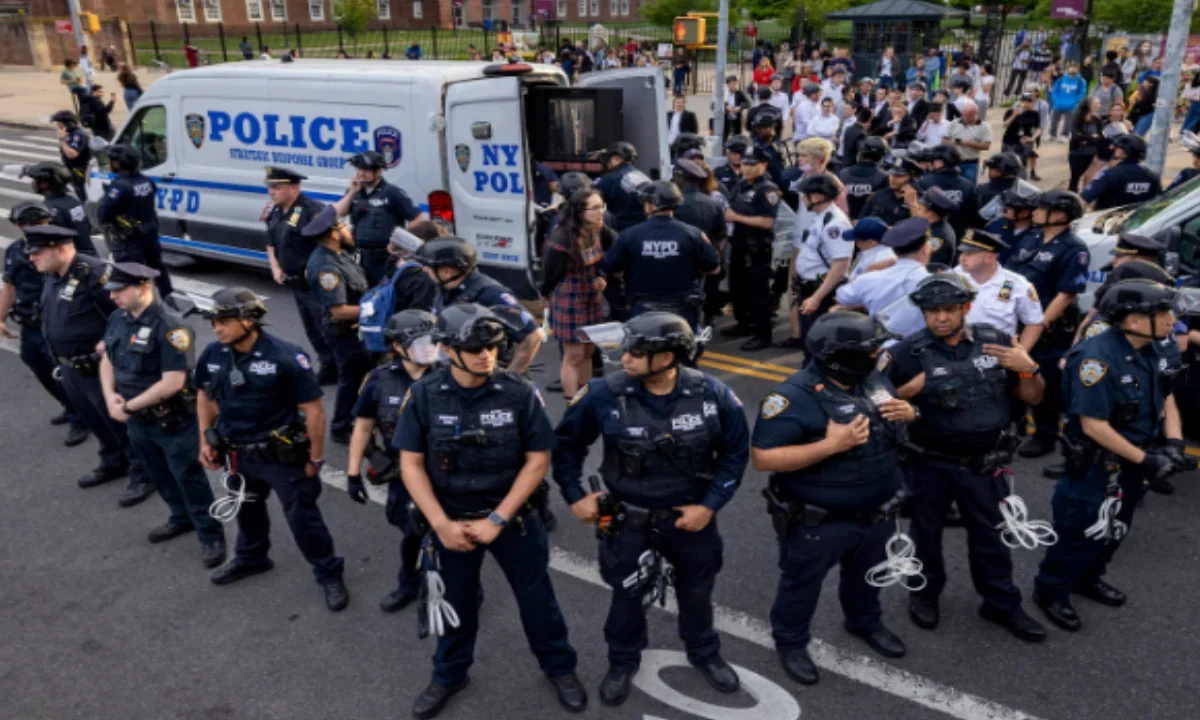
New York City Mayor Zohran Mamdani has announced the disbandment of the Strategic Response Group (SRG)—a controversial special unit within the New York Police Department (NYPD). The unit had long faced criticism for its use of excessive force, mass arrests, and aggressive tactics against protesters. It will be replaced by a new division composed of unarmed mediators tasked with managing protest situations. Additionally, several harsh police tactics used for protest control have been banned.
Mayor Mamdani and Police Commissioner Jessica Tisch made the joint announcement on Monday. With this move, Mamdani has fulfilled a key campaign promise. The core objective of his plan is to separate the responsibilities of counter-terrorism from the management of peaceful protests, aiming to reduce confrontations between police and protesters by prioritizing dialogue and negotiation. Under the new framework, a civilian unit called the “Community Dialogue and De-escalation Division” (CDDD) will be established under the Mayor’s Office. Members of this division will carry no weapons and will have no authority to make arrests.
Why the SRG Was Disbanded
The NYPD established the SRG in 2015 as a rapidly deployable special force designed to handle emergency situations. Its mandate included counter-terrorism, addressing major crimes, managing public safety crises, and controlling mass protests.
Comprising approximately 500 personnel, this special force was capable of conducting rapid operations across New York City. Over time, however, it became the subject of allegations involving the use of excessive force, the indiscriminate detention of protesters, and the harassment of journalists and observers.
Criticism intensified following the 2020 death of George Floyd—a Black man killed by police in the United States—which sparked widespread protests against racism and police violence. In New York City, the role of the SRG in suppressing these demonstrations drew particularly sharp condemnation. Allegations emerged that police officers used pepper spray, mass arrests, and other harsh tactics to disperse protesters.
In 2023, following a lawsuit filed by several organizations—including the New York Civil Liberties Union (NYCLU)—against the city, New York Attorney General Letitia James reached a legal settlement. This settlement, which addressed allegations of excessive police force during the 2020 protests, brought the operations of the Strategic Response Group (SRG) under scrutiny.
Criticism of the unit persisted thereafter. The role of the SRG also became a subject of controversy during pro-Palestine demonstrations across various universities and cities. In 2024, when police conducted an operation to clear a student sit-in at Columbia University—organized to protest Israel’s offensive in Gaza—fresh questions were raised regarding the role of the SRG and other specialized police units.
New Measures for Managing Protests
Under the reform plan announced by the Mayor and the Police Commissioner, three new structures are being established.
First, a “Community Dialogue and De-escalation Division” (CDDD) will be created under the Mayor’s Office of Community Safety. This will be a civilian-led division tasked with engaging with protest organizers, facilitating dialogue, de-escalating tensions, and ensuring that situations remain peaceful. Members of this division will neither carry weapons nor possess the authority to make arrests.
Second, a “First Amendment Support Team” (FAST) will be formed under the NYPD’s Community Affairs Bureau. Comprising 30 uniformed police officers, this team will receive specialized training in communication, conflict resolution through dialogue, and de-escalation. FAST will lead these efforts until the new civilian division becomes fully operational.
Third, a “Patrol Support Division” (PSD) will be established under the police department’s Patrol Services Bureau. This division will be composed of carefully vetted police officers. Most of their time will be spent on routine patrols and standard police duties. However, during large-scale protests or public gatherings, they will utilize their specialized training to help manage the situation. In rare instances, they may also be tasked with making arrests if necessary.
The counter-terrorism operations of the SRG—specifically the deployment of heavy weaponry to secure critical infrastructure—will be placed under the NYPD’s existing Intelligence and Counterterrorism Bureau. Consequently, protest management and counter-terrorism efforts will be handled through separate organizational structures.
Prohibited Tactics at Protests
A key component of the new reform plan is the prohibition of certain aggressive police tactics used during protests. Under the new rules, the practice of “kettling”—encircling protesters and cutting off their exit routes—will be banned. The use of long-barreled firearms and tear gas during protests will also be prohibited.
Furthermore, pepper spray may no longer be used as a tool for managing public gatherings. Restrictions have also been placed on the use of Long-Range Acoustic Devices (LRADs)—which emit high-intensity sound—to disperse protesters; the sound output from these devices must now be kept within a 90-decibel limit.
Even the use of bicycles by police officers as weapons is being prohibited, with exceptions permitted only when absolutely necessary to prevent death or physical harm to oneself or others. According to the Mamdani administration, the objective of these changes is to uphold the constitutional rights of citizens participating in peaceful protests and to reduce conflict between the police and the public.
**Fulfilling Mamdani’s Campaign Promises**
During his mayoral campaign, Mamdani pledged to dismantle the Strategic Response Group (SRG). He argued that the policing approach used for peaceful protests should not be the same as that used to counter terrorism. Mamdani stated that individuals exercising their constitutionally protected rights to protest should not be treated in the same manner as those posing a terrorist threat. A new, civilian-led framework is being established, prioritizing dialogue, communication, and de-escalation during protests.
He further noted that the new plan incorporates key reforms from the “CURB Act,” proposed by City Council member Chi Ossé. This legislation is designed to impose stricter limitations on the police’s authority to control protests and their use of aggressive tactics.
Police Commissioner Jessica Tisch has also expressed support for the reforms, emphasizing the necessity of regularly reviewing police operations and implementing essential changes. She reassured the public that these adjustments would not compromise the police’s ability to ensure the safety of New Yorkers. Authorities have confirmed that the implementation of these reforms will not require any change in the total number of police personnel, nor will it entail additional expenditure.
**Welcomed by Human Rights Groups, Yet Concerns Remain**
Various civil rights and human rights organizations in New York have welcomed Mamdani’s announcement. The New York Civil Liberties Union (NYCLU) described the decision to disband controversial units like the SRG—and to ban tactics such as “kettling” and the use of tear gas—as a significant step toward protecting the rights of protesters.
However, these organizations caution that dismantling a single unit does not guarantee a shift in overall police conduct. They emphasize the need to monitor whether old, problematic tactics might resurface under the new framework. The Legal Aid Society of New York has welcomed the decision, though it has also emphasized the need for strict oversight of the new Patrol Support Division’s operations. The organization expresses concern that if the tactics and personnel of the former Strategic Response Group (SRG) resurface within this new unit, the very purpose of the reforms could be undermined.
Linda Tigani, head of New York’s Commission on Racial Equity, stated that they do not want the old unit to return merely under a new name. She noted that the campaign promise was to dismantle the unit, not simply to rebrand it.
Conversely, organizations representing police officers have opposed the decision. Patrick Hendry, president of the New York City Police Benevolent Association, remarked that this is not a good day for New Yorkers who desire a safe and orderly city. He argues that the new arrangement could hinder police operations during incidents such as protests that block bridges and roads, or other situations involving public disorder.
**Redeployment of 500 Police Officers**
Approximately 500 officers from the SRG will be reassigned to other units within the NYPD by next spring, with some set to join the Counterterrorism Bureau.
However, the Mayor’s office has not provided specific details regarding how many former SRG members will be integrated into the new Patrol Support Division. Questions also remain as to whether the new unit will employ the same tactics as its predecessor.
Meanwhile, Police Commissioner Keechant Sewell has stated that the police department’s overall capacity to manage public gatherings will remain intact. According to her, the new structure will not weaken police security operations; rather, it will lead to a clearer delineation of responsibilities.
Ultimately, this decision marks the beginning of a significant shift in New York’s policing system. The new administration faces a major challenge: striking a balance between upholding civil rights and the freedom to engage in peaceful protest, while simultaneously maintaining public safety and law and order. Only time will reveal how effective these new divisions prove to be and whether they succeed in curbing controversial policing tactics. Sources: The Washington Post, Reuters, AFP, The Guardian, Office of the Mayor of New York, City & State New York, New York Civil Liberties Union, Curb Coalition, ABC7 New York, NBC New York, and CBS News