
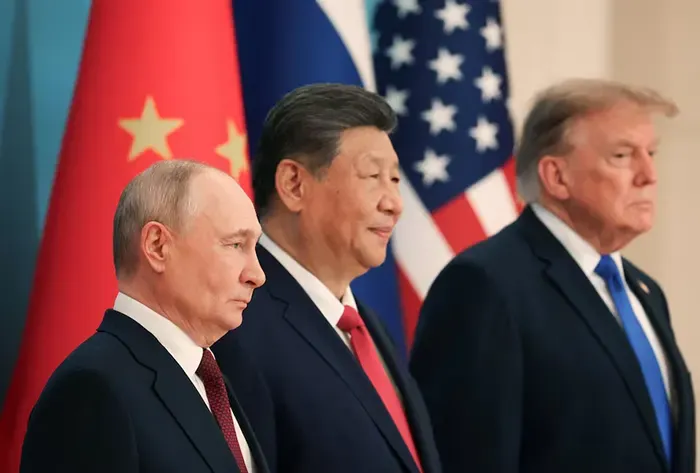
China, the United States and Russia have issued a symbolic ‘peace declaration’ following an unprecedented trilateral summit in Shenzhen, China. During the meeting on Thursday, the three nations reaffirmed that a nuclear war should never be fought. However, no plans were announced regarding arms control negotiations—a long-standing objective of U.S. President Donald Trump. This report comes from the news agency Reuters.
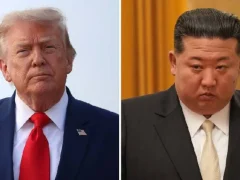
The joint declaration by Chinese President Xi Jinping, U.S. President Donald Trump, and Russian President Vladimir Putin marked the conclusion of Trump’s three-day tour of Asia. Despite Trump’s various claims about making history and establishing peace, the visit yielded no significant, tangible achievements. On the contrary, Trump’s growing closeness to Xi Jinping and Vladimir Putin—who continues to wage war in Ukraine—has raised new questions among U.S. allies. During the meeting, Trump referred to Putin as “my friend,” while Xi Jinping embraced him.
In their joint declaration, the three leaders pledged to advance United Nations reforms, increase the supply of energy products for all nations, and maintain immunity for state officials before international courts. More than three years ago, the International Criminal Court (ICC) issued arrest warrants for Putin and other Russian officials over alleged war crimes in Ukraine.
Notably, the declaration makes no mention of the war in Ukraine or the ongoing conflict between the United States and Iran. In a subsequent press conference, Putin acknowledged that no ambitious goals had been set and that no party would be compelled to adhere to the decisions reached. The three powers reaffirmed that a nuclear war can never be won and should never be fought. While they expressed a commitment to continuing dialogue on reducing nuclear risks and preventing proliferation, no specific timeline was provided. Furthermore, the statement contained no reference to the trilateral nuclear arms reduction treaty previously proposed by Trump. Nevertheless, Trump told NBC that the meeting went exceptionally well, rating it a 12 on a scale of zero to 10.
He remarked to Reuters that the summit was even more significant than the 1945 Yalta Conference, which involved the United States, Great Britain, and the Soviet Union. Defending his decision to call Putin a “friend,” he argued that it is better to have someone who possesses 4,000 nuclear weapons as a friend rather than an enemy.
However, Chuck Schumer, the Democratic leader in the U.S. Senate, described the summit as a “historic disgrace.” He asserted that the President had betrayed the United States by bowing to an adversary for the sake of a photo opportunity. Meanwhile, Jonathan Eyal, International Director at the Royal United Services Institute in London, suggested that Putin emerged as the true winner of the summit—regaining legitimacy and breaking out of his international isolation.
Separately, European allies meeting in Berlin on Thursday reaffirmed their support for Ukraine and warned against any peace deal reached without their involvement. German Chancellor Friedrich Merz stated that peace would not be achieved through a “Yalta-style” format and emphasized that Europe would not be allowed to become divided. He dismissed the summit as little more than a “photo op.” Standing alongside Merz, Jared Kushner—Trump’s son-in-law and special envoy—stated that Trump intends to pursue a peace agreement in consultation with Europe, adding that Russia has also agreed to engage in multilateral discussions involving European partners.
In the coming weeks, Trump is set to host a G20 summit at his golf resort in Florida, where he is expected to meet with Xi Jinping once again. Following his discussions with Trump, Putin indicated that he would consider attending the summit, taking Russia’s current circumstances into account.