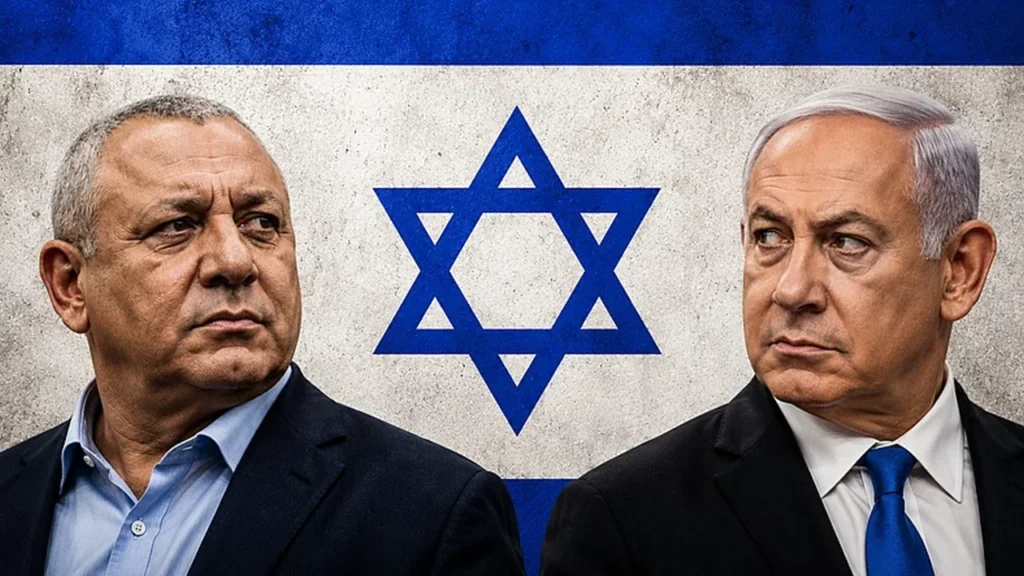
Former Israeli Army Chief Gadi Eisenkot has emerged as the primary challenger to Prime Minister Benjamin Netanyahu in the country’s upcoming general election, scheduled for October 27.
Eisenkot’s rise comes at a critical juncture in Israeli politics. He formed a new political party named ‘Yashar’ in 2025. Voters are expected to closely evaluate Netanyahu’s success or failure in handling the conflict that erupted following the October 7, 2023, Hamas attack from Gaza.
A recent opinion poll by the local broadcaster Channel 12 indicated that Eisenkot’s ‘Yashar’ party has edged ahead of Netanyahu’s Likud party in the 120-seat Knesset (Israeli parliament).
The poll projects that ‘Yashar’ could secure 23 seats, while Likud might win 22.
In the same survey, 43 percent of respondents identified 66-year-old Gadi Eisenkot as the most suitable candidate for prime minister, whereas 34 percent considered the incumbent, Netanyahu, to be the right choice.
However, Eisenkot also holds staunchly anti-Palestinian and hardline views. Following the Hamas attack, he dismissed the prospect of a future Palestinian state as entirely irrelevant. He was also a key architect of Israel’s aggressive military strategy in Lebanon, advocating for a doctrine of using overwhelming military force in response to any enemy attack.
Eisenkot is currently campaigning on a 10-point platform, which he claims will revitalize Israel’s security, national unity, and democratic institutions.
Eisenkot served as the Chief of the Israeli Army from 2015 to 2019. A central pledge in his election manifesto is the establishment of an independent state commission of inquiry into the cross-border Hamas attack of October 2023. The Gaza war—which later escalated into a broader regional conflict—began in the wake of that attack. At the same time, the incident sparked fierce criticism of the Netanyahu government over intelligence failures.
Thousands of Israelis have repeatedly protested, demanding the formation of such an inquiry commission. However, the Netanyahu-led coalition government has instead proposed a commission whose members would be selected by politicians.
Additionally, Eisenkot has pledged to formulate a “new long-term national security policy” aimed primarily at strengthening the military and border security. He also advocates for protecting judicial independence, the rule of law, minority rights, and a free press.
However, his stance on resolving the broader Israeli-Palestinian conflict remains unclear.