The memorandum of understanding reached between Iran and the US on June 17 has completely collapsed. Tit-for-tat attacks between the two nations have been ongoing for six consecutive nights. Notably, in this renewed conflict, US forces have—for the first time—begun targeting key civilian infrastructure within Iran.
A Press TV report states that from late Thursday night through Friday, US forces attacked various civilian infrastructure—including several bridges—in Iran’s southern Hormozgan province. Vehicles were traversing these bridges at the time of the attacks.
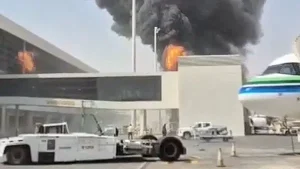
US forces also targeted Iranian airports during this period. For the first time, US Central Command (CENTCOM) acknowledged striking Iran’s “military logistics infrastructure” during its latest operation in the country.
Iranian state media confirmed that at least five bridges in the southern region were attacked.
Last week, US President Donald Trump threatened massive airstrikes on Iran’s critical infrastructure. He also did not rule out the possibility of a ground offensive along Iran’s coast or islands. News of attacks on civilian installations followed shortly thereafter.
Meanwhile, in response to the strikes on civilian targets, Iranian forces have intensified their own attacks across the Middle East. Iran had previously warned that if US forces attacked critical infrastructure, everything in the Middle East would be razed to the ground.
Consequently, Iran launched attacks targeting a US special operations command center in Syria, a US radar installation in Oman, and weapons depots and missile launch systems in Kuwait.
Al Jazeera has also confirmed that Iranian forces carried out attacks in Qatar, Jordan, and Iraq.
A CNN analysis suggests that the series of precision strikes by US forces—targeting bridges, railway junctions, and power transmission lines in key coastal cities of southern Iran—has raised new questions.
Some analysts believe the objective of these attacks is not merely to weaken Iran’s military capabilities, but potentially to prepare for wresting control of the strategically vital Strait of Hormuz from Tehran. Hamidreza Azizi, an analyst specializing in Iranian affairs, states that the primary objective of these attacks is to disrupt the Iranian military’s logistics and mobility in the southern region. In his view, this could also be part of preparations for a potential future ground offensive.
This marks the most intense military operation since the ceasefire between the two nations last April.
According to Azizi, the United States is attempting to sever Iran’s military supply lines by targeting bridges, power lines, and other infrastructure alongside military facilities. Simultaneously, radar installations and naval bases belonging to the Islamic Revolutionary Guard Corps (IRGC) are being targeted.
As he puts it, the scope of this operation extends beyond merely diminishing Iran’s capacity to threaten shipping in the Strait of Hormuz.
He suggests that this indicates Washington likely views seizing control of Iran’s southern coastal region as the only effective solution to the challenges posed in the Strait of Hormuz.
Meanwhile, US officials have stated that destroying Iranian missile launch sites, radar systems, and other military installations is laying the groundwork for a larger-scale military operation in the future.
Donald Trump has also reportedly considered the possibility of a broader military campaign. The US is already conducting daily strikes on Iranian positions near the Strait of Hormuz.
Notably, US forces launched an attack last Wednesday on the Greater Tunb island in the strait—a location that has long served as a key base for the Iranian military.