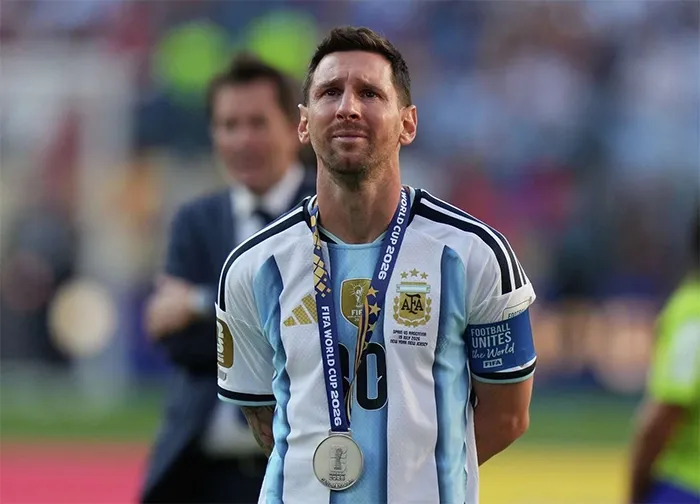
At one end of MetLife Stadium, there was an atmosphere of celebration and frenzy; Spanish footballers were reveling in the joy surrounding the World Cup trophy. At the other end, the scene was starkly different. Lionel Messi sat alone on the green turf. His boots and shin guards lay unlaced before him; leaning back on his hands, he stared silently toward the stands. FIFA volunteers were busy setting up the stage for the trophy presentation. Although one of them gestured for him to move, Messi seemed not to notice; his gaze was searching the crowd for his family members. Television cameras repeatedly captured images of that silent anguish.
Argentina had taken the field dreaming of making history. Their goal was to become the first team since Pelé’s Brazil to win consecutive World Cups. But that dream remained unfulfilled. Lionel Scaloni’s team failed to register a single shot on target throughout the match. In contrast, Spain secured the title by converting one of their twelve shots into a goal. After the match, a dejected Scaloni said, “We are deeply disappointed. We are grateful to our fans; they gave us strength until the very end. It was an open game, but ultimately, we couldn’t pull it off. Spain deserved the win. That is the reality.” He added, “One must return stronger from moments like this. We have to regroup and start afresh.” But will Lionel Messi be part of that new beginning? With the 2021 and 2024 Copa América titles and the 2022 World Cup victory in between, Argentina had been a symbol of dominance in international football over the past few years. This marked their third final appearance across four tournaments. For Messi, the emotional stakes of this match were even higher, as he had spent the most glorious years of his life in Spain. It was there, wearing the Barcelona jersey, that he established himself as one of the greatest players in world football. Thus, this defeat at MetLife felt like the conclusion of a painful chapter on a personal level as well. Was this, then, Messi’s final match on the World Cup stage? The answer remains unknown.
He had begun his World Cup campaign with a hat-trick against Algeria. He scored a crucial equalizer against Egypt in the Round of 16 and provided two brilliant assists against England in the semi-final. Over the course of the tournament, he tallied 8 goals and 4 assists.
Messi narrowly missed out on the individual honor of the Golden Boot, as France’s Kylian Mbappé scored a brace in the third-place play-off to finish with 10 goals. However, the story of the final was entirely different. Spain controlled possession from the start, forcing Argentina to chase their opponents throughout the match. Messi could not exert the same influence on the game as he had in earlier rounds of the tournament. His statistics in the Argentina jersey tell a tale of extraordinary achievement: 207 matches, 125 goals, one World Cup, two Copa América titles, and one Finalissima. Few players have achieved such success in international football. Yet, this defeat to Spain in the 2026 World Cup final may well mark the final chapter of Messi’s journey with La Albiceleste. While he has not yet officially announced his retirement, this trophy-less exit could prove to be his last appearance for Argentina. The next World Cup is scheduled for 2030, by which time Messi will be 43—an age at which playing in the World Cup is realistically almost impossible. The 2028 Copa América is relatively closer, though; whether he appears in the sky-blue and white jersey again will depend on his physical capability, fitness, and personal decision. One thing, however, is certain: what Lionel Messi has achieved in the Argentina jersey transcends mere statistics—it embodies the emotions of a generation, the pride of a nation, and an immortal epic in the history of football.