US Secretary of State Marco Rubio and Russian Foreign Minister Sergey Lavrov met in Manila last Thursday on the sidelines of a summit of Southeast Asian nations. Officially, the primary agenda of the meeting was stated to be the Ukraine-Russia war.
However, the meeting between Rubio and Lavrov took place against the backdrop of sensational new reports. These reports suggest that Russia is playing a far more active role in Iran’s attacks on US military sites in the Middle East than has been publicly acknowledged.
Early in the conflict involving Iran, Israel, and the US, reports emerged that Tehran was targeting infrastructure belonging to the US intelligence agency, the CIA. Three days into the conflict—on March 3—The Washington Post reported, citing two knowledgeable sources, that a CIA station located within the US Embassy in Riyadh had been attacked. Subsequently, on March 6, CNN reported—citing US intelligence sources—that Moscow was assisting Tehran in pinpointing the locations of US troops and warplanes in the Persian Gulf.
Recently, the international news agency Reuters reported that US intelligence officials have launched an investigation into Russia’s potential involvement in the Iranian drone attacks on CIA infrastructure, specifically the US Embassy in Saudi Arabia. The precision and effectiveness of the strikes suggest that there may be evidence of Russian assistance behind them.
Nicole Grajewski, an assistant professor at the Center for International Research at Sciences Po University in Paris, stated that the possibility of Russian involvement in Iran’s targeting process is quite “plausible.” Grajewski told Al Jazeera, “This was largely suspected, as the recent attacks were far more sophisticated and powerful than those Iran had carried out previously.”
Grajewski added, “Unlike Russia, Iran does not possess high-level space-based capabilities.” “Compared to Russia, Iran lacks sufficient military-grade satellites for routine surveillance… so it appears they may have struck a deal with the Russians.”
However, Nicole Grajewski notes that Iran possesses its own human intelligence capabilities (sources or spy networks) for target identification in the Middle East—a factor often overlooked by many.
Russian Support for Iran
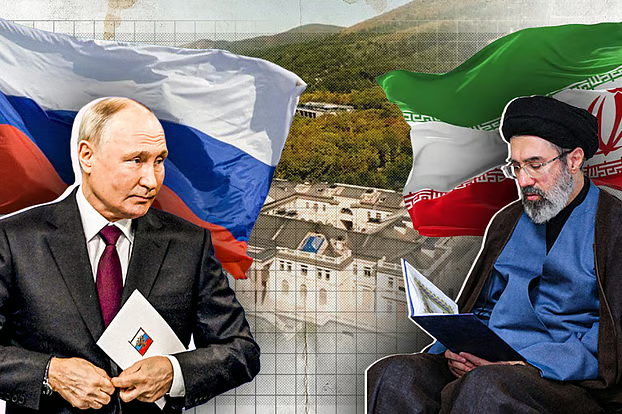
Faced with war and Western sanctions, Moscow and Tehran have deepened their military ties. Many analysts argue that this relationship is not a permanent alliance but rather a temporary, pragmatic arrangement for survival against the West. Grajewski, however, disagrees.
Nicole Grajewski states, “Both countries perceive themselves as facing similar threats in global politics. Their cooperation has become truly robust since the Ukraine war and has intensified further of late; they are now far more dependent on one another.”
The two nations drew closer militarily after Tehran supplied Moscow with key weaponry—such as Shahed drones and Fateh-110 ballistic missiles—following Russia’s invasion of Ukraine in February 2022.
Last year, the two sides signed a 20-year “comprehensive strategic partnership agreement,” pledging to enhance defense cooperation.
“Recently, tit-for-tat attacks between the United States and Iran have intensified. US strikes on Iran continued for a twelfth consecutive night. Last Thursday morning, at least two people were killed in an attack at the Shalamcheh crossing on the Iraq border. In retaliation, Iran has launched attacks across several countries, including Jordan and nations in the Persian Gulf, over the past few days.” However, at the time, Russian Deputy Foreign Minister Andrey Rudenko stated in the State Duma that the agreement did not imply the formation of a “military alliance or mutual military assistance” with Iran. The Moscow Times reported this information.
Furthermore, Russia faces allegations of helping to enhance the targeting precision of Iranian-made Shahed-136 drones by supplying the “Kometa-M” anti-jamming navigation system.
Reports from last March indicated that Russian anti-jamming technology was discovered in the wreckage of a Shahed-136 drone recovered following a failed Iranian attack on a British Royal Air Force (RAF) base in Cyprus.
However, Russia has dismissed The Wall Street Journal’s report regarding the “Kometa-M” system as completely fabricated—or “fake news.”
Nevertheless, Grajevsky explains that a conflict between the United States and Iran would, in a sense, be advantageous for Moscow. This is because it diverts global attention away from the war in Ukraine and has the potential to weaken American power on the global stage.
Grazhevsky says, “I think the Russians view this as part of a broader struggle within the global order. They believe this very event could ultimately lead to the decline of the United States.”
“Naturally, they do not want Iran to collapse completely. Therefore, they constantly try to strike a delicate balance—ensuring Iran confronts the US on its own, while simultaneously receiving enough support to survive this critical juncture in its history.”
Recent Attacks
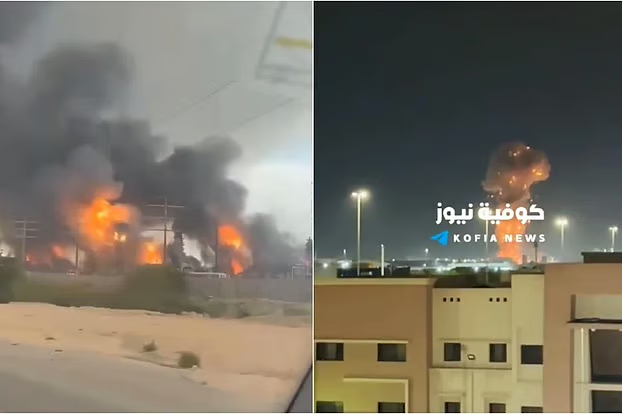
Tit-for-tat attacks between the US and Iran have intensified recently. US strikes on Iran continued for the twelfth consecutive night. Last Thursday morning, at least two people were killed in an attack at the Shalamcheh crossing on the Iraq border. In retaliation, Iran has launched attacks across several countries in the Persian Gulf region, including Jordan, over the past few days.
However, according to Grazhevsky, Iran’s own strategies and weaponry are influencing the course of the conflict far more than any intelligence support from Russia.
Grazhevsky notes, “Russian involvement is not the sole driving force or the decisive ‘game-changer’ for the Iranians. Iran already possessed these capabilities; they had already built up massive drone and missile forces. What has happened is that Russian assistance has provided a slight additional advantage and further strengthened them.”