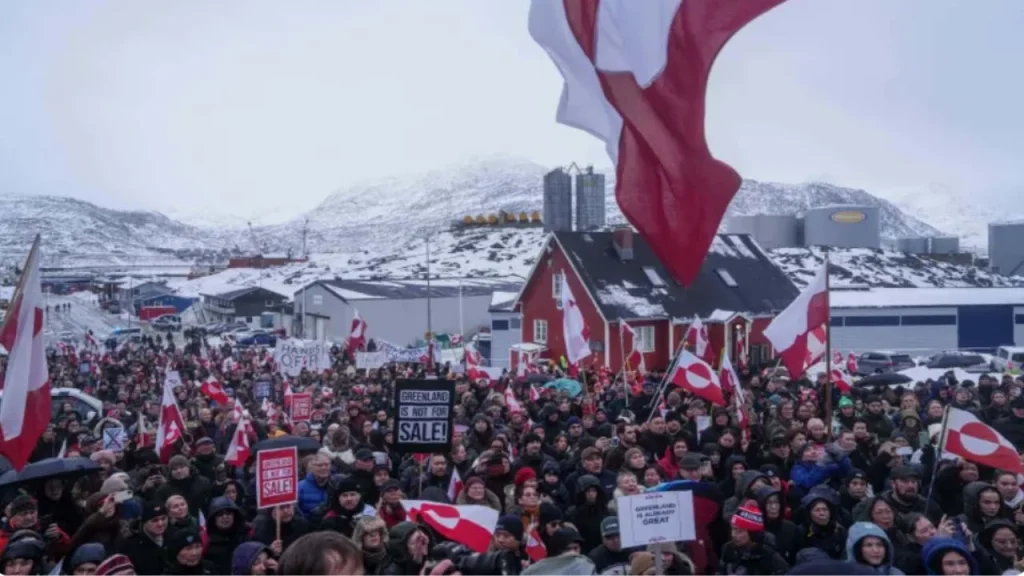
The United States has reached an agreement with Denmark and Greenland to expand its military presence in the territory. However, both Denmark and Greenland have stated that this agreement will not undermine Greenland’s sovereignty. The agreement also acknowledges the right of the Greenlandic people to self-determination.
Announcing the agreement on Friday, US President Donald Trump stated that it would grant the United States “permanent control” over Greenland’s security and other needs. However, clarifications provided by Denmark and Greenland emphasize that Greenland’s sovereignty and territorial integrity will remain intact.
Greenland’s Prime Minister, Jens-Frederik Nielsen, stated that the agreement recognizes the sovereignty and territorial integrity of the Kingdom of Denmark, as well as the right of the Greenlandic people to self-determination. Danish Foreign Minister Lars Løkke Rasmussen also remarked that the agreement would strengthen security in the Arctic and North Atlantic regions while respecting Denmark’s established boundaries.
The agreement paves the way for a significant US military presence in Greenland. It also includes provisions preventing rival nations from establishing their own military bases there. However, details regarding the exact extent of the military expansion, the number of troops to be deployed, or the locations of any new military installations have not yet been disclosed.
There remains a lack of clarity regarding other key aspects of the agreement. Specifically, it has not been revealed whether the United States will gain any formal authority over Greenland’s foreign policy or natural resources. Consequently, the true scope of the agreement will become clearer once the full text is released.
Greenland is a territory of immense strategic importance within the Arctic region. Its geographical location is vital to the security architecture of the United States, Europe, and the Arctic. Furthermore, Greenland holds the potential for vast natural resources, particularly critical minerals. Melting ice is also opening up possibilities for new shipping routes across the Arctic. For these reasons, US strategic interest in Greenland has grown in recent years.
A US military presence in Greenland is, however, nothing new. During the Cold War, the United States maintained multiple military bases there. Currently, the country retains a military presence at the Pituffik Space Base in northern Greenland; this base is utilized for various security operations, including missile surveillance.
Tensions had been simmering between the United States and Denmark over Greenland for several months. Trump had previously expressed interest in bringing Greenland under US control and did not rule out the possibility of military action, a stance that strained relations between the US and its NATO allies. Subsequently, several European nations, including Denmark, deployed military personnel to Greenland.
The new agreement is viewed as a move to alleviate those long-standing tensions. NATO has also welcomed the deal; a spokesperson for the alliance stated that the agreement would help enhance security, stability, and cooperation in the vital Arctic region.
The agreement is scheduled to be signed next week during the United Nations General Assembly session. However, it remains subject to the necessary parliamentary approvals before it can take effect.
Consequently, Greenland will remain under Danish administration for the time being, and the right of its people to self-determination will be upheld. At the same time, the path has been cleared for a significant expansion of the US military and strategic presence in Greenland. The full extent of this new US security role will only become clear once the complete terms of the agreement are disclosed.