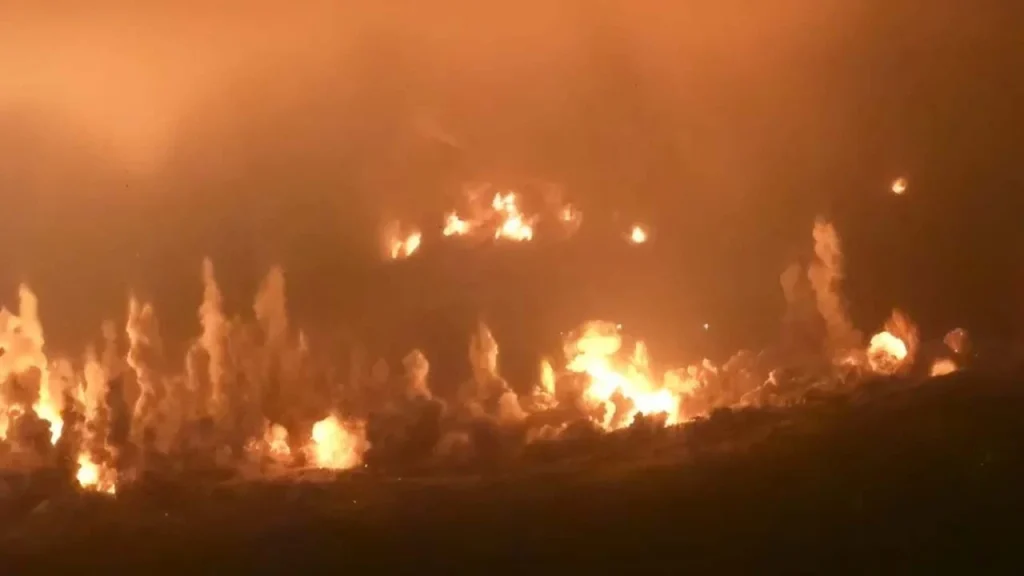
The Israeli military has claimed the destruction of a major underground military facility belonging to Hezbollah in southern Lebanon. According to the military, over 1,000 tons of explosives were used to destroy the massive complex, which included two tunnels extending beneath the Ali Taher Ridge.
The Israel Defense Forces (IDF) stated that the combined length of the destroyed tunnels exceeded two kilometers. The tremors caused by the blast were so intense that they felt like an earthquake; the US Geological Survey (USGS) reported that the explosion generated seismic activity equivalent to a magnitude 4.1 earthquake.
Video footage and images released by the IDF on Thursday showed a massive fireball rising into the sky following the explosion. Local residents reported that the entire area shook within seconds of the blast.
Ahmed, a resident of the city of Nabatieh, said a deafening sound was heard about 15 seconds after the explosion. “The whole house shook as if a real earthquake had struck,” he recounted. “People rushed out into the streets in panic; there was the sound of crying children and screaming people. Many vehicles left the area, heading towards Beirut.”
Residents of the coastal city of Sidon, located approximately 40 kilometers north of the Ali Taher Ridge, also reported feeling the tremors from the explosion.
What was inside the underground facility?
The IDF claims that this underground infrastructure served as a command center for Hezbollah’s Badr Unit. It housed stockpiles of anti-tank weapons, mines, and explosives, alongside dozens of rockets, missiles, and unmanned aerial vehicles (drones).
The Israeli military stated that the facility had been under construction and expansion for over two decades. The IDF claims it was built with Iranian funding and planning. Additionally, the IDF reported that some Hezbollah members inside the facility were killed, while others managed to flee. According to Israeli forces, the destruction of this facility marked the completion of an operation to dismantle eight Hezbollah tunnels and establish a ‘security zone’ in the area. However, there has been no immediate public reaction from Hezbollah or the Lebanese government regarding these claims by Israel.
Tensions Escalate Again in Southern Lebanon
Israeli forces took control of Ali Taher Rize last week. They have consolidated their positions in the area following months of clashes with Hezbollah.
Israeli forces have maintained a presence across vast swathes of southern Lebanon since hostilities between Israel and Hezbollah reignited in March. Israel refers to this area as a border-adjacent ‘security zone.’
Lebanese media reports indicate that fresh Israeli attacks occurred in various parts of the country’s south on Thursday, including Nabatieh al-Fawqa and Mansouri in the Tyre district.
Meanwhile, the Lebanese army has increased its deployment in areas outside Israeli control. A report by the local television channel MTV stated that military presence has also been stepped up in the southern city of Nabatieh, aiming to maintain control over the situation and restore confidence among local residents.
Background of the Conflict
Lebanon became embroiled in the conflict involving Israel, the United States, and Iran on March 2. The situation deteriorated further when Hezbollah launched rocket attacks on Israel in retaliation for the killing of Iran’s Supreme Leader.
In response, Israel launched extensive airstrikes across Lebanon and conducted ground operations in a significant portion of the country’s south. Reports indicate that Israeli forces continue to occupy approximately 5 percent of Lebanese territory.
The intensity of the conflict subsided somewhat following a ceasefire between Iran and the United States in June, alongside a separate agreement between Lebanon and Israel. That framework entails the disarmament of Hezbollah, the gradual withdrawal of Israeli forces from southern Lebanon, and the deployment of the Lebanese army in the region. However, Hezbollah was not a direct party to that agreement and has refused to engage in direct negotiations with Israel. Although the intensity of the fighting has subsided, Israeli attacks and the destruction of infrastructure in southern Lebanon continue.
According to figures from the Lebanese Ministry of Health, at least 4,362 people have been killed in the country during the ongoing conflict. The death toll includes 395 women and 259 children. However, the ministry’s statistics do not distinguish between combatants and civilians among the deceased. Meanwhile, Israeli authorities report that 40 soldiers and four civilians have been killed in the conflict.