Last Monday, China conducted a test of an intercontinental ballistic missile (ICBM) from a nuclear-powered submarine in the Pacific Ocean. This move has drawn sharp criticism from the United States, Japan, Australia, and New Zealand, who view the event as a demonstration of Beijing’s expansionist stance.
According to China, the ICBM was launched from a submarine at 12:01 PM last Monday. It traveled several thousand kilometers but did not carry a destructive warhead.
China’s state news agency, Xinhua, reported that the missile was launched as part of an annual military training exercise and was not aimed at any specific country.
This marked the first test launch of a Chinese ICBM into the Pacific Ocean in nearly two years.
Chinese Foreign Ministry spokesperson Mao Ning stated that the entire missile testing process was conducted safely, adhering to established standards and professionalism.
Several countries, including Australia and Japan, complained that Beijing had informed them of the launch only hours beforehand. In response, Mao Ning expressed hope that the concerned nations would not overinterpret the event.
Meanwhile, the United States stated that it had monitored the launch and confirmed that the missile landed in the southern Pacific Ocean.
According to the Pentagon, the US Department of Defense, this was a long-range missile capable of striking the US mainland from China’s coastal waters.
What is known about the missile test?
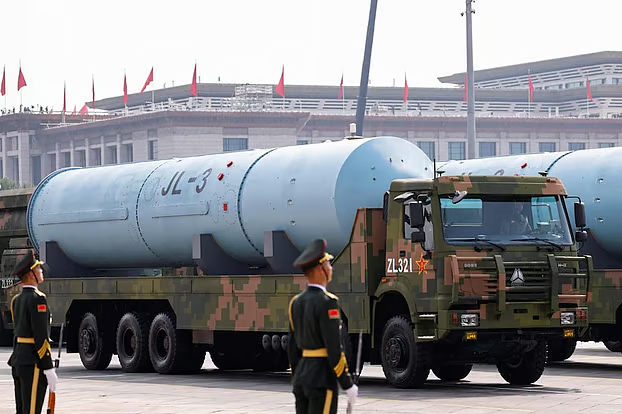
China’s state news agency, Xinhua, released a photograph of the missile last Tuesday, though no detailed specifications were provided. Based on the image, it is believed to be a JL-2 or JL-3 type ICBM; both are submarine-launched ballistic missiles. China’s state-backed newspaper, the Global Times, stated that it was likely the JL-3—the most advanced of China’s submarine-launched missiles. It was first showcased during a military parade last year.
The JL-3 missile has a range exceeding 10,000 kilometers, whereas the older JL-2 missile has a maximum range of approximately 7,300 kilometers.
The missile launched on Monday traveled a distance of at least 7,300 kilometers. If it was indeed the JL-2, it was tested at its maximum range.
“At a time when the United States is striving harder than ever to curb the proliferation of nuclear weapons, China is moving in the exact opposite direction.”
–Tommy Pigott, US State Department Spokesperson
Why this missile test has raised concerns
China conducted this missile test amidst heightened tensions with the United States and its regional allies. Furthermore, the test took place in a nuclear-weapon-free zone in the South Pacific, further escalating concerns among the United States, Australia, Japan, and New Zealand.
This region was declared a nuclear-weapon-free zone under the 1986 Treaty of Rarotonga. China ratified the relevant protocols of the treaty in 1987, thereby pledging not to conduct nuclear weapons tests in the region or threaten the use of nuclear weapons against treaty signatories that hold territory there.
The US State Department stated that China’s actions, occurring at a time of major global conflicts, undermine international efforts regarding nuclear arms control and non-proliferation.
State Department Spokesperson Tommy Pigott said, “At a time when the United States is striving harder than ever to curb the proliferation of nuclear weapons, China is moving in the exact opposite direction.”
The spokesperson urged China to participate in arms control discussions and called for the routine notification of other nations prior to the launch of intercontinental ballistic missiles and spacecraft. Australian Prime Minister Anthony Albanese described the missile test as “a provocative move by China that undermines regional stability.”
Speaking during a visit to Honiara, the capital of the Solomon Islands, Albanese said, “This was a test of an intercontinental ballistic missile capable of carrying nuclear weapons, launched from a nuclear-powered submarine. It is truly concerning because we need to reduce nuclear weapons, not increase them. Furthermore, the test was conducted with very short notice, which is also a matter of serious concern.”
Australian Foreign Minister Penny Wong stated that the test took place against the backdrop of China’s rapid military expansion and a lack of transparency regarding it. Countries in the region expect greater transparency and credibility from China concerning its intentions.
New Zealand Foreign Minister Winston Peters described the test as “unwelcome and concerning.” The New Zealand government asserts that by launching the missile into waters designated as a nuclear-weapon-free zone in the South Pacific, China has violated a bilateral agreement.
Reactions from China’s neighbors
Taiwan has stated that this missile test is an attempt by China to intimidate the international community.
A senior Taiwanese security official noted on Monday that Chinese naval activity has intensified—including joint exercises with Russia—and that Taiwan is monitoring the situation closely.
Solomon Islands Prime Minister Matthew Wale, while describing China as a good friend to his country, remarked, “This is not a friendly act. It is not good for our region.”
Wale added, “Whether it is China, the United States, or any other nation, we do not want anyone testing intercontinental ballistic missiles in the Pacific Islands region. Be our friend, but do not intimidate us.”
“This was a test of an intercontinental ballistic missile capable of carrying nuclear weapons, launched from a nuclear-powered submarine. It is truly concerning.”
—Anthony Albanese, Prime Minister of Australia
What message did China intend to convey?
According to experts, this missile test by China could carry various implications.
China conducted this test at the very moment Australia and Fiji were signing a mutual defense pact. Under the agreement, if one country comes under attack, the other will step in to assist.
China is engaged in a competition with the United States and its allies—particularly Australia—for influence over strategically important island nations in the Indo-Pacific region. Some analysts believe the timing of the missile test may be linked to this rivalry.
Mark Douglas, an analyst at the New Zealand-based maritime tracking firm Starboard Maritime Intelligence, stated that plans for the test were likely made well in advance. However, the timing of the notification given to neighboring countries is a point worth noting. Meia Nouwens, a senior fellow for Chinese security and defence policy at the International Institute for Strategic Studies (IISS), believes that the United States and other concerned nations will closely monitor and analyze this launch to gain insight into the capabilities of China’s People’s Liberation Army.
The researcher further noted that China might have conducted this test to signal its dissatisfaction with the Australia-Fiji defence agreement. However, in her view, this move could backfire and damage China’s image among the nations of the South Pacific region.