The US military’s Central Command (CENTCOM) reported carrying out strikes in Iran yesterday, Thursday, for the sixth consecutive night. Meanwhile, Iran stated that it launched retaliatory attacks today, Friday, against various US bases in the Gulf region.
The ceasefire established between the US and Iran last month has effectively collapsed, with the conflict between the two sides now escalating into a pattern of regular tit-for-tat strikes. The recent exchanges occurred as a continuation of this cycle.
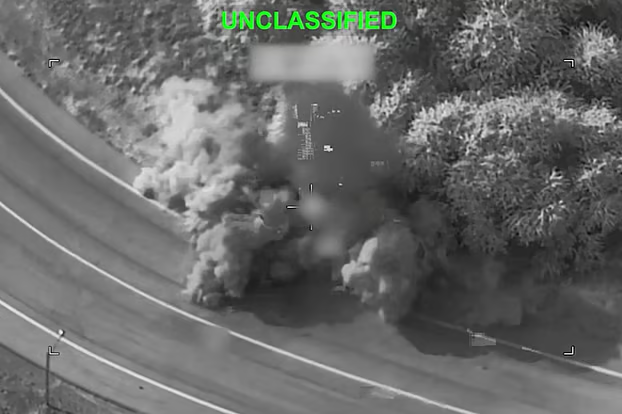
The US military stated that it conducted another night of strikes to further degrade Iran’s military capabilities. Targets included Qeshm Island and areas surrounding Bandar Abbas; the latter hosts key bases for the Iranian Navy and the Islamic Revolutionary Guard Corps (IRGC), as well as the country’s largest seaport.
In a statement, CENTCOM said that US forces—utilizing fighter jets, drones, and warships—struck dozens of military targets, including coastal surveillance and air defense centers, military supply infrastructure, and facilities linked to maritime capabilities.
Meanwhile, Iran launched missile and drone attacks on US military bases in several neighboring countries, including an airbase in Jordan.
Early today, the Iranian military announced strikes on various US installations in Bahrain and Kuwait. Eyewitnesses reported hearing explosions in Doha, the capital of Qatar; the country’s Ministry of Interior stated that a child was injured by flying metal debris resulting from the blasts.
Iranian media reported that the latest US strikes targeted five bridges, a railway station in the coastal city of Bandar Khamir, and the Iranshahr airport in the southeast.
The state news agency IRNA reported that at least seven people were killed in US strikes on bridges in the southern Iranian port city of Bandar Khamir.
However, the news agency Reuters could not immediately verify these reports.
Shipping in the Strait of Hormuz Effectively Halted
Due to the escalating conflict, shipping through the Strait of Hormuz—one of the world’s most critical maritime routes for oil and gas transport—is once again facing major disruptions. This has caused global fuel prices to rise.
Tehran has once again imposed a blockade on the strait, and Washington has stepped up fresh sanctions on Iranian ports since last Wednesday.
Sources told Reuters that if Washington attacks Iranian infrastructure, Tehran might move to close the Bab el-Mandeb Strait—another vital waterway at the entrance to the Red Sea—using its Houthi allies in Yemen.
Last week, Iran attacked ships traversing a specific shipping lane in the Strait of Hormuz. White House Press Secretary Karoline Leavitt said at a briefing on Thursday, “US President Donald Trump will not allow terrorist activities to continue in the Strait of Hormuz and will ensure that Iran faces the consequences.”
However, Leavitt added that President Trump remains sincere about pursuing a diplomatic solution.