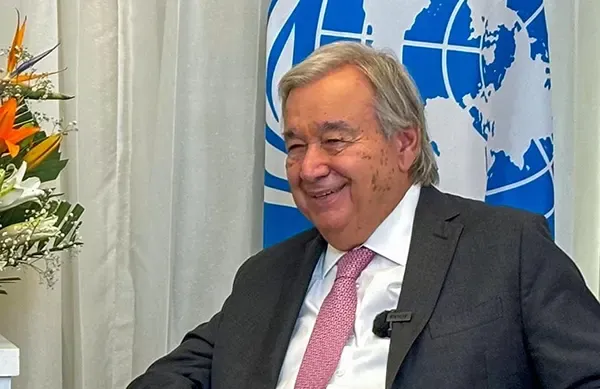
The UN Security Council has become paralyzed. Global superpowers have yet to realize the limits of their own power. UN Secretary-General António Guterres made these remarks—his harshest yet—regarding the prevailing “culture of impunity” and division in global leadership. He spoke during an exclusive interview with The Hindu on the sidelines of the 18th BRICS summit. Key excerpts from the interview are presented below:
Question: In a speech last year, you mentioned that the risk of the “never again” pledge regarding genocide being broken is growing dangerously. Eighty years after World War II and the founding of the UN, do you feel the organization is no longer capable of fulfilling the role for which it was established?
Answer: Let us be very clear about this from the start. The UN has ensured that we have not faced a third world war. There are many conflicts across the globe, but the superpowers have not engaged in direct war with one another. This has been made possible largely due to the UN’s work over the past 18 years. The problem is that we are currently in the midst of a deep geopolitical divide. On one hand, there are superpowers that have not yet acknowledged the limits of their power and are engaging in operations that lead to disastrous consequences. The divisions among these superpowers have created a sense of impunity for mid-sized powers to initiate conflicts.
Question: Reports indicate that various groups in Yemen have now seized control of the Bab al-Mandab Strait. Can the UN provide any assistance in this situation?
Answer: We are trying to assist as much as possible regarding the fundamental issue of ensuring freedom of navigation. Rights and freedoms regarding navigation must be respected everywhere—be it the Black Sea, the Strait of Hormuz, or the Bab al-Mandab. This is crucial. No tolls should be levied, and permission cannot be granted to some while being denied to others. Freedom of navigation is a fundamental principle that we are upholding. Alongside this, the UN has been involved in devising—and has proposed—mechanisms to create at least some exceptions for the transport of food and fertilizers. Question: Leaders and top officials from Iran, the UAE, and Saudi Arabia are attending the BRICS summit. Will you seize this opportunity to foster political will?
Answer: I have spoken with all of them. But the problem is, when superpowers are divided, respect for anything vanishes. Everyone believes they can do whatever they please. We are also seeing middle-power nations getting entangled in various conflicts. Look at Sudan—how many countries are involved in the conflict there? It would have been enough had the conflict remained confined to the people of Sudan. Instead, many other nations have become involved because a culture of impunity has taken root.
Question: The future of global governance is being discussed at the BRICS summit. Is it time to reform the United Nations, or is it time to completely overhaul the multilateral system?
Answer: We have been pushing for fundamental reforms for a long time. The core issue here is power. We still have institutions, multilateral bodies, and economic governance systems that align with the world as it was in 1945. It is clear that the UN needs deep reform, particularly the Security Council. We are implementing many reforms across various operational areas of the UN, but the fundamental question remains one of power.
Question: The question is, if the UN has become ineffective, should it be reformed, or should a new system be established in its place?
Answer: But the UN has not collapsed. Look at the vast humanitarian work the UN carries out across the globe. Despite dwindling resources and various budget cuts, not a single UN institution has collapsed. They continue to operate in the world’s most dangerous regions, providing aid to the people there. Look at peacekeeping operations; UN peacekeepers remain active in the world’s most perilous areas.
Question: The UN recently adopted a proposal to revise its map to better reflect the actual geographical dimensions of various territories. Has India expressed concern regarding the map displayed on the UN website? It depicts certain Indian territories—disputed with Pakistan and China—as separate entities. Answer: There is actually no such thing as a ‘UN map showing borders.’ The resolution adopted by the General Assembly is not a map. That resolution acknowledges the distortions that exist due to the actual size of territories and past power dynamics. I believe it would be appropriate to rectify them. However, the United Nations has not published any map defining borders; nor is it the UN’s role to determine the borders of any country. Therefore, this has no connection to the borders between two countries or to disputed territories.
Question: There is a map on the UN website that is being viewed as a new map.
Answer: That is not an official UN map. It is a contribution from a non-governmental organization (NGO). The map serves merely as an indicator. The UN has not provided any definition or decision regarding where a country’s borders should lie.
Question: Certainly, the conflict between India and Pakistan is one of the challenges you have faced as UN Secretary-General. During your first visit to India in 2018, you expressed hope of assisting with the India-Pakistan situation and offered to use your “good offices” for mediation if needed. Was there ever a time when you actually mediated between the two countries? The United States claims to have done so.
Answer: I do not know whether the United States mediated or not. Let me make it clear: I am not a mediator. I respect both countries. I discuss various issues with the leaders of both nations. I hope that one day the two countries will be able to sit down together. However, the UN is not directly involved in any mediation process. Any mediation requires the consent of both parties; that is lacking here.
Question: It is no longer just the superpowers that are at war; they are now also putting forward alternatives to the UN—such as the US “Board of Peace” and China’s “Global Governance Initiative.”
Answer: Do you consider the “Board of Peace” to be an alternative system?
Question: That is how the United States is presenting it.
Answer: The United States has also consistently stated that it is not intended to replace the UN. Regarding China’s “Global Governance Initiative,” it is also clear that the UN must remain at the center of the global governance system.
Question: But these are unilateral initiatives that are displacing the work the UN system is already doing.
Answer: These initiatives are not rectifying any flaws in the UN’s operations. And let us clarify the “Board of Peace” issue—it is essentially a proposal to resolve the situation in Gaza. To be clear, it is not an initiative to replace the UN. The UN is working all over the world.
Question: Another threat to the UN comes from Israel. The country has not only withdrawn from several UN bodies but has also declared you persona non grata (an unwelcome person) and denied you a visa. Furthermore, many UN officials have been killed.
Answer: I did not ask for a visa. If one thing is clear—and I bear primary responsibility for this—it is that the United Nations has consistently maintained a very clear stance. Whether regarding the conflict involving Russia or the Israel-Palestine conflict, the UN has always served as a crucial reference point and standard-bearer for the Charter, international law, and international humanitarian law. Unfortunately, we are not responsible for the decisions made by various nations—sometimes even by the most responsible ones—to disregard international law and allow the “law of force” to prevail over the “force of law.”
Question: Do you believe that Israel’s war in Gaza falls into the category of “never again”—referring to the genocide you spoke about?
Answer: “Genocide” is a legal definition; the authority to make that determination lies with the courts—specifically, in principle, with the International Criminal Court. What we are saying is that what is happening in Gaza is utterly condemnable. It is completely unacceptable. It represents a horrific violation of all principles of international law. However, we are not assigning a legal definition to it. The situation is so horrific that it does not even require being labeled as such.
Question: Do you want it to be legally recognized as genocide?
Answer: That is not for us to decide. Determining the legal definition of events that occur in various situations is not our role.
Question: So, what happens if another country decides not to allow UN officials or the Secretary-General to enter its territory and proceeds to carry out similar killings?
Answer: The United Nations does not have the power to stop that. And that is precisely the problem I mentioned at the beginning.
Question: The election for the UN Secretary-General is taking place this year. Do you feel you need another term to resolve these issues?
Answer: No, I do not need another term at all.
Question: Many candidates vying for your position are women. Do you hope that the first female UN Secretary-General will be elected as your successor?
Answer: I do not wish to interfere in the election campaign. However, I believe it is entirely natural for women to have the opportunity to reach the highest positions at the UN, just as in any other country. It is a matter of gender equality and balance. Over the past decade, we have achieved full gender parity across 170 senior leadership positions within the UN. Women now account for 55 percent of UN Resident Coordinators worldwide.
Question: The true meaning of the ‘glass ceiling’ is that women may hold various important positions within an organization but never reach the very top. Would you like to see a woman serve as the UN Secretary-General?
Answer: I would be delighted by that.
Question: In your view, what has been your greatest achievement and your biggest failure?
Answer: It is for others to judge my achievements or failures. What gives me the greatest satisfaction is that, over the last ten years, we have managed to address various crises while upholding full respect for the UN’s core principles. We have never applied double standards. Our biggest failure has been our inability to convince—particularly those nations holding the levers of power—that we must seriously reform global governance institutions, especially the Security Council.
Question: I thought you would say—the failure of countries to make adequate commitments regarding the fight against climate change and the Green Climate Fund…
Answer: This is not a failure of the United Nations. The UN is at the forefront of the fight to tackle climate change. It is a failure of the member states, who repeatedly prioritize their own short-term interests over an issue that is vital for the very existence of humanity.
Question: Have you thought about what comes next? What will you do after stepping down as UN Secretary-General?
Answer: I have absolutely no idea. I am working hard to ensure I properly fulfill my responsibilities until December 31st. We shall see what happens after that.