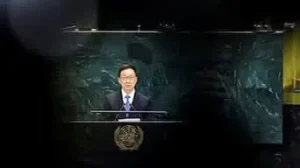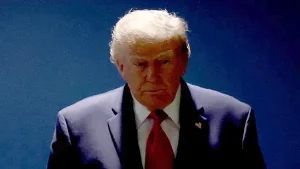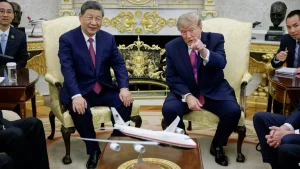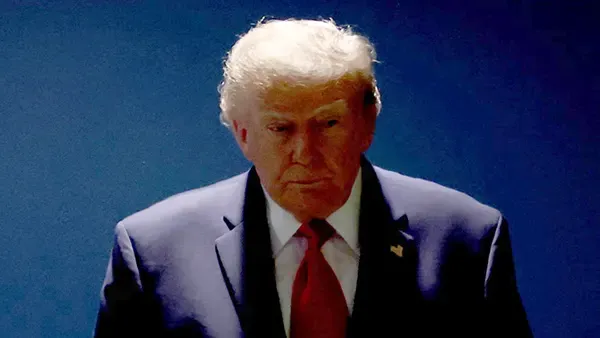
US President Donald Trump has threatened to “obliterate” Iran while speaking at the United Nations. Yet, despite projecting military might, he cannot shield himself from the pressures of domestic politics. Twenty months into his term, the gap between Trump’s image of invincibility and his actual political influence is steadily widening.
CNN anchor Kaitlan Collins questioned Trump as he entered the UN headquarters in New York. Trump had previously banned CNN from the White House; however, journalists from the network have been seen there again after a court blocked that decision.
Upon seeing Collins, an irate Trump remarked, “I am surprised to see CNN covering me here. You shouldn’t be covering me here.” Critics view this reaction as a sign of Trump’s diminishing control.
US federal courts are obstructing various measures taken by his administration. Republican lawmakers in Congress are no longer displaying the same level of loyalty as before. Simultaneously, discontent regarding inflation, fuel prices, and the prospect of war with Iran is putting pressure on his public support.
In the words of veteran Republican strategist Rick Wilson, “This is the beginning of the end. This is the start of the collapse.” He asserts that voter negativity and frustration have reached levels not seen since the Jimmy Carter era.
Trump has suffered several major setbacks over the past month. The Federal Reserve refused to yield to his pressure regarding interest rates. The Supreme Court also blocked an attempt to impose new restrictions on mail-in voting for the November midterm elections.
Another judge halted a move to attach Trump’s name to the Kennedy Center. Another judge has ordered the restoration of access for CNN, MSNBC, and Politico, overturning the decision to ban them from the White House grounds.
Meanwhile, signs of change are emerging within the Republican Party. Fearing that Trump could cause the party to lose congressional seats, some Republican candidates are distancing themselves from him. Byron Donalds, a candidate for Governor of Florida, has removed most references to Trump from his campaign website.
Campaign advertisements for Congresswoman Maria Elvira Salazar state that federal immigration law enforcement has gone “too far” and that Latino voters feel a sense of “betrayal.”
According to Wilson, Republicans have long demonstrated loyalty to Trump out of fear of potential primary challengers or his attacks on social media. However, as the election approaches, political self-preservation is becoming increasingly important for party members.
In his words, the more of a political liability Trump becomes, the more aggressively he behaves. Voters are now associating Trump with issues such as war, fuel costs, and rising prices of essential goods.
Critics believe that in this climate, Trump is reverting to his old tactics of clashing with the media, stoking tensions over cultural issues, and engaging in political theatrics. The White House, however, has rejected these allegations, asserting that Trump’s policies have yielded significant successes in the economy, border security, job creation, and the energy sector.
Meanwhile, even greater political challenges await Trump. If Democrats gain control of the House of Representatives, they could launch investigations into the Trump administration over various allegations. Simultaneously, political attention will gradually shift toward the 2028 presidential election and potential successors.
Bill Galston, a senior fellow at the Brookings Institution, notes that the shift in attention toward potential candidates like Vice President JD Vance or Secretary of State Marco Rubio could prove uncomfortable for Trump. “Nothing would infuriate him more than the spotlight shifting away from him,” he says.
History offers examples of second terms proving difficult for many US presidents; historian Allan Lichtman has termed this the “second-term curse.”
According to conservative writer Charlie Sykes, Trump’s greatest fear is losing relevance. In his words, “It would be extremely naive to think he will just quietly fade away.”
Sykes’s most significant observation is: “The irony is that the weaker he becomes, the more dangerous he gets.”