








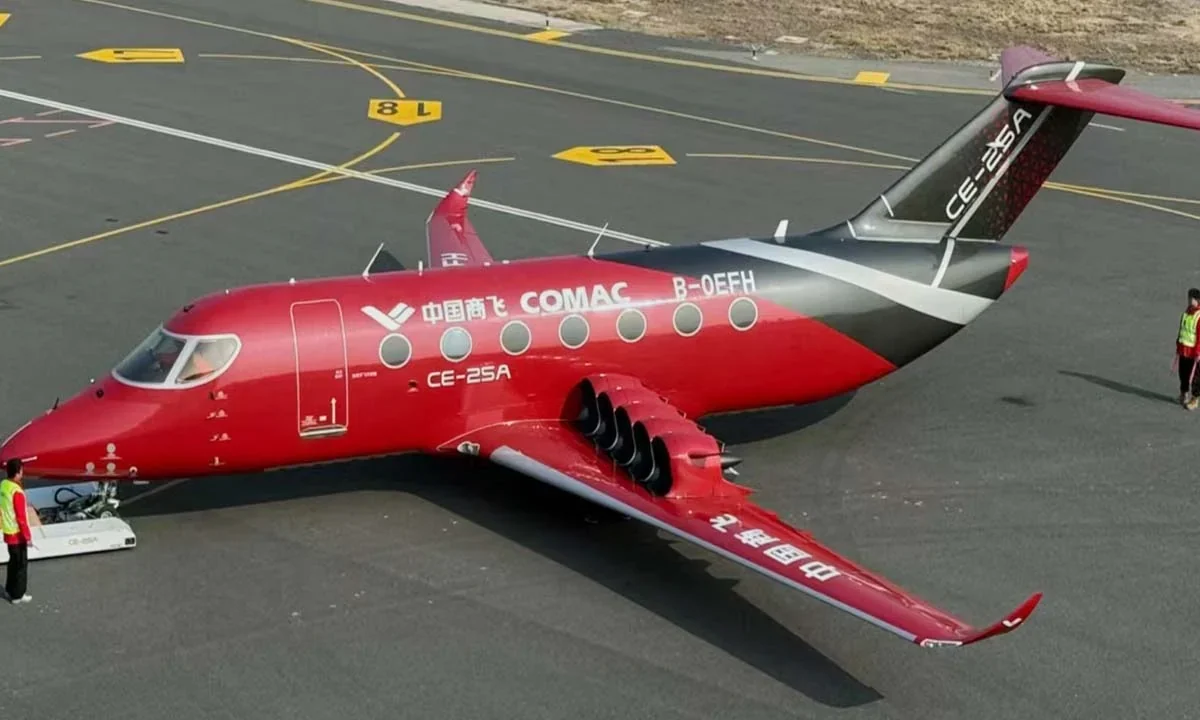
A 19-seater electric aircraft, developed in China, has successfully completed its maiden test flight with pilots and test personnel on board. While the aircraft had previously undergone several unmanned test flights, this marks the first time it has taken to the skies with two pilots and test crew. According to the manufacturer, the aircraft can cover a distance of up to 400 kilometers on a single full charge.
The test flight of the 10-ton aircraft took place on Saturday in the city of Binzhou, located in China’s eastern Shandong province. During the flight, the aircraft remained airborne for 16 minutes and 38 seconds, covering a distance of 60.4 kilometers.
The development team reported that the entire test flight proceeded smoothly, with all aircraft systems performing as expected and no issues encountered.
The electric aircraft, designated as the CE-25A, was developed by the state-owned Commercial Aircraft Corporation of China (COMAC). It is the company’s first electric commercial aircraft. An initial unmanned test flight was conducted on February 2, and in total, the aircraft has now completed 19 such unmanned test flights.
Designed primarily for short-haul travel between cities, the aircraft can accommodate 19 passengers. It is capable of reaching a maximum speed of 300 kilometers per hour and can travel up to 400 kilometers on a single charge.
The aircraft is equipped with specialized electric fans mounted on its wings, which provide the necessary propulsion. In developing the design and technology, COMAC collaborated with several partners, including CATL—one of the world’s largest battery manufacturers—and Shanghai Jiao Tong University.
Meanwhile, the manufacturer has applied for the necessary certification to begin commercial passenger operations, and the relevant regulatory authority has accepted the application. However, the aircraft must undergo several more testing phases before it can begin commercial passenger transport.
According to experts, if the CE-25A successfully proves itself for commercial use, it will open up new possibilities for short-distance passenger transport. Furthermore, by utilizing electricity instead of conventional fuel, it could pave the way for reducing both the reliance on traditional aviation fuel and the consumption of fossil fuels.
Source: Global Times