

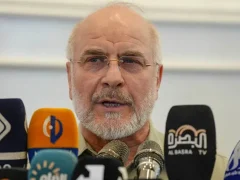

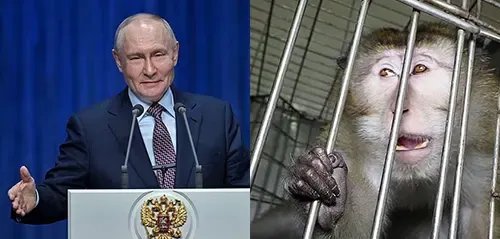
Russian scientists are conducting research on thousands of elderly monkeys in a quest to uncover the secret to eternal youth—an initiative driven by Russian President Vladimir Putin’s desire to live to the age of 150. The research is being led by 80-year-old Mikhail Kovalchuk, a key scientific advisor to Putin, as reported by the Daily Mail.
Kovalchuk heads the Kurchatov Institute, one of Russia’s premier scientific institutions, which houses over 7,000 monkeys across 22 different species—some of which are over 30 years old. Researchers are meticulously examining the blood, brains, and internal organs of these animals to unlock the secrets of longevity. Speaking at a scientific forum in Moscow, Kovalchuk explained that they are screening older monkeys—ranging from 18 to over 30 years of age—to observe every stage of the aging process. He noted that the subjects are undergoing a comprehensive range of tests, including biochemical analyses, vascular studies, and brain scans, which will serve as a foundation for developing methods to extend human lifespan.
Scientists have also established a specialized blood bank using samples from these elderly monkeys. The project is being conducted in collaboration with the Petrovsky Russian Scientific Center of Surgery. Konstantin Kotenko, the center’s director, stated that these samples are instrumental in understanding the biological mechanisms of aging. Mikhail Kovalchuk’s brother, 74-year-old billionaire Yuri Kovalchuk—often referred to as “Putin’s wallet”—is one of the President’s closest associates. In addition to Mikhail Kovalchuk, the project is also being led by Putin’s daughter, 41-year-old endocrinologist Maria Vorontsova. Recently, on Russian state television, he discussed plans for a drug designed to combat aging and “conquer death.” He acknowledged that the primary driving force behind longevity research is the “fear of death.”
This desire of Putin’s to reverse the aging process came to light during a visit to Beijing last year. A microphone captured a conversation he had with Chinese President Xi Jinping regarding organ transplantation and the possibility of humans living to the age of 150. Putin explained to Xi that advancements in transplantation could allow people to gradually become younger—potentially even achieving immortality—adding that the longer a person lives, the younger they could become. Later, at an AI conference, Putin remarked that living to 150 is likely possible, though he noted that even that duration might not be enough. Currently, Russia is conducting rapid research into 3D-printing living tissue, as well as growing human organs inside pigs. Furthermore, scientists working for Putin are developing what could be the world’s first drug aimed at delaying aging by blocking the RAGE gene.