


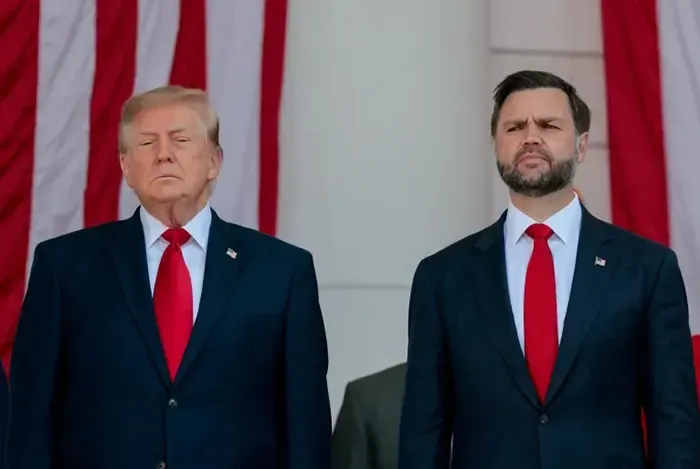
Iranian policymakers are assessing the implications of removing U.S. Vice President J.D. Vance from his role concerning Iran. Analysts suggest that this shift could increase the risk of conflict between the two sides. Vance has been tasked with focusing on domestic affairs—a decision announced by Trump in a post on Truth Social on Thursday. Trump further indicated that reaching an agreement with Iran is no longer a priority for the U.S. administration, as reported by Al Jazeera.
On February 28, the United States and Israel launched a surprise offensive against Iran. Since then, Tehran has viewed the U.S. Vice President as one of the more pragmatic figures within the Trump administration. Nasser Hadian, a professor of international relations at the University of Tehran, notes that by reassigning Vance to address domestic corruption, Trump is signaling a confrontation with the Democrats—a move that follows the Democrats’ significant gains against the ruling Republican Party in the midterm elections.
This development may also favor Israel. Vance had previously blamed the war for the Republican Party’s losses in the midterm elections, and it is reported that Israel has been pressuring Trump to launch fresh attacks on Iran. According to Hadian, this also serves as a message to Iran: reaching an agreement is no longer a priority, and the individual who held a relatively moderate stance toward Iran has been shifted to a different portfolio.
It is believed that Vance favored resolving the conflict through negotiations, as the economic costs of the war were mounting for the U.S., and public opinion polls indicated growing opposition to the conflict. Last June, when Vance was involved in discussions regarding a memorandum of understanding with Iran, he was supported by Trump’s envoys, Jared Kushner and Steve Witkoff. This led to a temporary cessation of hostilities and the resumption of shipping through the Strait of Hormuz. In contrast, U.S. Secretary of State Marco Rubio has dismissed the conditions set forth by Iranian authorities for ending the conflict as “insane.” However, he has also acknowledged the costs of an all-out war, preferring instead to achieve success in the conflict by exerting economic pressure on Tehran and isolating it. It is reported that U.S. Secretary of Defense Pete Hegseth and the head of U.S. Central Command, Brad Cooper, favor renewed military action against Iran. Hegseth has faced an impeachment vote due to his role in the conflict.
In late October, Vance wrote a letter to Iranian security chief Mohsen Rezaei. This correspondence occurred as mediators were intensifying efforts to bridge the gap between the two sides. Initially, Rezaei described the tone of the letter as positive; however, last week, he dismissed reports of a potential direct meeting with Vance—as well as claims of progress—as “fake news” and “imaginary discussions.” He remarked that they had lost both the war and the election: Vance has conceded defeat, Rubio is on his way out, Hegseth is on the verge of losing his position, and the CENTCOM commander has effectively become a podcaster.
While communication continues through intermediaries, no significant breakthrough is expected. Tehran has demanded that the U.S. outline seven specific conditions and concrete steps toward concessions to end the conflict—terms that appear unacceptable to the United States. Mohammad Saleh Sedghian, director of the Arab Center for Iranian Studies, noted that Trump has repeatedly alleged the existence of rifts within the Iranian negotiating team. Conversely, Iranian authorities have questioned the credibility of any potential new agreement with Washington, asking: even if Rezaei were to reach a deal with Vance, what guarantee is there that Trump would actually implement it?
He further explained that the pervasive atmosphere of mutual distrust complicates the prospects for any agreement. This implies that the existing U.S. sanctions and stringent restrictions on Iran will remain in place—a situation that could prove even more damaging to Tehran than a brief military conflict. These sanctions and barriers are significantly increasing the economic burden on the Iranian people. He stated that the current situation—characterized by the absence of war yet a failure to reach any resolution through negotiations—is extremely dangerous.
The Iranian reformist newspaper *Shargh* argued this week that Vance’s role regarding Iran has not concluded, but rather remains unresolved; it also noted that the conflict could potentially escalate further. The conservative daily *Farhikhtegan* rejected the portrayal of Vance as a genuine anti-war figure, asserting that diplomacy, military force, and economic pressure ultimately serve the same objective for the United States: compelling Iran to accept its terms.
For the time being, both sides remain locked in a struggle for control over the Strait of Hormuz, with retaliatory attacks targeting vessels and military installations. On Friday and Saturday, Iran’s Islamic Revolutionary Guard Corps (IRGC) and its regular army separately reported several new incidents. They stated that vessels had been damaged by naval mines or projectiles after attempting to use unauthorized routes through this vital waterway.
The latest weekly report from the United Kingdom Maritime Trade Operations (UKMTO), released on Friday, details eight incidents within or near the strait—most of which occurred along the southern route, near Oman. This week, the UKMTO recorded 139 outbound and 169 inbound transits through the strait—a figure approximately 65 percent lower than pre-conflict levels.
Hadian believes that Iranian policymakers will not tolerate the current situation indefinitely. He suggests that authorities may target warships, naval vessels, or military bases. As the blockade intensifies—exerted through maritime pressure, as well as restrictions along land borders and in the airspace—the risk of war increases. However, Hadian notes that Trump’s decision to remove Vance from his team regarding the Iran issue will not fundamentally alter the situation. Washington remains convinced that a strategy of economic pressure on Tehran will eventually force concessions; regardless of Vance’s presence, the United States would have pursued—and will continue to pursue—this same course of action.