






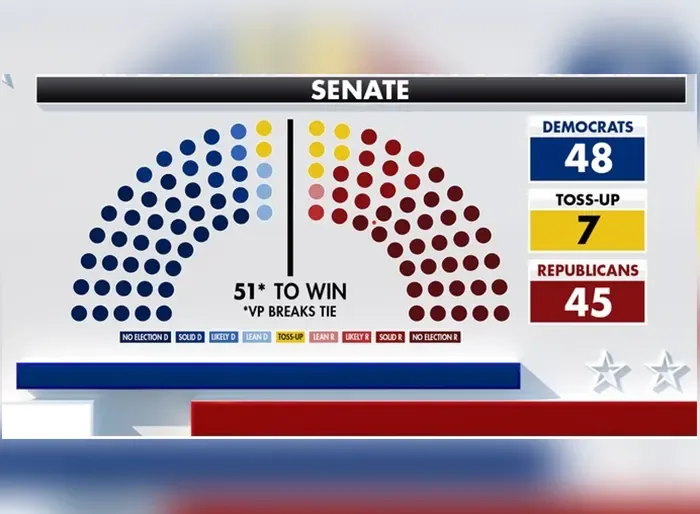
The U.S. Senate consists of 100 seats. For a party to secure an outright majority, it must win 51 seats. If no party achieves a clear majority in the Senate during the midterm elections, a complex situation arises. A 50-50 split could trigger a significant struggle between the Republicans and Democrats over the division of power. Neither the U.S. Constitution nor the Senate’s 44 standing rules contain provisions to determine which party holds the majority or minority status for the purpose of daily operations—a point reported by Fox News. Under Article I, Section 2 of the U.S. Constitution, the Vice President serves as the President of the Senate by virtue of their office. In the event of a tie vote on any proposal, the Vice President can cast a deciding, or “tie-breaking,” vote to resolve the deadlock. However, this does not automatically grant their party full control of the Senate or a majority in its committees. Currently, Vice President J.D. Vance holds this authority. The Constitution makes no mention of the positions of “Majority Leader” or “Minority Leader”—these are roles that emerged through political convention in the early 20th century. Consequently, in the event of a 50-50 split, a formal power-sharing agreement between the two parties is required to manage the Senate.
Such an even split has been rare in U.S. history. The first instance occurred in 1881; resolving that deadlock took several months and required reliance on two independent senators. A similar situation arose again in 1954. In more recent history, the Senate reached a 50-50 split following the elections of 2000 and 2020. In 2001, a historic agreement was reached between Republican leader Trent Lott and Democratic leader Tom Daschle. Although the Republicans held a nominal majority—thanks to Vice President Dick Cheney—the agreement ensured equal representation for both parties on every committee, as well as an equal allocation of budgets. A similar agreement was later reached between Chuck Schumer and Mitch McConnell in 2021.
However, analysts express skepticism about whether the political will to reach such an agreement would exist—given the intense polarization—should a similar parity emerge when the new Congress convenes in 2027. It remains unclear what stance Donald Trump and J.D. Vance might take on this matter. The political climate on Capitol Hill could become even more volatile, particularly if a prolonged legal battle arises over election results in a state like Alaska; in such a scenario, reaching an agreement would prove difficult. In the absence of an accord, Senate operations could grind to a complete standstill, requiring either J.D. Vance or a Democratic President pro tempore to dedicate significant time to presiding over debates on the Senate floor.