




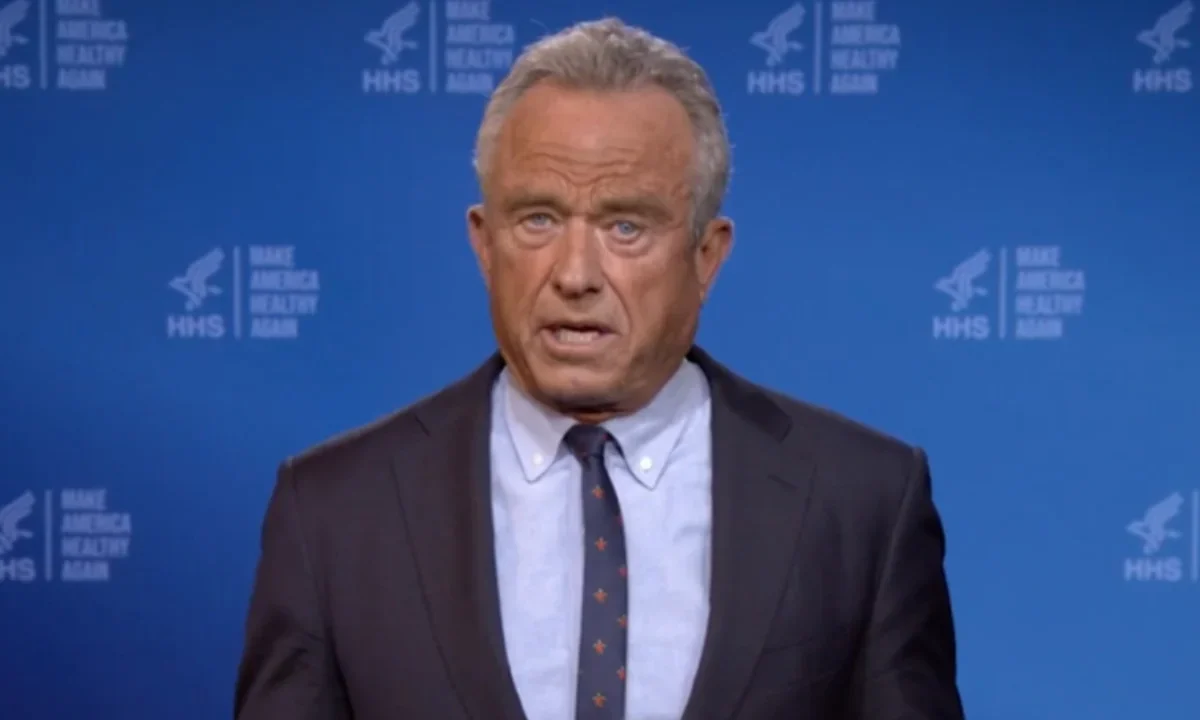
U.S. Health Secretary Robert F. Kennedy Jr. (RFK Jr.) is facing intense criticism for claiming that Arabs do not contribute to scientific pursuits, win Nobel Prizes, or even produce literature. Civil rights activists, healthcare organizations, and Democratic leaders have condemned his statements as false, racist, and inflammatory toward Arabs.
Kennedy made these remarks last Monday while campaigning for Republican Senate candidate Mike Rogers in Grand Rapids, Michigan. His comments, delivered ahead of the U.S. midterm elections, have sparked a widespread reaction.
Kennedy stated, “There are 500 million Arabs in the world. Yet, they do not produce science, they do not win Nobel Prizes, they do not win Fields Medals, nor do they receive the Wolf Prize. They also do not produce literature.”
He blamed the Muslim Brotherhood for this, claiming that the rise of the organization destroyed the tradition of contributions to science, literature, art, and engineering within Arab society. He further alleged that the Muslim Brotherhood has fostered a society defined solely by hatred, war, and a narrative of victimhood.
Following Kennedy’s remarks, critics pointed out that many scientists, writers, and prominent figures of Arab descent have received prestigious global awards, including Nobel Prizes—demonstrating that his claims are inconsistent with historical facts.
Michigan is home to a large Arab-American population, making Kennedy’s comments particularly sensitive in the state. Meanwhile, Republicans in Michigan have accused Democratic Senate candidate Abdul El-Sayed of having ties to the Muslim Brotherhood—allegations that El-Sayed has denied. Arabs Have Received International Awards, Including the Nobel
In response to Kennedy’s remarks, various media outlets have highlighted several examples of scientific and literary achievements by Arabs.
Egyptian-American chemist Ahmed Zewail received the Nobel Prize in Chemistry in 1999. He was recognized for his contributions to the development of methods for observing chemical reactions over extremely short timescales. Prior to this, in 1993, he was awarded the Wolf Prize in Chemistry.
Egyptian author Naguib Mahfouz received the Nobel Prize in Literature in 1988, while Yemeni journalist and human rights activist Tawakkol Karman was a co-recipient of the Nobel Peace Prize in 2011.
Additionally, Egyptian diplomat and former head of the International Atomic Energy Agency (IAEA), Mohamed ElBaradei, received the Nobel Peace Prize in 2005. Omar M. Yaghi, a chemist of Palestinian descent born in Jordan, was a co-recipient of the Nobel Prize in Chemistry in 2025. He had also received the Wolf Prize in Chemistry in 2018.
Michael Atiyah, a mathematician of Lebanese descent, was awarded the prestigious Fields Medal in mathematics in 1966. Furthermore, former Palestinian leader Yasser Arafat received the Nobel Peace Prize in 1994, and former Egyptian President Anwar Sadat was a co-recipient of the Nobel Peace Prize in 1978.
These examples have raised questions regarding the validity of Kennedy’s claims. Various media outlets have also presented evidence of international awards won by Arabs and individuals of Arab descent.
Allegations of Racist Remarks
The Council on American-Islamic Relations (CAIR), a U.S.-based civil rights organization, has strongly criticized Kennedy’s comments, describing them as a clear example of overt racism and bigotry. According to CAIR, the attempt to deny the contributions of Arabs to human civilization is not only false but could also fuel anti-Arab and anti-Muslim sentiment. The organization further warned that such remarks, coming from individuals in official positions, could place the affected community at even greater risk.
The health-focused organization ‘Protect Our Care’ also criticized Kennedy’s comments, labeling them a racist attack.
Peter Hotez, a scientist and the founding dean of the National School of Tropical Medicine at Texas Children’s Hospital, also weighed in. Highlighting the historical contributions of Arab scientists, he noted that during the Middle Ages, they played a crucial role in preserving the works of ancient thinkers—such as Aristotle, Hippocrates, and Galen—and transmitting them to future generations. They also contributed to the transfer of this knowledge during the European Renaissance.
Referring to his late colleague, Nobel laureate Ahmed Zewail, Hotez remarked that Zewail would not have agreed with Kennedy’s statements.
Context of the Political Debate
Kennedy made these remarks while campaigning for Mike Rogers, the Republican candidate for the Senate in Michigan. Rogers’ opponent, Democratic candidate Abdul El-Sayed, is a Muslim; he has denied allegations linking him to the Muslim Brotherhood.
U.S. President Donald Trump has also accused El-Sayed of being a member of the Muslim Brotherhood, labeling him a “jihadist.” However, various reports indicate that no credible, public evidence has been presented to support these claims.
Democratic Senator Chris Murphy stated that everyone should be wary of a concerted effort to delegitimize Muslim Americans—not just as citizens, but as human beings.
The Muslim Brotherhood was founded in Egypt in 1928. Governments across different nations hold varying stances regarding the organization and its various branches; some countries have designated it as a terrorist organization.
The U.S. Department of Health and Human Services did not immediately respond to Kennedy’s remarks, Reuters reported.