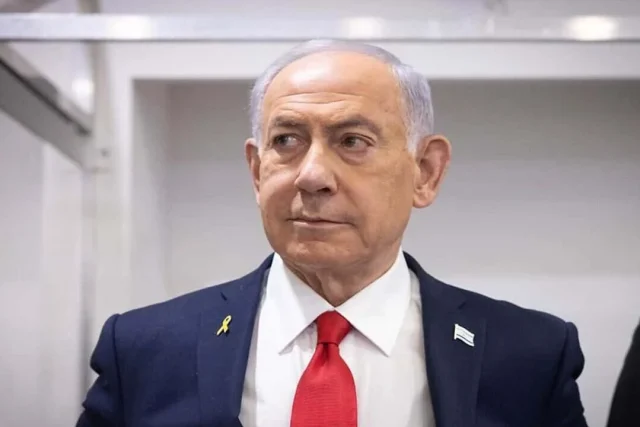

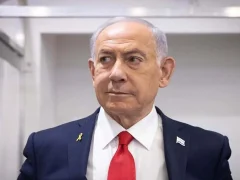




Exit polls from Israel’s parliamentary elections have failed to indicate that any single party or coalition has secured the majority required to form a government. According to surveys released by Israeli television channels on Tuesday, the coalition led by Prime Minister Benjamin Netanyahu’s Likud party is projected to win 51 seats. Meanwhile, the opposition bloc—led by former army chief Gadi Eisenkot—is also projected to secure 51 seats.
Consequently, neither side has managed to secure the 61-seat majority needed to form a government in the 120-member Knesset. Given this situation, political negotiations regarding the formation of a government could drag on for weeks, or even months.
Separately, the polls suggest that Arab-led parties could secure 18 seats. These parties could play a pivotal role in government formation, should other political factions agree to form an alliance with them.
How are the parties reacting?
Eisenkot stated that the exit polls highlight a lack of public confidence in Netanyahu. Current opposition leader Yair Lapid remarked that Netanyahu’s coalition is facing a “crushing defeat,” adding, “It is a total collapse. The people have told them to go home.”
However, Gideon Sa’ar—a member of Netanyahu’s Likud party—dismissed the opposition’s premature celebrations as “hasty.” Writing on social media, he noted, “Likud remains the largest party in Israel. It is always wise to learn from the past.”
Over the last 30 years, Benjamin Netanyahu has served as Israel’s Prime Minister for approximately 19 years, repeatedly surviving various political crises.
Ehab Jabareen, a Palestinian political analyst and researcher, told Al Jazeera that while the initial polls clearly point to a decline in the strength of Netanyahu’s coalition, it would be premature to declare either his victory or the end of his political career. He stated that the polls indicate Netanyahu’s coalition may lose its majority. However, it could also prove difficult for his opponents to secure a majority. If neither side succeeds in forming a government, Netanyahu could serve as interim Prime Minister while negotiations continue.
Who will the President task with forming a government?
It is not yet certain whom the President will task with forming a government.
Following the announcement of the final results on November 4, Israeli President Isaac Herzog will hold consultations with the leaders of the various political parties. He will then entrust the task to the individual he deems most likely to succeed in forming a government.
There is no requirement that the leader of the party with the most seats must be given the mandate to form a government. In the current situation, Netanyahu and Eisenkot are seen as the two potential candidates.
How much time is allotted for forming a government?
A candidate designated to form a government is granted a maximum of 42 days. Initially, they are given 28 days, which the President may extend by an additional 14 days.
During this period, intensive discussions and negotiations will take place among the parties. To secure support for forming a government, parties may demand policy concessions or key cabinet positions.
If a candidate cannot secure the support of 61 seats, they might attempt to form a minority government with the backing of smaller parties. Alternatively, the two leaders could reach an agreement to share the term, serving as Prime Minister in rotation.
To take office, a new government must secure a simple majority in a parliamentary vote of confidence. If some members abstain, a government could win the vote of confidence with fewer than 61 votes.
What happens if negotiations fail?
If the first designated candidate fails to form a government, the President may task another member of parliament with the responsibility for a period of 28 days. Should the second candidate also fail, a majority of the members of the Knesset (parliament) may nominate a third candidate, who would then be granted a final 14-day period to form a government.
If an agreement is still not reached, the parliament will be formally dissolved, and Israelis will be required to head to the polls once again. A new election must be held within 90 days. Until then, Netanyahu’s administration will serve as a caretaker government.
Has such a situation occurred before?
Between April 2019 and March 2020, Israel held three rounds of elections due to a political stalemate. Ultimately, a power-sharing agreement was reached between Netanyahu and his then-chief rival, Benny Gantz. Under the terms of the deal, the two were to serve as prime minister on a rotating basis.
However, the government collapsed within a year after failing to pass a budget.
Will the opposition form an alliance with Arab-led parties?
According to exit polls, Arab-led parties could play a pivotal role in the formation of a government. Yet, both Netanyahu and Eisenkot have ruled out the possibility of forming an alliance with these parties, citing a lack of shared values.
Israeli political analyst Asaf Ronel noted that while the polls suggest an end to what Netanyahu calls a “nightmare government,” significant questions remain as to whether other political leaders can overcome their objections and discriminatory stances toward working with Arab-led parties.
In his view, if other parties refuse to deviate from their campaign promises and decline to cooperate with the Arab-led parties, it is highly likely that Israel will face another round of elections in the coming months.
An Al Jazeera Explainer