



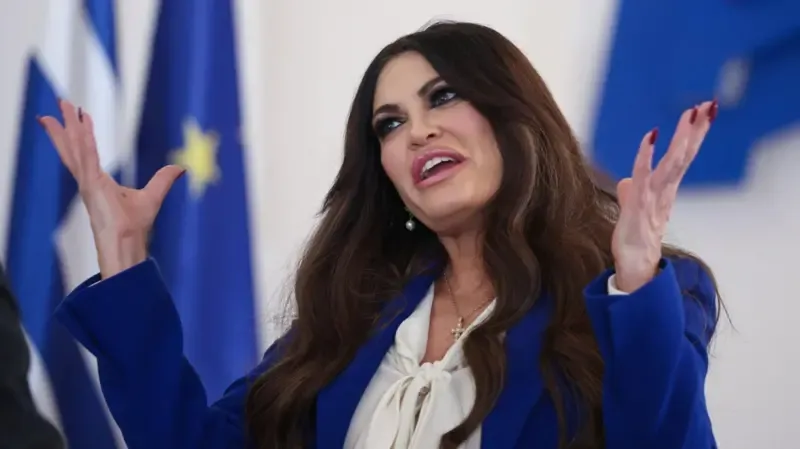
President Donald Trump ordered US Ambassador to Greece Kimberly Guilfoyle to resign. New Press Secretary Katie Zaccaria confirmed this during a White House briefing. Guilfoyle resigned immediately following the announcement, confirming the move in a post on X. She wrote that while her tenure as ambassador was coming to an end, her love for President Trump, the “America First” movement, and the country would never cease. Tuesday marked Zaccaria’s first briefing since her appointment as White House Press Secretary; however, it was notably brief, prompting questions from journalists.
Meanwhile, the controversy surrounding Guilfoyle has raised new questions regarding US diplomatic influence in Greek politics and the relationship between Washington and the Greek government. Opposition parties in Greece demanded an explanation from the government following allegations that she had threatened to oust the Greek administration. The controversy intensified after a Wall Street Journal report in September of this year. The newspaper stated that during a dinner in Athens last March, Guilfoyle hinted that the US could topple the government of any country—including Greece—if it so desired. The report claimed that while discussing the potential collapse of the Romanian government, Guilfoyle remarked, “We can do that to any country. We can do it here, too.”
However, Guilfoyle’s lawyer has disputed the Wall Street Journal’s interpretation of that conversation. Upon resigning, Guilfoyle denied the allegations against her in her post on X, stating that she would fight to defend her name, reputation, and integrity. Following the publication of the Wall Street Journal report, Greek opposition parties had demanded an explanation regarding the incident from Prime Minister Kyriakos Mitsotakis’s government. The report also notes that Greek Energy Minister Stavros Papastavrou protested against the remark, asserting that the United States cannot replace Greece’s democratically elected government. The controversy surrounding Guilfoyle was not limited to the alleged threat; opposition parties also raised questions regarding her purported role in expanding US exports of liquefied natural gas (LNG) to Greece and other Balkan nations.
Amidst the controversy, the Greek government maintained that no threat had been issued by the United States. Government spokesperson Pavlos Marinakis stated that no incident involving a threat to the Greek government had occurred. Meanwhile, Foreign Minister Giorgos Gerapetritis rejected calls to summon Guilfoyle to the Foreign Ministry over the matter. This controversy has sparked a broader discussion regarding US diplomatic influence in Greece, Washington’s role in the country’s domestic politics, and the relationship between Prime Minister Mitsotakis’s government and the US administration. Opposition parties are questioning the extent to which US interests—including in the energy sector—influence Greek policymaking. However, given the discrepancy between the allegations against Guilfoyle and the Greek government’s statements, debate over the true context of the incident continues.