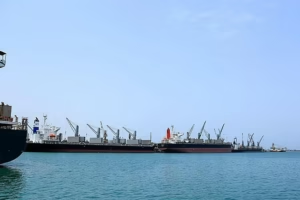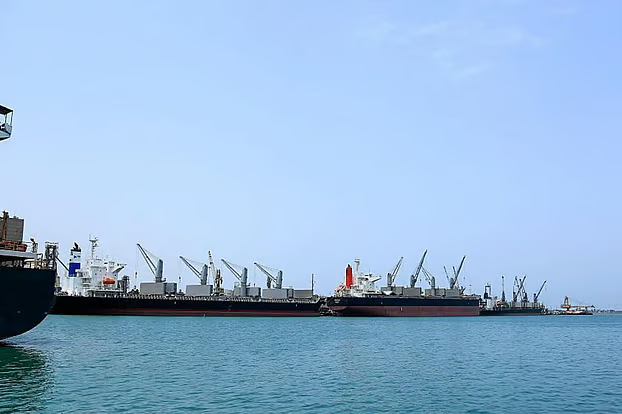
An Indian-flagged commercial vessel sank off the coast of Yemen after being struck by a projectile. However, all 14 people on board were safely rescued.
India’s Minister of Ports, Shipping and Waterways, Sarbananda Sonowal, confirmed the incident.
Thirteen of the 14 people on board the vessel, named ‘MSV Faiz Noor-e-Auliya’, were Indian citizens. Strongly condemning this “provocative attack,” Sonowal stated that all necessary measures would be taken to ensure the safety of seafarers in the region. However, it remains unclear exactly who carried out the attack.
This is the latest in a series of attacks on vessels navigating the Red Sea. Following the blockade of the Strait of Hormuz, some oil tankers had begun using the Red Sea as an alternative route.
India’s Ministry of External Affairs issued a statement following the incident. Describing attacks on commercial vessels in the region as “deeply concerning,” the statement said, “Targeting commercial vessels in this region must stop. It is imperative to restore free and unhindered shipping and trade in the region’s international waters, in accordance with international law, as soon as possible.”
“Recent repeated attacks by Yemen’s Iran-backed Houthi rebels on Saudi Arabian tankers have further heightened the risks for oil and cargo vessels operating in the Middle East.”
Most maritime routes in the region have been effectively disrupted since the US and Israel targeted Iran in late February. Iran’s blockade of the Strait of Hormuz—one of the world’s busiest oil transport routes—significantly impacted global oil prices. Consequently, some vessels transporting oil from Saudi Arabia were forced to use the Red Sea as an alternative route.
However, recent repeated attacks by Yemen’s Iran-backed Houthi rebels on Saudi Arabian tankers have further increased the risks in the region.
A Reuters report stated that Yemen’s internationally recognized and Saudi-backed Ministry of Transport has blamed the Houthis for the attack. They claim the attack was carried out using an explosive-laden vessel. However, the Houthis have not yet commented on this incident.
Iran has clearly stated that it is not holding any talks with the United States, nor does it have any plans to do so; the discussions are primarily being conducted through Omani mediation.
Earlier, on July 20, the Houthis had announced a blockade on Saudi Arabia’s Red Sea ports.
The United Kingdom Maritime Trade Operations (UKMTO) reported several attacks on ships in the region last week.
Despite this situation, global oil prices dropped to a three-week low yesterday, Tuesday. This decline in the oil market was driven by optimism among top US officials regarding a potential agreement with Iran to reopen the Strait of Hormuz.
Previously, in June, the US and Iran signed a 14-point Memorandum of Understanding (MoU) aimed at halting military operations, reopening the Strait of Hormuz, and ending the conflict within 60 days. However, just three weeks after the agreement was signed, US President Donald Trump declared the ceasefire over. The deal collapsed following Iranian attacks on ships in the Strait of Hormuz and retaliatory US strikes against the country.
“An agreement on reopening the Strait of Hormuz could be finalized by Tuesday or Wednesday.” — Scott Bessent, US Treasury Secretary
However, US officials stated yesterday that negotiations with Iran are progressing quite positively. US Treasury Secretary Scott Bessent hinted that an agreement regarding the reopening of the Strait of Hormuz could be concluded by Tuesday or Wednesday. That said, Iran has made it clear that it is not negotiating with the US and has no plans to do so; the discussions are essentially being facilitated by Oman.