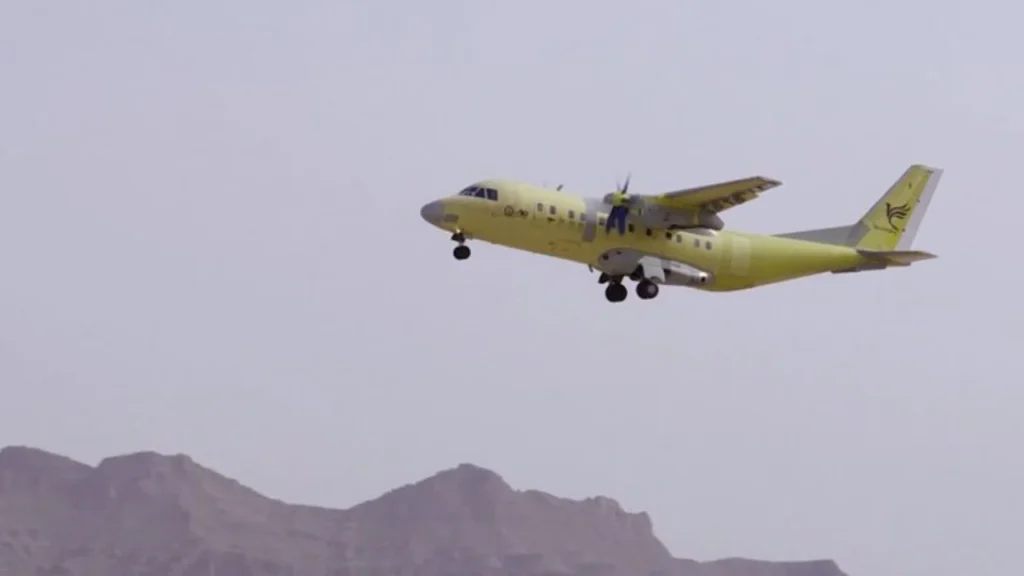
The ‘Simorgh’ transport and cargo aircraft, built using Iran’s indigenous technology, is currently in the final stages of obtaining operational certification. Authorities anticipate that, pending the successful completion of necessary standardization and licensing procedures, the aircraft will enter commercial service by the Iranian year 1406 (approximately 2027).
Shokri Mehr, Secretary of the Aerospace, Transportation, and Urban Development Headquarters under Iran’s Vice Presidency for Science, Technology, and Knowledge-Based Economy, stated in an interview that the government continued to provide full support for the Simorgh project over the past year. Comprehensive assistance was extended in accordance with agreements made with relevant knowledge-based enterprises.
He noted that the aircraft is currently undergoing standardization, licensing, and certification processes. This phase is critical, as the aircraft’s future entry into operational and commercial service depends upon it. He also mentioned that coordination is proceeding smoothly among the project implementer—the Iran Aircraft Manufacturing Industrial Company—and the country’s Civil Aviation Organization. Shokri expressed optimism that the project would advance rapidly through the acquisition of STC (Supplemental Type Certificate) or TC (Type Certificate) certification.
Iran’s aviation industry has faced numerous challenges for years due to international sanctions and restrictions on the supply of components. Against this backdrop, the Simorgh project is viewed not merely as a symbolic initiative, but as a strategic move to meet the country’s growing demand for cargo and air-based freight transport.
The Simorgh aircraft is based on the Iran-140 platform. Its primary objective is to produce an indigenous cargo transport aircraft for future use in the commercial transport sector. Simultaneously, it aims to bolster Iran’s capabilities in aircraft design, testing, quality control, and manufacturing.
According to experts, while the cargo and air support sectors may be relatively less developed within Iran’s aviation industry, they remain critically important. Building domestic capabilities in this area could lay the foundation for the construction of more advanced aircraft in the future.
The participation of knowledge-based companies in the project is also significant. These institutions are actively engaged in the manufacturing, testing, quality assurance, documentation, standardization, and licensing of various subsystems and components. Consequently, the Simorgh is regarded as a prime example of synergy within Iran’s aviation industry, technology sector, and innovation-driven economy.
Regarding the project timeline, Shokri stated that, under current plans, the aircraft could enter commercial service in the Iranian year 1406. However, there is a possibility of a slight delay due to some unforeseen disruptions encountered last year. He noted that the project implementers are working closely to address this matter.
He further mentioned that the Vice Presidency is primarily playing a supportive and coordinating role in the project. It is the implementing agencies and the Civil Aviation Organization that will determine the specific schedule for the aircraft’s certification and commercial operation.