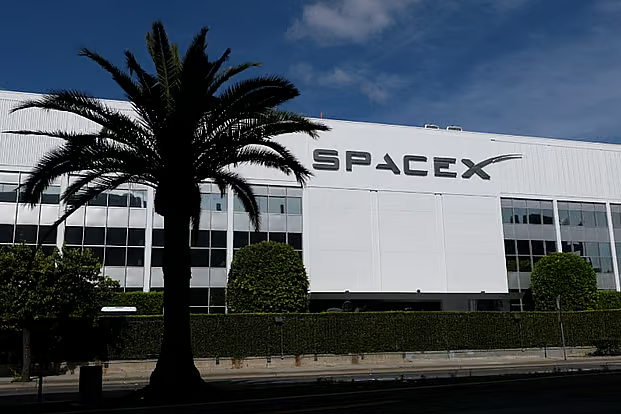
Billionaire Elon Musk founded SpaceX in 2002. At the time, his ambitious goal was to transport humans to Mars and establish a settlement there.
Today, SpaceX has evolved into a massive enterprise. It serves as one of NASA’s primary contractors and a leading provider of satellite-based internet services. Additionally, the company has incorporated Musk’s artificial intelligence-based startups. The social media platform formerly known as Twitter is now also under SpaceX’s ownership.
Yesterday, Wednesday, SpaceX submitted a filing to the US capital markets regulator. In the document, the rocket and technology firm stated that it aims to launch the largest IPO (Initial Public Offering) in history. Through this offering, the company plans to raise $75 billion in funds, valuing the firm at a total market capitalization of $1.77 trillion.
According to the filing submitted to the US Securities and Exchange Commission (SEC), SpaceX intends to offer more than 555 million (555,000,000) shares for sale to the market, with each share priced at $135.
The share-selling process is expected to take place by June 12. If this proceeds as planned, it will shatter the current record for funds raised through an IPO—currently standing at $25.6 billion. That record is currently held by Saudi Aramco, Saudi Arabia’s national oil company and the Gulf region’s energy giant.
Dominance in the Space Industry
South African-born Elon Musk founded SpaceX at the age of just 30. Prior to establishing SpaceX, he sold his dot-com business (an online-based enterprise) called Zip2. Subsequently, he founded an online payments company, which later merged to become PayPal. PayPal was subsequently acquired by eBay.
Following the sale of Zip2—and his subsequent business successes—Musk found himself with substantial financial resources. At that time, NASA had no plans for any imminent missions to Mars.
Musk devised a plan to generate greater public interest in space travel. He envisioned growing plants on the surface of Mars by sending seeds inside a miniature glass greenhouse. However, he was unsuccessful in his efforts to find a suitable means to transport it there. Consequently, he founded a rocket company.
In its early days, SpaceX faced repeated failures and incurred substantial financial losses. Finally, in 2008, SpaceX successfully launched its Falcon 1 rocket. Subsequently, the company developed partially reusable rockets and secured significant contracts with various organizations, including NASA.
Eventually, the Falcon 9 rocket became SpaceX’s primary workhorse. The company’s next major milestone was delivering supplies to the International Space Station. In 2012, their Dragon spacecraft reached the ISS. SpaceX became the first private space company to transport astronauts into space aboard a crewed spacecraft.
Meanwhile, development work on SpaceX’s massive Starship rocket is progressing rapidly. Its ambitious goal is to become the world’s first fully reusable orbital rocket. The rocket’s upper stage will be capable of carrying both humans and cargo simultaneously.