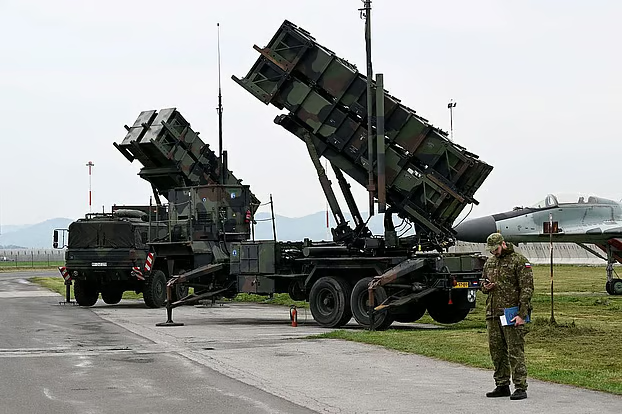
US Patriot missile defense system. File photo: Reuters.
The United States has exhausted nearly its entire stockpile of precision missiles during the ongoing five-month war against Iran. Three sources familiar with internal data revealed this information, raising significant concerns about the US military’s readiness for any potential future conflict.
The sources state that these weapons are primarily surface-to-surface missiles known as the “Army Tactical Missile System” (ATACMS) and the “Precision Strike Missile” (PrSM). Two of the sources claim that the US has used up “almost the entirety” of these weapon stocks.
Information regarding the extent of the US military’s shortage of ATACMS and PrSM missiles had not previously been disclosed.
These long-range missiles are a crucial component of the US military arsenal, enabling precision strikes against enemy targets from a safe distance. US-supplied ATACMS missiles played a pivotal role in the war in Ukraine, allowing Ukrainian forces to strike targets deep within Russian territory. Meanwhile, the PrSM is a newer, technologically advanced missile designed to replace the older ATACMS, which has a shorter range.
According to analysts, each of these sophisticated weapons costs over $1 million. They are considered vital for any potential conflict with a major power like China.
However, the sources declined to comment on the exact size of the remaining US stockpile of these weapons.
In February of this year, President Donald Trump launched a joint offensive against Iran alongside Israel. At the time, the conflict was predicted to be short-lived. However, as the war has dragged on, the three sources have expressed concern over the missile shortage. They believe that the dwindling stockpile could limit Washington’s ability to counter US adversaries such as Russia and China. A fourth person familiar with the matter stated that U.S. Central Command (CENTCOM), which oversees U.S. forces in the Middle East, had nearly exhausted its stock of ground-based missiles prior to the outbreak of hostilities. However, a replenishment process is underway, drawing supplies from U.S. military bases elsewhere in the world.
When asked to comment on the information regarding this stockpile shortage, the White House released a statement from President Trump. In it, Trump claimed that the United States possesses “far more weapons than any other country in the world” and has “far more than we need.”
Analysts acknowledge that certain military hardware—including artillery shells and various types of missiles—is currently being manufactured at record levels. However, they warn that the pace of production still falls short of the demands of a prolonged conflict.
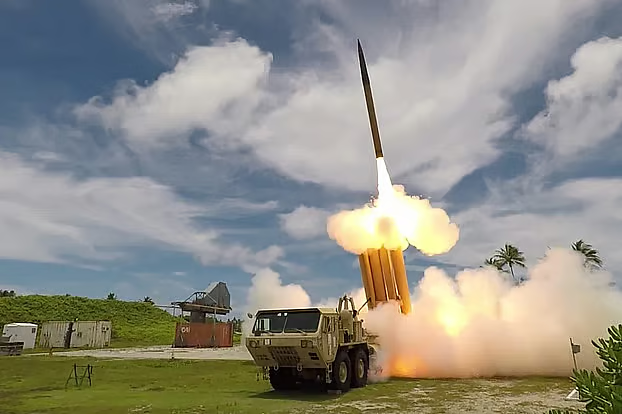
Lockheed Martin, the manufacturer of ATACMS, PrSM, and the THAAD ballistic missile defense system, did not immediately respond to inquiries regarding Trump’s remarks or supply levels. Similarly, Raytheon, the maker of Tomahawk cruise missiles and Patriot interceptors, offered no comment on the matter.
In response to a request for comment, Pentagon chief spokesperson Sean Parnell stated, “The U.S. military is the most powerful in the world, and we possess the full capability to deploy it anywhere, at any time, at the President’s direction. We have conducted numerous successful operations across multiple combatant commands while maintaining an arsenal with sufficient depth and capability to protect our people and interests.”
Information regarding these supply levels circulated within the government last week amidst heated internal discussions within the Trump administration. The debate centered on how long the U.S. could sustain strikes against Iran while maintaining a minimum stockpile of weapons necessary to handle other potential crises.

Warnings regarding weapons supply
According to sources, the primary reason for the depletion of ATACMS and PrSM stockpiles is the Trump administration’s risk-aversion strategy. Specifically, there has been a greater emphasis on using these types of missiles rather than resorting to riskier methods, such as dropping bombs from manned fighter jets. Since these weapons allow for strikes against the enemy from a safe distance, analysts consider them highly effective against adversaries possessing robust air defense systems, such as China. According to a March report by the Center for Strategic and International Studies (CSIS), these weapons have been used in attacks on targets within Iran.
The report notes that, as the PrSM is a relatively new weapon, initial stockpiles were limited; however, the US military has placed substantial orders for 2027. Meanwhile, the US Army has already announced that the ATACMS is being phased out, with production shifting toward the new PrSM.
According to two sources, military chiefs had been warning the President for weeks that stockpiles of defensive weapons—including Patriot interceptors, which are capable of destroying ballistic missiles—were running low. Last week, several media outlets reported that Trump decided against launching another major strike inside Iran after his military advisors warned him about the strain on U.S. arsenals.
However, a U.S. official denied this, claiming instead that Trump chose to hold off on further attacks due to pressure from Gulf nations.
**Depletion of Defensive Weapon Stocks**
A report published last week by the CSIS revealed that approximately 65 percent of U.S. Patriot interceptors were expended between February and July. Additionally, stockpiles of the THAAD ballistic missile defense system have dropped by at least 38 percent compared to pre-conflict levels. Both Patriot and THAAD systems detect and destroy airborne targets and rank among the most effective defensive assets in the U.S. arsenal.