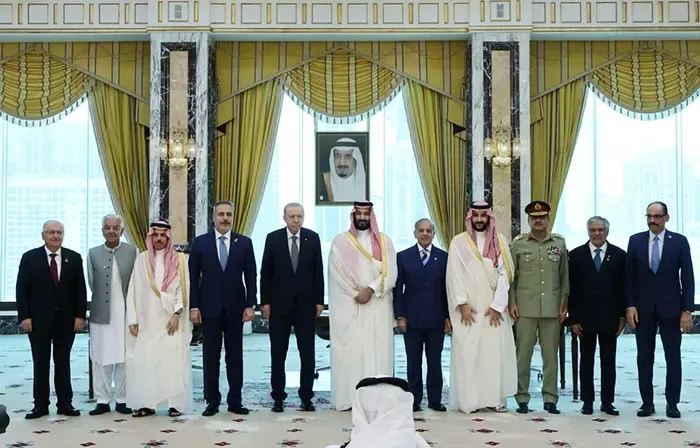
The ‘Mecca Joint Defense Pact’ has been signed among Saudi Arabia, Turkey, and Pakistan. This newly signed agreement has already drawn the interest of nations such as Bangladesh, Egypt, and Iran. Analysts believe that an expansion of this pact’s scope could bring about significant changes in regional security, alliances, and the balance of power. This report comes from The Media Line.
On August 7, Saudi Crown Prince Mohammed bin Salman, Turkish President Recep Tayyip Erdoğan, and Pakistani Prime Minister Shehbaz Sharif signed this joint defense pact in Mecca. The agreement stipulates that an armed attack on any one of the three nations will be considered an attack on all of them. Its primary objective is to strengthen collective deterrence capabilities and expand defense cooperation. The pact is described as defensive in nature and not directed against any specific country.
Bangladesh’s Potential Inclusion and Dhaka’s Strategic Position
Bangladesh is at the center of discussions regarding the potential expansion of this pact. Humayun Kabir, the State Minister for Foreign Affairs, and Shama Obaid recently indicated that Dhaka views the agreement positively and is considering the possibility of joining, keeping national interests and the country’s economy in mind. This initiative is seen as part of the ‘Bangladesh First’ policy and the balanced foreign policy of the new administration led by Prime Minister Tareq Rahman. Furthermore, deep economic ties with Saudi Arabia—along with the presence of approximately four million expatriate Bangladeshis—and growing diplomatic and commercial relations with Turkey are accelerating this consideration. However, according to Mohammad Ali Jafar, a researcher at Oxford University, this potential move by Bangladesh could cause significant ripples in South Asian geopolitics. If Dhaka enters into a military alliance or joint defense pact with Pakistan, it would naturally spark intense concern in New Delhi. India’s Ministry of External Affairs has already stated that it is closely monitoring the situation in West Asia and will take all necessary measures to safeguard India’s interests and maintain regional stability regarding national security. Moreover, analysts question whether Dhaka should directly join this alliance without thoroughly assessing the risks of becoming entangled in complex, distant Middle Eastern conflicts and weighing the associated economic and geopolitical pros and cons.
Stances of Iran and Egypt
On the other hand, Iran’s potential inclusion has emerged as the most contentious issue surrounding the alliance. Although an official from Iran’s parliamentary media reported that Tehran had received an invitation, the country’s Foreign Ministry subsequently denied it. Ali Hosseini, a researcher at the Iran Institute for BRI Studies, believes that joining this pact would be a major strategic error for Iran, as the agreement is structurally designed primarily as a conceptual defensive bulwark against Iranian military power. However, according to Jafar, Tehran’s participation could transform the pact from a narrow security circle into a broader Muslim framework—though this would require Iran to demonstrate significant trustworthiness to avoid conflict with the United States.
There are also various calculations regarding Egypt’s participation. Egyptian Foreign Minister Badr Abdelatty has stated that Cairo is reviewing the matter seriously. Ofir Winter, a senior researcher at Tel Aviv University’s Institute for National Security Studies (INSS), notes that Egypt does not wish to disrupt its delicate balance by aligning itself directly with any single camp, given the current state of relations between Israel and the Arab world. Cairo must make its decision while keeping in mind its ties with Turkey and the legal obligations of the 1979 peace treaty with Israel.
All in all, the Mecca Defense Pact remains in its preliminary stages. If its scope is limited to like-minded nations in the Middle East and South Asia, it will emerge as a new security network. However, if countries with diverse geopolitical interests—such as Bangladesh, Egypt, or Iran—join the alliance, it will usher in far-reaching and complex shifts in regional politics.