The UK’s National Crime Agency (NCA) has advised parents against making photos of their children publicly accessible online. This recommendation is part of a groundbreaking set of guidelines aimed at tackling the rise of sexually abusive content created using artificial intelligence (AI).
The guidelines, issued by the NCA and the child protection watchdog ‘Internet Watch Foundation’ (IWF), suggest that parents or legal guardians set their social media accounts to ‘private’ or share photos of their children only within a ‘Close Friends’ group.
The NCA and IWF emphasized that they are not dictating how parents should behave online; rather, they want parents to be aware of the issue and how to address it.
The guidelines recommend reviewing social media accounts to identify older photos that could be exploited by criminals. They also advise revisiting photo-sharing consent agreements—such as those with educational institutions or sports clubs—that may have been signed years ago, before the advent of AI technology capable of manipulating images.
Tim Wright, a senior manager at the NCA, said, “We are encouraging parents and guardians to take a few simple steps today.”
The guidelines outline three specific actions: checking social media ‘privacy settings,’ reviewing who can view photos of the children, and having open discussions about granting permission to individuals or organizations to publish photos of the children online.
If you wish to remove photos of your children from a website or social media platform, you are fully entitled to do so without hesitation. —Tom Dyson, Head of Marketing, IWF
The NCA has stated that most parents and guardians are likely unaware that technological advancements have provided criminals with accessible tools to create child sexual abuse material (CSAM) without needing to establish direct contact or a relationship (grooming) with the victims.
Lorna Sinclair, the NCA’s Education Manager for Child Sexual Abuse, said, “Generally, when parents or guardians post photos of their children online, they do not consider that those images could be misappropriated and transformed into CSAM. Many parents and guardians are completely unaware that such a problem even exists.”
A Concerning Situation
According to IWF data, the volume of AI-generated child sexual abuse material online rose by 14 percent last year. The organization identified 8,029 hyper-realistic AI-generated CSAM images and videos.
The IWF monitors CSAM-related incidents and operates a reporting hotline. Teenagers under the age of 18 have contacted the organization after falling victim to blackmailers who manipulated their photos into nude images using AI.
“Report Remove,” a confidential service dedicated to removing non-consensual, compromising images of minors from the internet, has also encountered instances of such image manipulation. They have seen cases where ordinary, fully-clothed selfies were transformed into extreme pornography using AI.
In another incident reported to a similar service called Childline, a 15-year-old girl revealed that a stranger had created a “hyper-realistic” fake nude image of her. The image incorporated her face and her bedroom. The source material for this image was likely obtained from the girl’s Instagram account. The publication of these guidelines follows incidents where the websites of UK educational institutions were targeted by blackmailers. These perpetrators obtained images of children from the websites, used AI tools to transform them into child sexual abuse material, and subsequently threatened to disseminate the content.
The ‘Early Warning Working Group’ (EWWG)—a UK advisory body tackling online harm that includes the NCA and IWF among its members—has advised educational institutions to remove photos that clearly reveal students’ faces from their websites and social media accounts.
Dan Sexton, Chief Technology Officer at the IWF, stated that he felt “very uncomfortable” telling parents not to make photos of their children publicly available, yet he believes there is no alternative. He said, “I don’t know what else to tell parents. I myself used to be very cautious [about posting photos of children online] because there is no protection or security there.”
Advice for parents and guardians
The guidelines issued by the NCA and IWF state, “If you wish to post photos of your child online, we recommend creating a ‘Close Friends’ group or restricting access so that only specific individuals can view them.”
The children’s charity NSPCC has advised those under the age of 18 to utilize ‘private settings’ on their social media accounts.
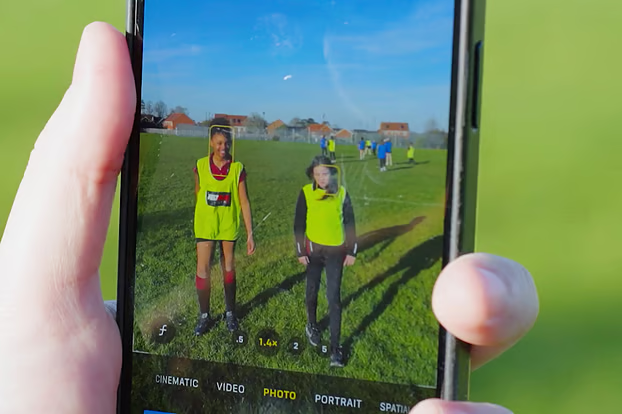
Some videos released as part of this guidance feature dramatized scenes showing parents taking photos of their children—such as while playing or standing at school gates—while reminding them of the risks associated with posting these images online. The NCA and IWF aim to encourage both parents and children to feel empowered to say ‘no’ if they are uncomfortable with sharing photos online.
The guidance on reviewing social media accounts suggests that users examine their own profiles to check if their children’s faces, bodies, or school uniforms are visible in photos, consider whether they are still comfortable having those images online, and think about whether they can delete them or change the privacy settings.
It also advises checking whether friends or family members are posting photos of the children online (including old posts) and having “clear and calm” discussions about what steps can be taken regarding this.
Additionally, the guidance recommends reviewing consent forms—previously signed by parents or guardians—that authorize the use of children’s photos by schools, nurseries, or clubs, and considering whether they wish to withdraw that permission.
Tom Dyson, Head of Marketing at the IWF, stated, “If you want to remove photos of your children from a website or social media platform, you have every right and the freedom to do so without hesitation.”