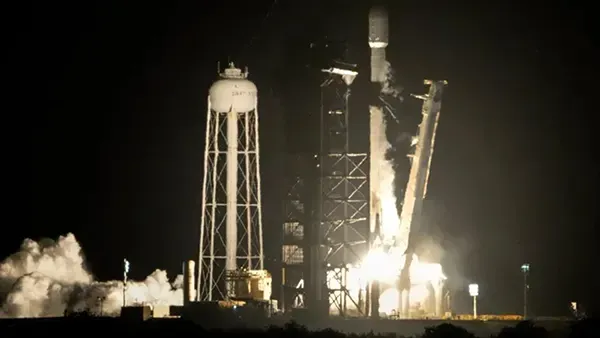
Debris weighing approximately four tons from a SpaceX Falcon 9 rocket has crashed onto the lunar surface, according to Al Jazeera. Tracking data indicates that the impact created a new crater on the Moon.
Scientists view this as a rare opportunity to study high-speed celestial impacts. Reports state that the second stage of a Falcon 9 rocket—launched in early 2025—struck near the Moon’s Einstein crater early Wednesday (August 5) at a speed of approximately 8,700 kilometers per hour (about 5,400 miles per hour).
Based on orbital analysis by independent astronomers and data from space monitoring agencies, the energy released during the impact was equivalent to the explosion of about 3 tons of TNT.
Typically, after delivering their payloads into space, such rocket components either burn up upon re-entering Earth’s atmosphere or fall in a controlled manner into designated ocean areas.
In this instance, however, the debris’s orbit gradually shifted over 18 months due to the gravitational influence of the Sun, Earth, and Moon, eventually placing it on a collision course with the lunar surface.
SpaceX stated that the collision was unintentional; once the rocket’s remaining fuel was exhausted, altering its trajectory was no longer possible.
Juliana Scheiman, SpaceX’s Director of NASA Science and Dragon Programs, explained that a combination of solar activity and the gravitational pull of various celestial bodies pushed the debris toward the Moon.
Meanwhile, NASA’s Lunar Reconnaissance Orbiter (LRO) and South Korea’s Danuri spacecraft have prepared their sensors to observe the impact site.
Although the flash of the impact itself will not be visible due to daylight conditions at the site, the orbiting spacecraft will capture data on dust clouds and obtain high-resolution “before-and-after” images of the newly formed crater. Space tracking expert Bill Gray told the Associated Press that while this poses no immediate risk, it highlights the need for greater caution regarding the disposal of spent spacecraft components.
He further noted that Earth’s orbit and the surrounding space environment are becoming increasingly crowded.
Notably, this marks the second instance of discarded rocket debris accidentally crashing into the Moon. Previously, on March 4, 2022, a segment of a Chinese Long March 3C rocket—launched in 2014—impacted the far side of the Moon, creating an unusual double crater.