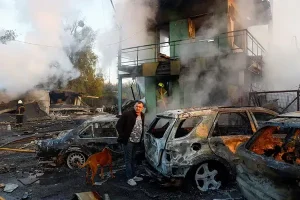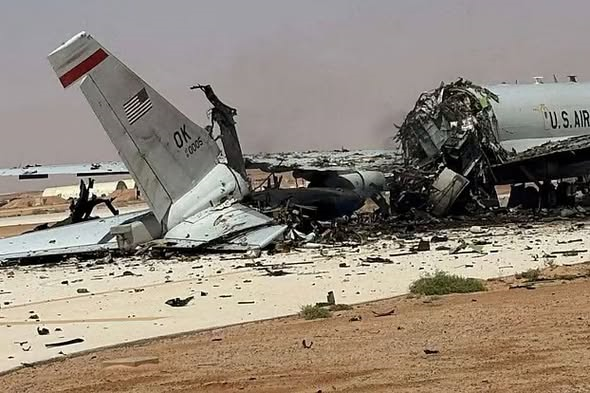
In the conflict with Iran, at least 42 aircraft belonging to the US military—including bombers, drones, surveillance planes, and aerial refueling tankers—have been either destroyed or damaged.
This information was revealed in a recent report by the US Congressional Research Service (CRS).
However, due to various factors—such as data classification, the ongoing nature of the conflict, and the process of determining the specific causes of damage—it is anticipated that the actual extent of these losses could rise further.
On February 28, the United States and Israel jointly launched a military operation against Iran. The US designated this campaign “Operation Epic Fury.” Forty days into the offensive—on April 8—and through the mediation of Pakistan, the United States and Iran agreed to a temporary ceasefire.
The Pentagon, the US Department of Defense headquarters, recently disclosed that the cost of military operations against Iran under “Operation Epic Fury” has already reached approximately $29 billion.
During a hearing on May 12, Jules Hurst, the Pentagon’s Chief Financial Officer, stated: “A major reason for the escalation in costs is that we have now obtained a precise calculation of the funds required to either repair or replace the weaponry and equipment that were damaged or destroyed on the battlefield.” “Consequently, the total cost has exceeded previous estimates.”
List of Damaged or Destroyed Aircraft
The damaged and destroyed aircraft include: four F-15E Strike Eagle fighter jets, one F-35A Lightning II fighter jet, one A-10 Thunderbolt II ground-attack aircraft, seven KC-135 Stratotankers (aerial refueling aircraft), one E-3 Sentry (an airborne early warning and control aircraft), two MC-130J Commando II special operations aircraft, one HH-60W Jolly Green II combat search-and-rescue helicopter, 24 MQ-9 Reapers (medium-altitude, long-endurance drones), and one MQ-4C Triton (high-altitude, long-endurance drone).
The Pentagon has not yet released a comprehensive assessment of the losses sustained during this conflict. However, the Congressional Research Service (CRS)—a research agency that provides policy and legal analysis to the U.S. Congress—stated that it compiled this list primarily by reviewing various statements from the Department of Defense and U.S. Central Command (CENTCOM), as well as news reports.
Iran’s Warning
Iranian Deputy Foreign Minister Abbas Araqchi shared the CRS report on the social media platform X (formerly Twitter). In his post, he wrote that Iran gained significant experience from the fighting that took place prior to the April ceasefire—a fact acknowledged by the United States itself.
Araqchi warned that if Trump were to launch another military campaign against the Islamic Republic, Tehran would leverage the knowledge it has acquired to present the U.S. forces with “many more surprises.”
Araqchi further noted that, months after the commencement of hostilities against Iran, the U.S. Congress has finally acknowledged the loss of dozens of aircraft worth billions of dollars. He added that it is now confirmed that it was Iran’s formidable armed forces that were the first to shoot down the much-touted F-35 fighter jet.