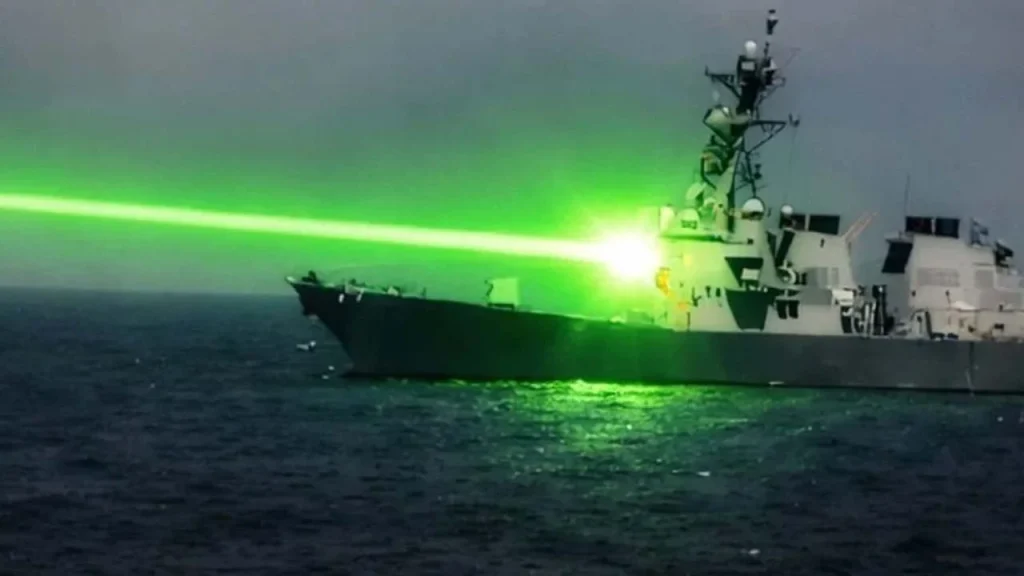
The United States has deployed state-of-the-art, high-power laser weapons in the strategically vital Strait of Hormuz in the Middle East. This technology is being utilized to counter suspicious drones and potential cruise missiles. Remarkably, US troops are operating these laser weapons using modified Xbox controllers—video game consoles manufactured by Microsoft.
A report by the US media outlet New York Post confirmed this information, citing President Donald Trump’s Department of Defense. The US military asserts that laser technology allows for the destruction of drones and incoming cruise missiles at a fraction of the cost associated with the expensive missiles used in conventional defense systems.
The United States has been developing this technology for nearly five decades. US officials claim that its current capabilities surpass those of technologies employed by other global military powers. Recently, the technology also underwent field testing along the country’s southern border.
Unlike conventional missile defense systems, this method does not require launching separate interceptors or physical missiles to destroy each target. Consequently, the cost of repelling each attack is significantly reduced. However, the report notes that the US military has already spent approximately $500 million on the development and deployment of this technology.
The laser system draws power from generators or high-capacity batteries and converts it into a powerful beam of light. This highly concentrated beam is then directed at a specific target. The intense heat generated can cause specific parts of a drone or other aerial vehicle to overheat rapidly, leading to damage or total destruction.
Mark Neice, president of the research firm Directed Energy Consultants, stated that the laser system can track a drone’s flight path with extreme precision and strike specific sections of the aircraft. This capability allows for the disabling of a drone’s sensors or the complete destruction of the drone itself. However, another aspect of this technology has sparked significant interest: the military is using modified Xbox controllers to operate laser weapons. The US military’s rationale is that the cutting-edge technology required for target control already exists within the gaming industry; therefore, there is no need to invent an entirely new control system for military use.
Jared Keller, editor of the military newsletter Laser Wars, believes that moving laser technology out of the laboratory and onto the actual battlefield is a crucial step. To illustrate this point, he jokingly cites the popular video game Halo, noting that anyone who has used the “Spartan Laser” in the game would find it easy to operate real-world laser weapons.
Instances of this technology being used include operations against drug cartels in Mexico and deployments on US warships in the Middle East. However, according to experts, the weapon has not yet been used directly against human targets.
Brent Ziarnick, a senior fellow for defense studies at the American Foreign Policy Council, states that if a sufficient power supply can be ensured, laser technology could create an effective defensive shield. This would reduce the need for soldiers to stockpile vast amounts of ammunition and could bring about major changes in military logistics and supply chains.
For now, however, the size and weight of the technology mean we are not seeing “laser backpacks” for individual soldier use. The current laser systems deployed in the Middle East are so heavy that they must be mounted on large warships to operate.
According to reports, a US laser system known as “HELIOS” is capable of destroying drones by firing a 60-kilowatt beam. Meanwhile, Boeing recently unveiled the “Compact Laser Weapon System” (CLWS), which is reportedly capable of countering larger Group-3 class drones.
Nevertheless, laser weapons do have certain limitations; the systems remain quite heavy, and they generally require clear skies to function effectively. Moreover, if a massive swarm of drones attacks simultaneously, a single laser system might not be able to rapidly engage all the targets. Consequently, even with future advancements in laser technology, questions remain as to whether it alone would suffice as a substitute for conventional defense systems.
Source: New York Post