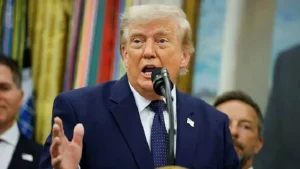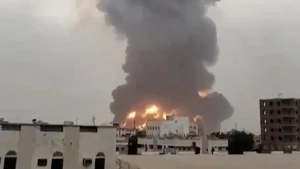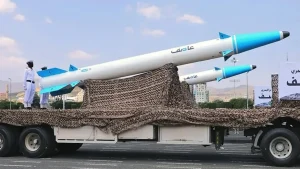
US President Donald Trump is set to declare the Strait of Hormuz as US territory very soon. Simultaneously, Washington is preparing to exert severe economic pressure on Iran to force an end to the hostilities. Al Jazeera journalist Kimberly Halkett reported this from the US. Meanwhile, Iran has reacted sharply to Trump’s threat. The country’s Deputy Foreign Minister, Kazem Gharibabadi, stated that the Strait of Hormuz would remain Iranian territory and that the blockade there would persist until the US accepts defeat.
Iranian Foreign Minister Abbas Araghchi also clarified his country’s stance regarding the Memorandum of Understanding signed in Islamabad. He stated that the agreement reached in Islamabad signified the “end of the war,” not merely a “ceasefire.” He asserted that hostilities resumed after the US violated that agreement. Meanwhile, Mark Ginsberg—a former US ambassador and former White House advisor on Middle East policy—believes that the Trump administration’s current campaign against Iran could ultimately fail. He told Al Jazeera that Washington’s current strategy is essentially an “economic game of chicken,” where the key question is which side will back down first. In his view, the situation differs from the past because the Strait of Hormuz has moved to the very center of the conflict, and Iran has been cut off from the foreign currency reserves needed to keep its economy running. However, Ginsberg believes the Trump administration lacks a clear strategy to resolve this impasse. He noted that the administration’s ultimate goal remains unclear, adding, “We do not know what the President plans to do.”
According to him, all that is evident so far is that the Trump administration is persisting with a strategy of sustained pressure. Comparing the positions of Washington and Tehran to two vehicles heading toward a collision, Ginsberg remarked that the question is who will swerve off the road before the crash occurs. He speculates that, in the end, the Trump administration might be the one to yield before the Iranian government does. According to Dan Grazier, Director of the National Security Reform Program at the Stimson Center, Tehran is likely capable of withstanding the additional economic pressure the US is threatening to impose in an effort to force the opening of the Strait of Hormuz. Grazier notes that the Iranians can likely weather this pressure. He points out that Iran has been viewed by the US as a “pariah state” since 1979 and has endured various sanctions for decades. Consequently, there are doubts regarding the realism of the Trump administration’s belief that economic warfare will succeed where six months of military threats failed.
Grazier believes that Washington is leaning towards economic pressure partly because US military stockpiles of long-range munitions and missiles are dwindling. A former Marine Corps officer, Grazier observes that while statements from various US administrative officials have been contradictory, available data suggests the US military is facing a shortage of weapons necessary for long-range military operations.
He notes that the US has military and security responsibilities across various regions of the world; therefore, Washington cannot afford the risk of completely exhausting its ammunition supplies in a single conflict. In his view, this shortage of weaponry has necessitated a shift in US strategy. Grazier analyzes that this is why the Trump administration is now turning toward economic warfare alongside military posturing.
The Strait of Hormuz is the primary maritime route connecting the Persian Gulf to the Arabian Sea. A significant portion of the world’s energy supply passes through this narrow waterway. Consequently, a prolonged conflict or naval blockade here would deal a severe blow not only to Iran and the US but also to global energy markets and international trade. Tensions have been further heightened by Trump’s threat to designate the strait as “US territory” and Iran’s vow to maintain its counter-blockade. Ultimately, the future trajectory of the conflict hinges on the interplay between Washington’s economic pressure and Tehran’s capacity for resistance.