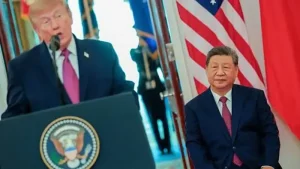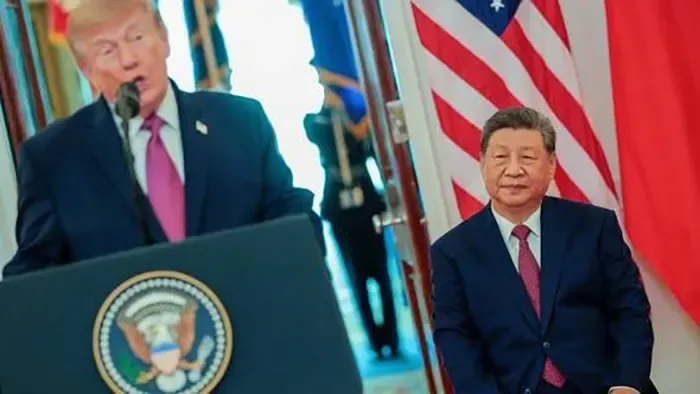
US President Donald Trump proposed selling American weapons to Chinese President Xi Jinping. Trump made this offer despite long-standing restrictions on the export of US military equipment to China. David Perdue, the US Ambassador to China, disclosed this information to the media. Perdue shared these details during an interview with Fox News Sunday while discussing Trump’s policies regarding China and the continued sale of US arms to Taiwan. Online outlet RT reported this news. Perdue stated that President Trump often remarks, “We sell weapons to other countries around the world.” At one point, he even directly asked President Xi if he was interested in purchasing any weapons. However, the ambassador did not provide details regarding when the proposal was made, what type of weapons were discussed, or how Xi responded.
The two leaders have met twice this year. Their first meeting took place in Beijing in May. Subsequently, Xi visited Washington last week for a three-day state visit. In reality, however, any US arms sales to China would face significant legal hurdles. In 1990, the US Congress imposed restrictions on exporting defense equipment—specifically items on the US Munitions List—to mainland China. Although there are provisions for limited waivers and presidential discretion based on national interest, these restrictions have effectively maintained a US arms embargo on Beijing for decades.
Yet, despite officially adhering to the “One China” policy, the US remains Taiwan’s primary foreign arms supplier. The Taiwan Relations Act of 1979 stipulates that the US will provide Taiwan with defense equipment and services in quantities necessary to maintain sufficient self-defense capabilities. Beijing considers Taiwan part of China and has repeatedly demanded an end to Washington’s military assistance. China claims that these arms sales violate its sovereignty and destabilize relations across the Taiwan Strait.
Prior to Xi’s visit to Washington, China’s Ministry of Defense had urged the US to exercise extreme caution regarding this matter. Last December, the Trump administration approved an $11 billion arms package for Taiwan—the largest such package announced to date. Additionally, another arms package worth approximately $14 billion has been stalled for months; Trump has described it as a valuable bargaining chip. A White House document released following the meeting between the two leaders made no mention of any decision regarding this pending package.
Purdue made these remarks while defending Trump’s track record on the Taiwan issue, asserting that Trump has already approved significantly more arms for Taiwan than previous presidents. The ambassador framed the question Trump posed to Xi not as a formal arms sale proposal, but rather as an illustration of the President’s deal-oriented, bargaining-based political approach. However, it remains unclear what kind of weaponry Washington could actually supply to Beijing that China does not already manufacture itself.
China is currently self-sufficient in domestic production capabilities across almost all key categories of conventional weaponry. While various widely cited lists place China behind the United States in terms of arms production or sales capacity, these rankings are primarily based on revenue in dollar terms rather than actual production volume. Shipbuilding, however, allows for a direct comparison of production capabilities; in this sector, China’s industrial output capacity is estimated to be roughly 230 times greater than that of the United States.
Furthermore, data presented during congressional hearings indicates that China’s capacity for producing small-scale drones exceeds that of the United States by more than a hundredfold. Consequently, the United States primarily holds an advantage in specific areas involving cutting-edge technology and technical expertise. Yet, the U.S. regards these very technologies and capabilities as highly sensitive, making it extremely unlikely that they would be shared with China—its principal strategic rival.