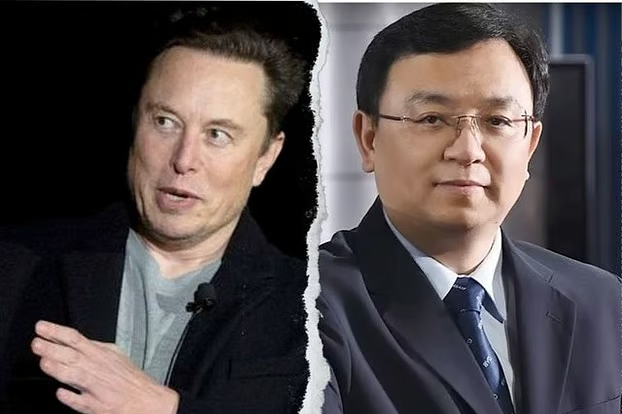
Tesla's Elon Musk (left) and BYD's Wang Chuanfu. Photo: Reuters
In the 100-year history of the automobile industry, the world has never witnessed such a seismic upheaval. The long-standing hegemony of Germany, Japan, and the United States has now been overshadowed by the sheer dominance of the Chinese giant, BYD. BYD—which has usurped the throne of Elon Musk’s Tesla—is not content with merely manufacturing cars; it has also firmly established itself as a new global powerhouse in the realms of semiconductor chips and artificial intelligence.
By leveraging affordable technology and the capacity for swift, precise decision-making, BYD has emerged today as one of the most influential forces in the global automobile industry. Curiously, despite having surpassed Tesla, the company describes itself as “the world’s biggest unfamiliar brand.” This special feature explores the backstory behind the unimaginable rise and ultimate triumph of this Chinese enterprise.
Tesla Loses Its Throne
Elon Musk’s Tesla has lost its long-held, undisputed dominance in the electric vehicle market. A BBC report indicates that, based on annual sales figures for 2025, China’s BYD has for the first time overtaken its American rival to become the world’s number one manufacturer of electric vehicles (EVs). Over the past year, Tesla’s sales have declined by 9 percent—a drop that accelerated to 16 percent during the final three months of the year.
In stark contrast, BYD has set an incredible record. The company announced that sales of its battery-powered vehicles surged by 28 percent last year, surpassing the 2.25 million mark. It is this remarkable surge, above all else, that has challenged Tesla’s long-standing leadership in the global market. Analysts believe that the U.S. government’s withdrawal of a $7,500 subsidy, coupled with customer dissatisfaction regarding Elon Musk’s political activities, has played a significant role in Tesla’s recent decline.
The entire battle essentially boils down to a contest between “affordability” and “luxury.” While the average selling price of a Tesla vehicle stands at approximately $45,000, BYD’s average price is a mere $22,400.
According to a CNN report, BYD’s “Seagull” model—priced at just $10,000 (approximately 1.2 million Taka)—has emerged as a major source of alarm within the global automotive industry. For Tesla and its European competitors, matching BYD’s pricing has become an almost impossible challenge.
BYD is no longer confined solely within China’s borders; the company has now embarked on a market-conquest campaign across Latin America, Southeast Asia, and Europe. In the United Kingdom, for instance, BYD’s sales have surged by 880 percent over the past year. The company’s “Seal U” SUV model has garnered an overwhelmingly positive response within the UK market.
As billionaire Elon Musk devotes more of his attention to the social media platform “X” and his aerospace venture, SpaceX—often at the expense of Tesla—many investors are beginning to lose confidence in the electric vehicle manufacturer.
In the eyes of Wall Street analysts, Tesla’s future currently appears rather bleak. Colin Langan, an analyst at the U.S. financial services firm Wells Fargo, has characterized Tesla as a “growthless company.” According to him, despite repeatedly cutting prices, Tesla is no longer able to generate sales growth.
Tony Sacconaghi, an analyst at the U.S. investment research firm Bernstein, believes that Tesla is gradually losing its appeal to lower-cost Chinese brands like BYD. In his view, Tesla has now been reduced to nothing more than an ordinary automaker. Data from Reuters and Bloomberg indicates that, for the first time in four years, Tesla has experienced a decline in sales.
It is worth noting, however, that while BYD may be outpacing Tesla in terms of sales volume and market expansion, Tesla still maintains a strong position when it comes to revenue generated per vehicle. Under pressure to regain market leadership, Elon Musk is now placing a major bet on robotaxi and humanoid robot technologies. However, in the eyes of many analysts, Tesla’s future currently appears uncertain due to Musk’s lack of focus and a market downturn.
What is BYD’s core strength?
BYD’s incredible success lies at the root of their unique manufacturing strategy of ‘vertical integration’ or self-reliance. According to a Bloomberg analysis, BYD makes 75 percent of the parts for the popular Seal model in-house. On the other hand, Tesla’s self-reliance is 68 percent.
BYD manufactures not only car batteries or motors, but everything from chipsets to car seats. According to a Reuters report, BYD’s production did not stop even in the face of the corona epidemic due to this capability. Basically this own management has made BYD one of the most cost effective and powerful companies in the world.
The electric car market is now largely a battle of advanced software and semiconductors. BYD claims this is their most advanced autonomous driving chip ‘Xuanji A-3’.
Most importantly, it is able to increase vehicle mileage by consuming 20 percent less power than any other chip. Previously, electric vehicle dashboard controls, driver assistance technology (ADAS) and engine management systems operated separately.
But BYD has brought all of this under a single integrated software on a laptop-sized central computing platform with the Xuanji A-3 chip.
Before entering the car market, BYD was the leader in battery manufacturing. According to Forbes, one in every five smartphones in the world has a BYD battery. Even big companies like Apple or Samsung depend on them for batteries.
Utilizing long experience in battery manufacturing, BYD has brought a technology called Blade Battery to the market. This lithium iron phosphate (LFP) battery is so safe that it functions as part of the vehicle’s structure.
Apart from this, it has introduced the innovative ‘Flash Charging’ system, through which certain car models can charge 70 percent of the battery in just 5 minutes. It is possible to travel 400 km easily on this charge.
BYD is building its own cargo ships to dominate the export market and deliver cars around the world.
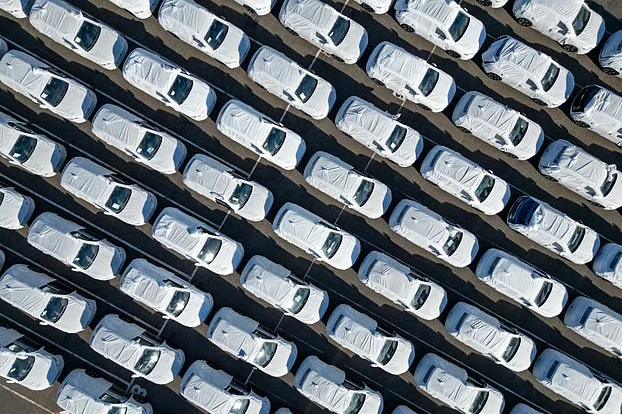
According to the South China Morning Post, the ship ‘BYD Explorer 1’ has already arrived at the port of Europe with hundreds of thousands of cars. That is, the entire process from production to delivery of the car to the customer is now under the sole control of BYD. As a result, this Chinese company is able to release high-quality cars in the market at a much lower price than Tesla by reducing transportation costs.
Executive Vice President Stella Lee speaking about BYD’s future plans and technological excellence at the International Motor Show held in Munich, Germany last year.

Mask vs. Chuanfu, a battle of two different philosophies
Tesla chief Elon Musk likes to live lavishly. He likes to be in the limelight all the time. But BYD founder Wang Chuanfu is just the opposite.
In a Bloomberg report, he has been directly called the ‘anti-Elon Musk’. Chuanfu was originally a freelance engineer. According to Forbes, he founded BYD with 20 employees in 1995 with just a $300,000 loan from his cousin. A story about his frugality is well known in the automobile world.
Once before an important investor meeting, he bought a cheap shirt from a roadside general store and attended the meeting as he did not have a good shirt. Chuanfu believes that engineering excellence, not glamour, is the real strength of his company.
According to a report in Fortune magazine, Chuanfu still eats in line with workers in the common canteen of his factory in Shenzhen and still likes to spend time in the laboratory.
Elon Musk is currently busy with various political debates and social media ‘X’. Chuanfu, on the other hand, is now exploring the new future of transportation.
Interestingly, in an interview with Bloomberg in 2011, Musk chuckled when he heard about BYD’s car. But today this frugal engineer has taken the mask market.
From London to New Delhi, BYD is reaching everywhere
BYD is no longer limited to China. They are conquerors all over the world. From London’s iconic red double-decker buses to taxis in Mexico City, Hong Kong, New Delhi or Los Angeles, BYD now has a strong presence.
However, the Western world is now desperate to stop this victory of BYD. US President Joe Biden has imposed 100 percent tariffs on Chinese electric cars. But this huge wall of tariffs is not stopping BYD much.
BYD executive vice president Stella Lee told the media that the US market is not their main target right now. They are more focused on the emerging markets of Southeast Asia, Latin America and Europe.
However, this struggle is not merely about tariffs or trade; at its core lies the critical issue of national security. Western nations fear that modern electric vehicles are, in essence, “smartphones on wheels.”
Modern electric cars are equipped with dozens of cameras, radar systems, and sensors. These devices constantly collect data—generating precise maps of the road and capturing details of everything in their surroundings. The United States fears that if these vehicles pass by critical American infrastructure, the resulting video footage or mapping data could be transmitted directly into the hands of Chinese intelligence agencies.
Furthermore, the in-cabin microphones and facial recognition sensors record the driver’s conversations and identity. Western nations worry that Beijing could leverage this technology to conduct surveillance on key individuals.
A security analysis conducted by the White House notes that, since these vehicles are connected to the internet, Beijing could—if it chose to—remotely disable thousands of cars via software updates. Such a capability would be sufficient to bring a nation’s entire transportation system to a standstill.
Even in the ongoing trade war, the Western world is finding itself cornered by BYD. Because BYD is self-reliant in the production of batteries and chips, American automakers like Ford and General Motors are unable to compete effectively in terms of cost. Consequently, century-old automotive brands now face the risk of bankruptcy, and the jobs of hundreds of thousands of workers hang in the balance.
China is no longer merely selling cars; it is seizing control of the global automotive industry itself.
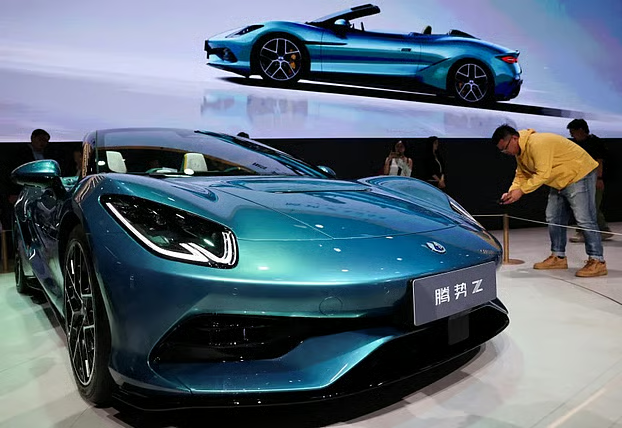
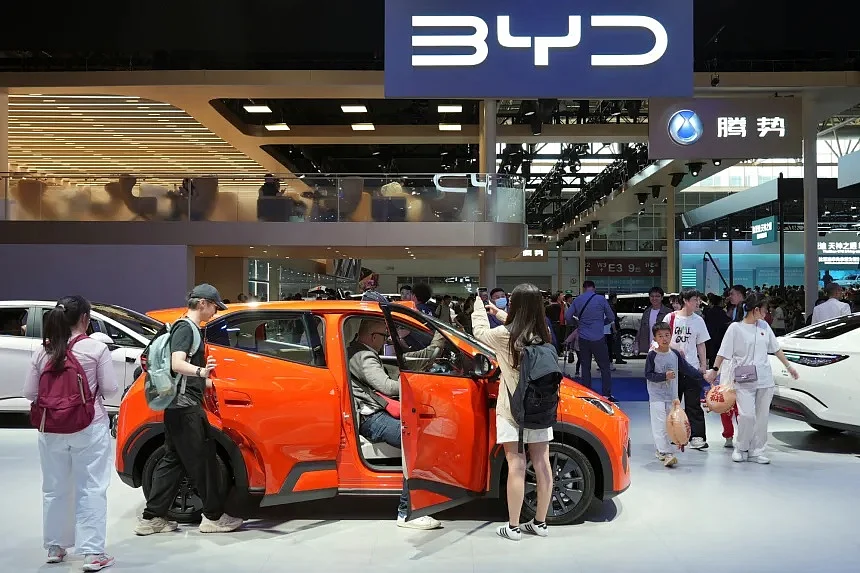
Visitors admire BYD’s affordable electric vehicle, the “Seagull,” at the auto show held in Beijing last week. This model has already generated immense interest across the global market.
Driverless Cars by 2027
BYD’s innovative prowess is now surpassing even the realm of science fiction. Analyses by CNN and Bloomberg reveal that BYD’s premium model—the “Yangwang U8″—is capable of floating on water like a boat in emergency situations, allowing it to effortlessly traverse bodies of water. Not only that, but this car is also capable of performing a full 360-degree rotation—much like a tank—while remaining stationary in a single spot, without requiring any extra space. This capability is known as “Tank Turn” technology.
Furthermore, straight out of a James Bond movie, the roof of this vehicle features a drone station. While the car is in motion, the drone automatically takes flight to capture live video footage of traffic conditions ahead or the surrounding environment, relaying it directly to the driver’s dashboard.
BYD’s “U9” supercar model takes things a step further. It possesses the ability to “hop” in place and can even continue driving while maintaining its balance, even if it is missing a wheel.
This Chinese automaker’s race for innovation extends beyond the road and into the skies. According to Reuters, BYD’s subsidiaries are currently working on “flying taxis”—or flying cars—capable of vertical takeoff and landing, much like a helicopter.
However, BYD’s ultimate goal lies even further ahead. According to Bloomberg, the company is technically prepared to commercially launch fully autonomous vehicles by as early as 2027; they are now merely awaiting legal approval from the Chinese government.
BYD’s new “Xuanji” smart architecture essentially transforms every vehicle into a powerful robot. According to analysts, this affordable, high-tech solution from China is poised to be the driving force behind the global transportation revolution of 2030. BYD’s greatest strength lies in its ability to democratize artificial intelligence—bringing it out of the realm of luxury and making it accessible to the general public.
Sources: Reuters, BBC, CNN, Bloomberg