Tensions have resurfaced in the relationship between Riyadh and the United Arab Emirates (UAE) centering on a new defense pact involving Saudi Arabia, Turkey and Pakistan. Prominent figures from both Saudi Arabia and the UAE have engaged in a public debate over whether Riyadh is moving towards a new regional security framework outside the Gulf Cooperation Council (GCC).
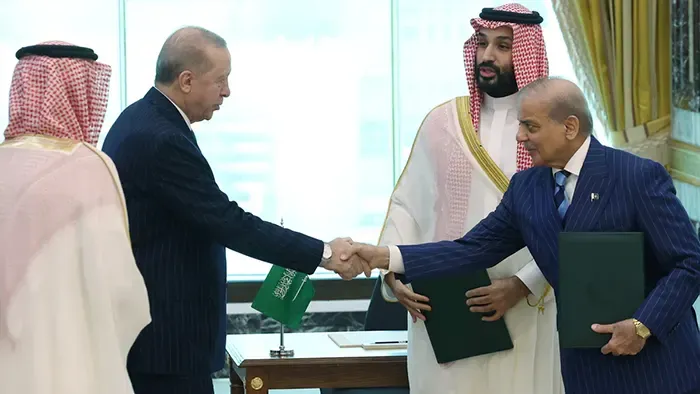
Under the “Mecca Joint Defense Pact” signed on August 7, an armed attack on any one of the three nations is to be treated as an attack on all three. Several influential Emirati commentators have sharply criticized the agreement. They question whether Saudi Arabia is moving to establish a new regional security framework outside the GCC.
The GCC is a regional alliance comprising six energy-rich monarchies in the Gulf region: Bahrain, Kuwait, Oman, Qatar, Saudi Arabia, and the United Arab Emirates.
At the forefront of this criticism is political analyst Abdulkhaleq Abdulla, a former advisor to UAE President Mohamed bin Zayed. He has questioned the rationale behind the new defense pact in multiple posts.
In one post, Abdulla offered congratulations on the formation of the new alliance. However, he argued that strengthening military and political cooperation among Gulf nations and consolidating “Gulf unity” is more important.
He remarked that this priority outweighs investing in regional military and political cooperation with countries whose credibility and capability to counter threats from Iran and Israel are in question.
He further questioned the nature of the alliance, noting that a key condition for any alliance’s success is the identification of a common enemy; he asked who the enemy of the nations in this alliance is.
Saudi Prince Abdulrahman bin Musaed quickly responded to his comments. He stated that the pact is a matter of national sovereignty and questioned why Emirati academic circles were so concerned about Riyadh’s strategic decisions.
In a post on X, Prince Abdulrahman wrote, “Whether it is called an alliance, a pact, or anything else—what is the problem?” He questioned how this could conflict with establishing ‘Gulf unity.’ Does a country not have the right to enter into agreements with one or more other nations in its own national interest?
Fahad Al-Arabi Al-Harthi, Chairman of the Asbar Center for Studies and Research, also supported the agreement. He stated that the Mecca Agreement is not an ‘alliance’ formed against anyone. Its foundation is not the identification of a common enemy; rather, it aims to build collective resistance and defense capabilities against potential threats to any party and to safeguard security and stability.
However, some Saudi social media users criticized the UAE in much harsher terms. One comment asked whether the UAE had informed other Gulf nations before establishing relations with Israel through the 2020 Abraham Accords.
The comment questioned whether the Gulf states were notified prior to the UAE establishing ties with Israel. As the controversy intensified, Abdullah went a step further, making a statement that many interpreted as a direct message prioritizing national interest over pan-Islamic or trilateral alliances.
He wrote that anyone who values their community more than their homeland lacks security; similarly, those who prioritize their Arab or Islamic identity over their homeland also lack security. In his view, loyalty, faithfulness, and sincerity should be reserved solely for the homeland—without any competing allegiances.
In response to Abdullah’s post, Abdulaziz Al-Tuwaijri, former head of the Islamic World Educational, Scientific and Cultural Organization (ICESCO), made a pointed remark. He wrote, “Anyone who betrays [the cause] by collaborating with Zionists will never find security.”
In another post, Al-Tuwaijri highlighted the UAE’s own security partnerships. He asked: if the UAE’s defense agreement with India and its extensive cooperation with Israel are acceptable, why is the Saudi-led defense agreement with Turkey and Pakistan being questioned? At the end of the post, he cited an Arabic proverb—”Those who have a sense of shame are dead”—thereby sharply criticizing the moral stance of the agreement’s detractors.
This public exchange of views surrounding the agreement has brought to the fore the existing differences between Riyadh and Abu Dhabi regarding regional strategy and security policy.