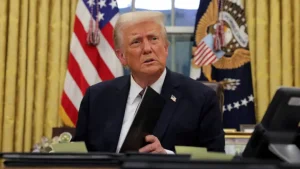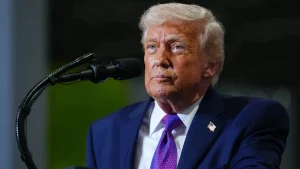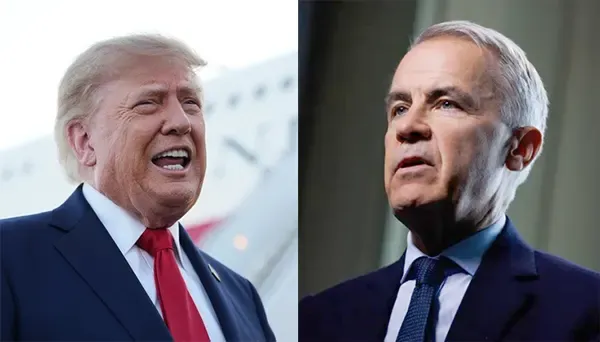
Tensions between Canada and the United States have escalated since President Donald Trump assumed office for his second term. Initially, he proposed making Canada the 51st state of the US, sparking a war of words between the two nations. This was compounded by the imposition of high tariffs. He even renamed ‘Lake Ontario’ to ‘Lake America.’ US President Donald Trump and Canadian Prime Minister Mark Carney met in Washington to discuss Trump’s imposition of a 50% tariff on specific Canadian goods, but the meeting proved unproductive. Consequently, relations between the US and Canada have become deeply adversarial. In response, Mark Carney initiated efforts to strengthen ties with the European Union (EU). Amidst this situation, European Commission President Ursula von der Leyen proposed making Canada the EU’s first ‘associate member.’ Shortly thereafter, US President Donald Trump threatened to impose new tariffs. CNN reported this development.
The proposal for Canada to become an associate member is part of an effort by the EU and Canada to draw closer and strengthen their respective economies amidst growing trade tensions with the US. However, on Wednesday, Trump stated that if he viewed any new agreement with Canada as a “hostile move,” the US might impose “heavy tariffs” on the European Union. Trump remarked, “If it is done with good intentions, that is fine. If there are bad intentions, we will impose very heavy tariffs on Europe—that is a possibility.”
Canada is currently embroiled in a trade war with its largest trading partner, the US, creating a renewed impetus to deepen ties with the European Union. Meanwhile, Trump has repeatedly called for Canada to become the 51st US state—a notion Canadian Prime Minister Mark Carney has firmly rejected. Carney attended Ursula von der Leyen’s ‘State of the Union’ address in Strasbourg, France, as a guest. There, von der Leyen stated that in this new world, it is essential to rethink our partnerships and build global alliances for our resilience and democracy. She added, “In short, we want to take our relationship with Canada to the highest possible level.”
Meanwhile, Carney is keen on forging closer ties with the EU. On Sunday, he remarked that Canada is moving towards establishing a unique alliance with the European Union. Earlier this year, in a speech at Davos, Switzerland, Carney emphasized the need for ‘middle-power’ nations to work together, noting the significant fragmentation emerging in the global order at the time. Amidst this context, von der Leyen stressed on Wednesday that the decision to deepen ties with Canada is not a partnership directed against anyone else, but rather one aimed at bolstering collective strength.
However, the European Union has also been grappling with the impact of tariffs imposed by Trump on US allies over the past year. It remains unclear exactly what benefits or obligations would entail if Canada were to become an ‘associate member’ of the EU. Similarly, it is not clear whether all 27 EU member states support this plan. As a member of the British Commonwealth, Canada shares deep cultural and historical ties with Europe. Canada’s structures—including its parliamentary democracy, universal healthcare, and social welfare systems—align closely with European models. Canada even shares a small land border with Europe; this border with Denmark exists via Hans Island, a small territory located off the northwest coast of Greenland. Additionally, the French-administered islands of Saint-Pierre and Miquelon lie just 20 kilometers off the coast of Newfoundland.
Yet, despite the likelihood of meeting most political, economic, and legal criteria, there is one distinct obstacle to Canada becoming a full member of the EU: the country is not geographically located in Europe. To join the European Union, a country must undergo a rigorous, multi-stage accession process. Furthermore, the candidacy requires the unanimous approval of the EU’s 27 member states. Currently, several countries are awaiting entry into the European Union; among them, nine have been officially recognized as candidates for EU membership.