Airport authorities have also attributed the situation to air traffic congestion in Greek airspace, causing prolonged inconvenience for many passengers.
Significant delays were reported at Ben Gurion Airport on Friday, with passengers describing long periods of hardship.
Passengers reported that even after boarding, some flights were delayed because luggage had not yet been loaded. In other instances, travelers faced long waits to retrieve their suitcases or bags upon arrival. Delays also affected flights bound for Israel; passengers were informed that the congestion was due to the heavy operational load at Ben Gurion Airport.
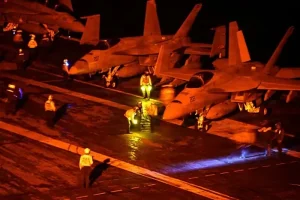
In a statement, the Israel Airports Authority (IAA) cited several reasons for the situation, notably the prolonged presence of US aerial refueling tankers at the airport.
The IAA statement noted that a combination of peak summer flight traffic and congestion in Greek airspace—the primary route from Israel to Europe—forced the airport to handle 90 flights within a span of just three hours. Additionally, the presence of multiple US refueling aircraft—deployed amidst tensions with Iran—limited available parking space, further complicating operations.
The IAA stated, “When a large number of flights arrive in a short timeframe, limited parking space reduces operational flexibility and places extra strain on ground operations and internal airport systems.” The agency denied that staff shortages were a cause of the delays.
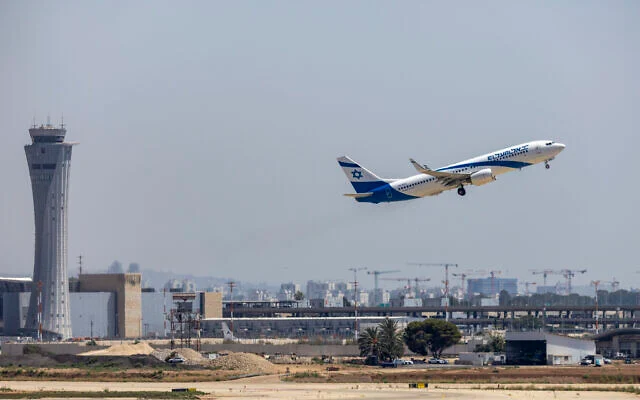
An El Al aircraft taking off from Ben Gurion Airport near Tel Aviv, August 4, 2026. (Yossi Aloni/Flash90)
Significant delays were reported at Ben Gurion Airport on Friday, with passengers describing long periods of hardship. Passengers reported that even after boarding, some flights were delayed because luggage had not yet been loaded. In many instances, passengers also had to wait a long time to retrieve their suitcases or bags upon reaching their destinations. Delays were also reported on flights bound for Israel; passengers were informed that this was due to the heavy operational load at Ben Gurion Airport.
In a statement, the Israel Airports Authority (IAA) attributed the situation to several factors, notably the prolonged presence of US aerial refueling tankers at the airport. The IAA stated that a combination of peak summer air traffic, congestion over Greek airspace on major routes from Israel to Europe, and operational constraints caused by the large number of US refueling tankers stationed at the airport—due to the conflict with Iran—led to a complex situation involving 90 flights within a three-hour window.
The IAA noted, “When a large number of aircraft arrive in a short span of time, a shortage of parking space reduces operational flexibility and places a strain on ground handling systems.” The agency denied reports that the delays were caused by staff shortages.
Receive the daily edition of ‘The Times of Israel’ via email and never miss our top stories.
Newsletter email address
By signing up, you agree to the terms and conditions.
The IAA stated that the delays stemmed from the intense activity associated with the movement of over 90,000 passengers on Friday, including the luggage handling process and general slowdowns across the “entire handling operation.”
The continued presence of US tankers at Ben Gurion Airport has become a subject of controversy. Transportation Minister Miri Regev had promised last month that a maximum of 20 tankers would be permitted at the airport at any given time, with the remainder relocated to various military bases across the country. It is not immediately clear whether this limit of 20 tankers has been implemented at Ben Gurion Airport, as there is pressure from the United States to allow a larger number of tankers to be stationed there.