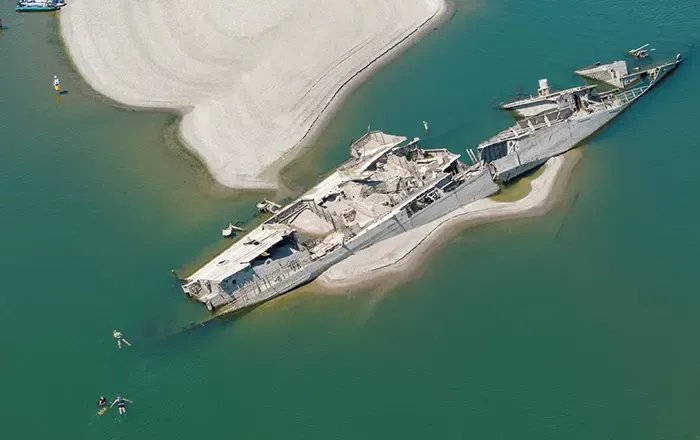
Due to the ongoing severe drought across Europe, the Danube—one of the continent’s major rivers—has receded to unprecedentedly low levels. As the water levels dropped, several Nazi German warships from World War II emerged from the riverbed near Prahovo, Serbia. The Independent reported this development. The European Investment Bank stated that at least 200 warships, cargo vessels, and barges—destroyed during the German retreat in 1944—had been submerged in the riverbed; the drought has now made them visible.
Additionally, the wreckage of the ‘Fulton,’ a Hungarian cargo ship from 1937, has surfaced near Opatovac, Croatia. The alarming drop in the Danube’s water level poses a serious threat to tourism, industry, and power generation across Europe. In Budapest, Hungary’s capital, the water level has plummeted to a record low of 23 centimeters—far below the previous all-time low of 33 centimeters recorded in 2018. Low water levels have brought cargo shipping to a near-standstill, forcing cruise ships to anchor far from the city center. The water crisis has also severely impacted the region’s nuclear power plants; water from the Danube is used to cool reactors at Hungary’s Paks Nuclear Power Plant and Romania’s Nuclearelectrica plant.
Due to the critically low water levels, both countries have halved their nuclear power output. Romanian official Ilie Bolojan declared a nationwide state of emergency for August and announced plans to import electricity from Ukraine, Greece, and Bulgaria. Meanwhile, Hungarian official Péter Magyar warned at a press conference on Friday that if water levels drop further, the Paks power plant might have to be shut down completely for the first time in 44 years. The country has asked major industrial enterprises to reduce electricity consumption as the demand for power has risen by nearly 20 percent due to the heatwave. There are fears that Europe’s energy system could face a severe crisis, given the low likelihood of river water levels returning to normal in the coming weeks.