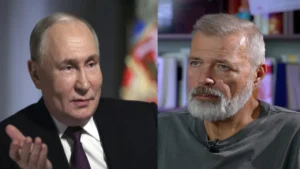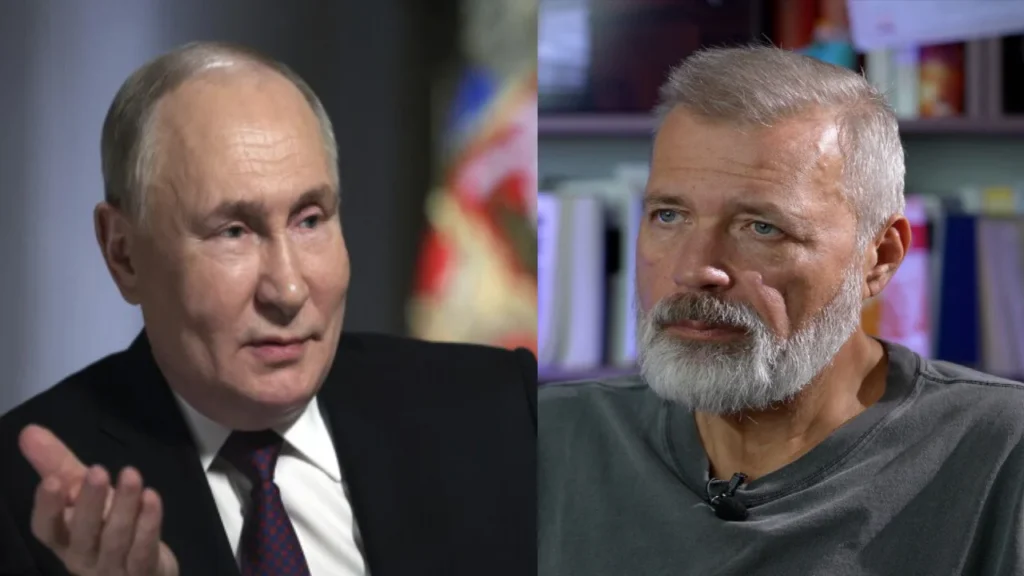
Nobel Peace Prize-winning Russian journalist Dmitry Muratov has stated that Russian President Vladimir Putin can no longer claim victory in the war against Ukraine. In his view, regardless of how the conflict—which has been ongoing for nearly five years—eventually concludes, the immense loss of life makes it impossible to label the outcome a victory for either side.
In an interview with the BBC, Muratov—co-founder and former editor-in-chief of the Russian newspaper Novaya Gazeta—remarked that while it might be possible to destroy Ukraine, conquering the country is not feasible. He noted that a million or more people have lost their lives in this war between two Slavic nations; after such a staggering death toll, the outcome can by no means be described as a victory.
Russia launched a full-scale military offensive in Ukraine in February 2022. At the time, Moscow termed it a “special military operation” and anticipated a swift conclusion. However, the conflict dragged on, becoming the bloodiest in Europe since World War II.
Meanwhile, Russian President Putin continues to speak of a Russian victory. Muratov, however, believes that the long-term consequences of the war have created a deep crisis for Russia itself. He also expressed concern regarding the crackdown on independent journalism and freedom of expression within the country.
Muratov stated that since the war in Ukraine began, numerous journalists, political activists, and government critics have been branded as “foreign agents,” extremists, or terrorists. He claims that at least 1,500 people in Russia are currently imprisoned for speaking out against state policies, although this figure is difficult to verify independently.
Novaya Gazeta, founded by Muratov, was once known as one of Russia’s most important independent newspapers. It gained widespread recognition for reporting on human rights violations, corruption, and state repression. In 2021, Muratov was jointly awarded the Nobel Peace Prize alongside Filipino journalist Maria Ressa for his efforts to safeguard freedom of expression. Yet, even the Nobel Prize could not save his newspaper.
Muratov said that government decisions led to the cessation of the newspaper’s print operations and the revocation of its registration. Currently, the Novaya Gazeta website has also been blocked in Russia; it can only be accessed from abroad or via a VPN. Muratov has questioned whether Russia’s security has actually improved due to the war in Ukraine. He noted that Ukrainian drones are now striking various facilities deep within Russian territory, and the country is facing numerous issues, including fuel shortages and disruptions to mobile internet services.
Regarding the potential use of nuclear weapons, the Nobel laureate journalist observed that the topic has been raised over 500 times in Russia since the beginning of the year. He expressed concern over these discussions taking place on state television and at various government events.
However, he remains skeptical about the likelihood of Putin losing power. Muratov stated that he does not believe in rumors of rifts or secret conspiracies within the Russian ruling elite. In his view, Russia remains firmly under Putin’s control, and even the country’s powerful figures fear him.
Muratov himself has been designated a “foreign agent” in Russia—a label that restricts an individual’s rights and casts them under a cloud of societal suspicion. Yet, he is more concerned about imprisoned anti-war figures than his own predicament. During the interview, he showed photographs of several jailed journalists and anti-war activists.
Among them are journalists Antonina Favorskaya, Konstantin Gabov, Sergey Karelin, and Artyom Kriger, all of whom have been imprisoned on charges of extremism. Former local councilor Alexei Gorinov is also behind bars for speaking out against the war. Muratov also recalled the case of pianist Pavel Kushnir, who was detained after releasing videos opposing the war in Ukraine; he subsequently died in a pre-trial detention center while on a hunger strike, at the age of 39.
Although Muratov considers the situation extremely difficult for critics in Russia, he is not entirely without hope. He noted that while many people are afraid to speak openly, there is no shortage of citizens who express support for him and his colleagues on the street. These are times when people remain silent, yet they whisper their gratitude—and what people are truly thinking is what matters most.