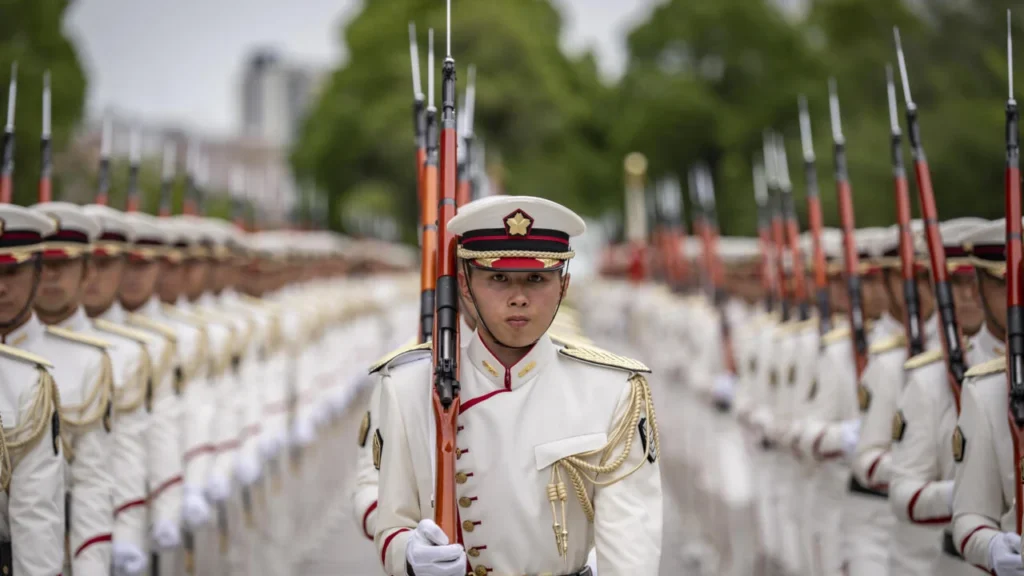
Japanese Defense Minister Shinjiro Koizumi has stated that rapidly strengthening Japan’s military capabilities is essential in the face of growing security risks posed by China, North Korea, and Russia.
In the preface to Japan’s annual defense white paper released on Tuesday, he remarked, “It is imperative for Japan to reinforce and modernize its defense capabilities with a greater sense of urgency and crisis awareness than ever before.”
He noted that not only are China and North Korea expanding their military power in the Asia-Pacific region, but military cooperation between China and Russia, as well as between Russia and North Korea, is also intensifying.
The defense white paper highlights that China’s military activities surrounding Japan are steadily increasing, extending beyond the so-called “First Island Chain” to the “Second Island Chain.”
It cites several incidents from 2025, including the operations of Chinese aircraft carriers and two separate occasions in June and July when Chinese military aircraft flew in extremely close proximity to Japanese aircraft.
According to the white paper, Japanese fighter jets scrambled 595 times during the year ending March 31, 2026. Of these, 366 scrambles were in response to Chinese aircraft and 214 to Russian aircraft. The figure for the previous year was 704, which was higher than in other recent years.
Japan has already taken steps to increase defense spending, expand security cooperation in Asia, deploy missiles to remote islands, acquire counter-strike capabilities, and relax arms export regulations.
However, the white paper warns that limitations in the country’s defense manufacturing sector could create obstacles for future arms procurement and technological innovation.
Defense Minister Koizumi stated that he held frank discussions with U.S. Secretary of Defense Pete Hegseth regarding the “unwavering” nature of the Japan-U.S. alliance. At the same time, security cooperation with the Philippines, Australia, and South Korea is being strengthened to foster a ‘free and open Indo-Pacific.’
He stated, “The security situation is rapidly becoming more complex. Therefore, enhancing the capacity to address crises across the Indo-Pacific region is the need of the hour.”
Meanwhile, China has expressed concern over Japan’s military preparations. Relations between the two nations have deteriorated further, particularly following remarks regarding Taiwan made by Sanae Takaichi. Beijing alleges that Japan is once again moving towards a path of ‘new militarism.’