




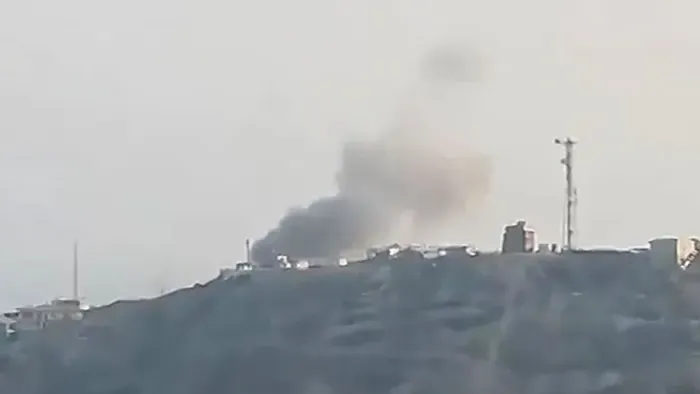
Iran-aligned Houthi rebels launched a surprise missile attack targeting the presidential palace complex in the southern Yemeni city of Aden, leaving at least five people dead and 16 injured. The Yemeni government confirmed this information on Thursday (October 15), according to Reuters.
The report states that the Al-Ma’ashiq Palace in Aden serves as the headquarters for Yemen’s Saudi-backed and internationally recognized government. This marks the first time the palace has been targeted during the ongoing conflict.
Yemen’s Information Minister, Muammar Al-Eryani, stated that the Prime Minister and cabinet members were safe at the time of the attack. Eyewitnesses told Reuters they heard several loud explosions near the palace.
The Yemeni cabinet reported that both missiles and drones were used in the attack.
Health Minister Qasim Buhaibeh confirmed that five people were killed and 16 injured in the strike targeting the government’s official headquarters within the presidential palace complex. The casualties included security personnel and civilian employees.
Meanwhile, Houthi military spokesman Yahya Saree stated that their fighters had bombarded a facility in Aden known as the headquarters for Saudi military operations.
He claimed the attack was part of a policy to target Saudi forces and their reinforcement efforts wherever they are stationed.
Saba, the Houthi-controlled news agency, reported that the headquarters was managed by Saudi officials and housed an arms depot. However, Reuters could not independently verify these claims.
Yemen conflict intensifies again
Fighting between Houthi rebels and Saudi-backed government forces in Yemen has intensified once more. International aid agencies have warned that the humanitarian situation in the country is rapidly deteriorating.
Last week, Yemeni government forces launched an offensive to retake areas held by the Houthis. According to relevant sources, some areas near the Bab al-Mandab Strait—a vital maritime route—have been recaptured.
Located at the junction of the Red Sea and the Gulf of Aden, this strait is of critical importance for international trade and shipping.
The civil war in Yemen began in 2014, when Houthi rebels seized the capital, Sanaa, forcing the government to relocate to the south. The following year, a Saudi-led military coalition intervened in support of the Yemeni government forces. After a long and bloody conflict, a ceasefire came into effect in 2022, which remained largely in place until this year. However, the ceasefire collapsed following the outbreak of hostilities involving the United States, Israel, and Iran.
Attacks on Saudi Airports and Oil Facilities
Due to its support for the Yemeni government, Saudi Arabia has become a primary target for Houthi attacks. Recently, the Houthis have been accused of launching ballistic missiles and drones at Saudi airports, seaports, and oil facilities. These actions have raised concerns about the potential expansion of a regional conflict and the disruption of Saudi Arabia’s ambitious economic plans.
On Thursday, the Saudi-led military coalition reported that the Houthis had carried out 20 attacks targeting Riyadh’s King Khalid International Airport this month. Coalition spokesperson Major General Turki al-Maliki shared this information with journalists, stating that these attacks resulted in 17 deaths and 333 injuries.
King Khalid International Airport is one of Saudi Arabia’s major international aviation hubs. The governing body of the UN’s International Civil Aviation Organization (ICAO) has condemned the recent attacks on civilian airports, aircraft, and aviation infrastructure.
The coalition further claims that a Houthi attack on Abha Airport, located in southwestern Saudi Arabia near the Yemeni border, left three people dead and 28 injured.
Al-Maliki also alleged that the Houthis have acquired advanced military technology with the assistance of various regional actors—including ballistic missiles, drones, and high-speed, explosive-laden watercraft. Saudi Arabia and its allies have long alleged that Iran provides the Houthis with weapons, funding, and military training.