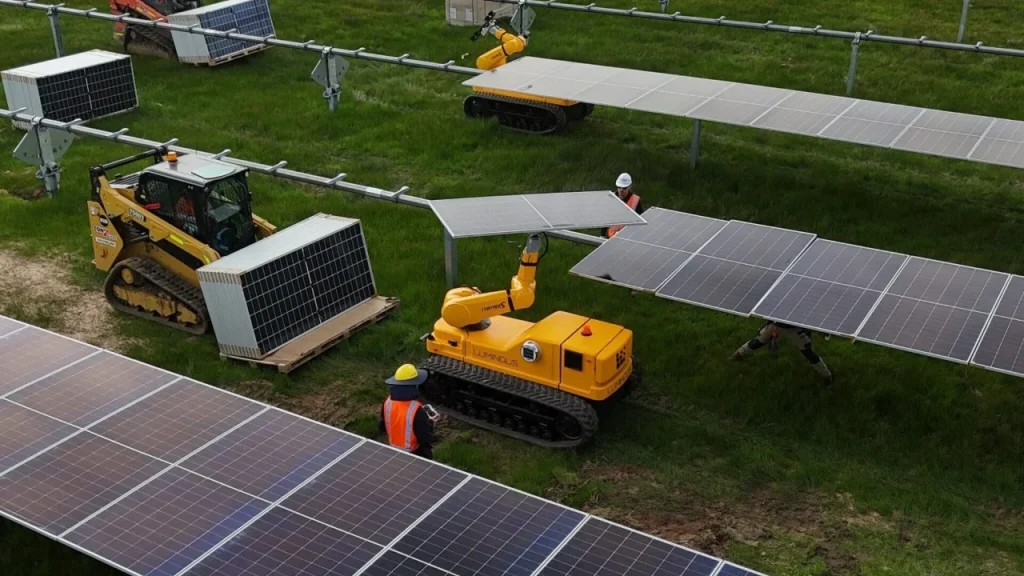
Solar power plants are currently being hailed as the “Bitcoin of the future” for both the economy and the environment. However, the methods used to construct these plants have not yet undergone significant change. Installing solar panels across hundreds of acres requires a vast workforce, steel structures, extensive land, and considerable time. Planted, a California-based startup, has taken the initiative to use robots to accelerate and automate this process.
While the cost of solar panels has dropped and their efficiency has improved, conventional installation methods still face major hurdles—including labor shortages, land-use issues, high steel demand, and lengthy construction times—according to a report by PowerMag.
Planted is working to address these challenges. The company recently secured $31.8 million in funding. It plans to use these funds to expand its fleet of robots that directly install solar power plants and to launch a new generation of machines named “Sage.”
The investment round was led by Piva Capital and RA Capital Management’s Planetary Health strategy. Google, Breakthrough Energy Ventures, Khosla Ventures, and Gigascale Capital also participated.
The nature of competition in the solar sector is shifting. While the focus was previously on manufacturing highly efficient panels at low costs, the speed at which vacant land can be transformed into power-generating capacity is now becoming equally important. Relevant companies believe that automated robotic technology can play a pivotal role in this area.
Breakthrough Energy Ventures was established as part of Bill Gates’ climate technology funding initiative. Meanwhile, Gigascale Capital was founded by Mike Schroepfer, a former executive at Meta. Google’s investment has also drawn particular attention, given the rising demand for electricity driven by the rapid expansion of digital infrastructure.
Planted has reported that the current demand for its robots exceeds its production capacity. In 2025, the company deployed robots to install over 10 megawatts of solar power capacity. It has set a target to increase this capacity to 100 megawatts within the current year—representing a planned expansion of nearly tenfold in just one year.
Meanwhile, the company’s pipeline of potential projects has already surpassed 20 gigawatts. Consequently, there is growing interest within the technology and energy sectors regarding how rapidly the use of robots in solar power plant construction might expand in the future.