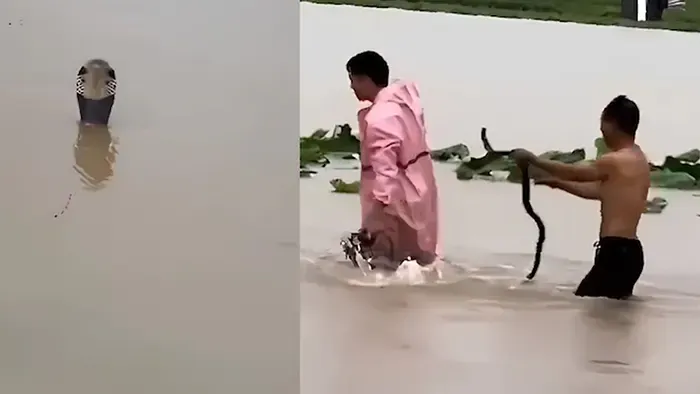
Panic has gripped the southern Chinese city of Hengzhou after hundreds of snakes spread across the area following severe flooding. At least 900 snakes escaped into the surroundings after a snake farm was washed away by floods triggered by Typhoon Maysak. State media reported that the majority of these snakes are venomous. (Source: CNN)
Hengzhou is home to approximately one million people. So far, at least 39 deaths have been reported in the city due to the floods; among the victims, one woman died from a snakebite.
It is believed she was bitten by a cobra that had escaped from a flooded snake farm. Several other people have also sustained injuries from snakebites.
Videos shared by local residents on social media show numerous snakes swimming through the floodwaters on the streets with their heads raised. These scenes have caused widespread alarm among the locals.
Although Chinese authorities initially downplayed the situation, they later issued warnings to villagers, advising them to stay away from the snakes. Measures have been taken to deploy specialized snake-catching teams, stock hospitals with sufficient antivenom, and ensure medical personnel are on standby.
Animals Escape from Zoo as Well
In addition to the snakes, several animals escaped from a zoo due to the flooding. These include two zebras, a zebu (humped cattle), three miniature horses, two donkeys, ostriches, emus, and raccoons, among others.
The privately-owned Guigang Zoo issued an urgent alert on Wednesday night (July 8), noting that the escaped animals could become aggressive if frightened. The public has been urged to notify authorities immediately if they spot any of the animals.
Yin Feifei, the zoo’s owner, told local media outlet Hongxing News that staff risked their own lives to secure the cages of dangerous animals as floodwaters rose, preventing them from escaping and posing a threat to public safety. However, three lions drowned in the flood. Local media outlet Shangyou News reported that more than 16,000 pigs were swept away by the floods. Videos circulating online show heavy machinery being used to retrieve the pigs from the floodwaters.
Hengzhou is located in the southeastern part of China’s Guangxi region. Surrounded by mountains and over 660 rivers, the city is known as China’s “Jasmine Capital.” Jasmine flowers—used in tea production—have been cultivated there for nearly 500 years.
However, alongside jasmine flowers, the Guangxi region has long been famous for snake breeding. More than 100 species of snakes are found in this region, which borders Vietnam.
Snake meat is a popular and nutritious food among locals. However, most snakes are now raised on farms for use in medicine and biomedical research.
A 2020 report stated that there were approximately 20 million snakes and over 14,000 snake farms in Guangxi.
Cobras and common rat snakes are the most commonly farmed species in the region. While rat snakes are non-venomous, cobra bites can be fatal.
3,000 Snakes Captured in Two Days
Zhu, a member of a volunteer snake-catching team in Hengzhou, told the state-owned Beijing News that his seven-to-eight-member team captured between 2,000 and 3,000 snakes over two days of continuous work. Most of them were rat snakes.
He explained that after floods, snakes often seek shelter in corners of houses or other hidden spots. Villagers notify the team when they spot a snake. The captured snakes are later handed over to experts so they can be released back into the wild.
Death by Snakebite: No Timely Medical Treatment
According to local residents, the woman who died from a snakebite could not be taken to the hospital in time. Due to flood-disrupted road connections, she could not receive prompt medical care, and the venom spread through her body.
“We asked for help, but it was already too late,” said a villager.
Warning to Residents
Local authorities have advised residents not to go outside at night unless necessary. People have been advised to avoid grassy areas and the vicinity of ponds or water bodies, as snakes may frequent these locations in search of food and shelter.
A report by the state news agency Xinhua notes that most snakes prefer cool, damp environments and generally do not attack humans unless provoked.
The report further suggests that substances with strong odors can repel snakes; therefore, snake-repellent powder could be sprinkled at home entrances. When moving outdoors in areas where snakes might be present, it is also advised to strike bushes with a stick while walking.
Local hospitals have reported having adequate stocks of antivenom; however, the treatment is effective only if snakebite victims reach the hospital promptly.
Although floodwaters have begun to recede, it remains uncertain how long the hundreds of displaced snakes will pose a threat to the public or whether it will be possible to capture them all.