Iraq, Syria, and the United States have initiated a plan to reactivate a historic oil pipeline spanning approximately 500 miles, aiming to reduce reliance on the Strait of Hormuz, which is controlled by Iran. Senior Iraqi and regional officials confirmed this information to the Middle East-based news outlet, Middle East Eye (MEE).
Sources told MEE that an agreement to revive the pipeline—stretching from Kirkuk in northern Iraq to the Syrian Mediterranean coastal city of Baniyas—could be formally announced next week. This announcement is expected to coincide with a meeting in Washington between Iraqi Prime Minister Ali al-Zaidi and US President Donald Trump.
The report states that Tom Barrack—the Trump administration’s ambassador to Turkey and special envoy for Syria and Iraq—is working to finalize the details of the agreement ahead of the Iraqi Prime Minister’s visit. During the trip, Al-Zaidi may also visit Texas, a US state known as a hub for the energy industry.
A senior Iraqi official told MEE that Prime Minister Al-Zaidi has developed a strong working relationship with Tom Barrack. Barrack aims to establish this pipeline project as an economic model for the Levant region that would be mutually beneficial for the United States and the countries involved.
The pipeline was originally constructed by the Iraq Petroleum Company in 1952 and had a daily transport capacity of approximately 300,000 barrels of oil.
However, Baghdad shut down the pipeline in the 1980s after Syria sided with Tehran during the Iran-Iraq War. Later, large sections of the pipeline were damaged during the 2003 US invasion of Iraq, and it has remained effectively inoperable since then.
A senior regional official informed MEE that reactivating the pipeline would require the construction of new storage facilities, pumps, electrical systems, and other infrastructure. According to him, the entire pipeline might actually need to be rebuilt from scratch, a process that could take two to three years to complete.
The official further noted that a consortium comprising several US companies has already been formed for this reconstruction, signaling the importance the United States attaches to the project.
Growing Importance Following the Hormuz Crisis
Syria and Iraq had held preliminary discussions about restarting the pipeline after Syria’s new president, Ahmed al-Shara, assumed power in late 2024; however, that initiative did not succeed at the time.
But against the backdrop of recent conflicts involving the US, Israel, and Iran—and Iran’s tightening control over the Strait of Hormuz—the pipeline has regained strategic importance.
Although Iraq began exporting limited quantities of crude oil via trucks through Syria during the war, it was insufficient to meet demand.
Middle East analyst Sarhang Hamasaeed stated that Iraq has begun to view Syria differently. While there was previously mutual suspicion, the war demonstrated that Iraq needs Syria.
Regional sources have reported that Syrian Foreign Minister Asad al-Shaibani will also visit the United States to attend the signing ceremony for the pipeline agreement.
Despite the influence of Iran-aligned Shia political parties and militias within Iraq’s current government, they are now seeking avenues for cooperation with Syria’s new administration.
Meanwhile, since assuming power, President Ahmed al-Shara has garnered support from the United States, Turkey, Qatar, and Saudi Arabia.
The Trump administration has already lifted several sanctions imposed on Syria and eased restrictions on al-Shara’s former organization, Hayat Tahrir al-Sham (HTS).
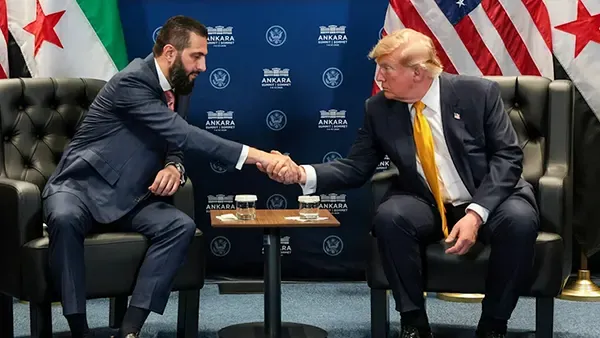
Last week, at the NATO summit in Ankara, Trump praised al-Shara as an “extraordinary” and “highly respected” leader. Concurrently, the US announced that Syria would be removed from the list of state sponsors of terrorism, a designation it had held since 1979. Participation of US Companies
Earlier this month, the Iraqi government approved a preliminary agreement with Capital TI, Chevron, and a Qatari firm to conduct a feasibility study for a new pipeline project extending from Kirkuk and Haditha to Baniyas.
Iraq routes approximately 95 percent of its total oil exports through the Strait of Hormuz; consequently, any closure or disruption of the strait severely damages the country’s economy.
According to data from the energy analytics firm Vortexa, Iraq’s seaborne oil exports dropped to just 8 percent of the previous year’s average last May.
It is worth noting that about 90 percent of Iraq’s state budget relies on revenue from oil sales. Therefore, analysts consider the establishment of alternative export routes to be crucial for the country.