





Russian sabotage activities are on the rise across Europe. Russian intelligence agencies and their proxies are now employing increasingly sophisticated tactics to target critical European infrastructure, raising the prospect of “mass-casualty events.” This warning comes from the International Institute for Strategic Studies (IISS), an influential research organization, as reported by The Guardian.
According to an IISS report, Russian intelligence services and their associates are targeting European railways, energy networks, and the defense industry in an effort to undermine European support for Ukraine.
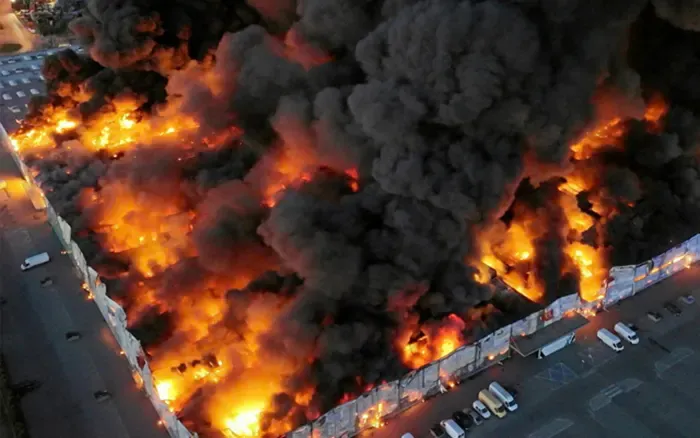
The IISS estimates that Russian sabotage operations have increased by 16 percent over the past 12 months. During the same period, incidents involving arson and the use of explosives have doubled, creating a heightened risk of mass casualties. Furthermore, there is a growing danger that miscalculations could lead to retaliatory strikes or an escalation of conflict.
The report notes that while many of these sabotage operations are still carried out by relatively unskilled operatives, a more semi-skilled group has also emerged. These actors are employing more complex methods, including the use of improvised explosive devices (IEDs) that can be detonated remotely or set to explode at a specific time.
Authorities across Europe have arrested individuals acting on behalf of Russia, expelled intelligence officers, and, in some instances, closed Russian consulates. However, the IISS states there is no clear evidence that these measures have diminished the Kremlin’s interest in using sabotage as a policy tool.
The report concludes that while arresting proxies may remove the individuals directly involved in carrying out acts of sabotage, it is highly unlikely to deter the Russian intelligence agencies that orchestrate these operations. These attacks are being carried out using multiple layers of intermediaries. Waves of attacks, targeting strategically significant countries and sectors, are occurring at regular intervals.
According to the IISS, Germany and Poland are primary targets for Russian sabotage, as their transport and industrial networks are critical for the delivery of military and other supplies to Ukraine. Over the past 12 months, more than half of the recorded acts of sabotage in Europe have targeted critical infrastructure.
The report notes that between October 2025 and September 2026, 29 acts of sabotage linked to Moscow were recorded in Poland. This includes an explosive attack on a railway line in November 2025, which damaged a route used for transporting supplies to Ukraine.
On August 4, in Leipzig, Germany, a drone laden with explosives was discovered near an Antonov cargo aircraft used for transporting Ukrainian military equipment. Investigators suspect that, shortly thereafter—following a suspension of air traffic—a second drone may have collided with a DHL cargo plane.
The IISS poses a critical question for Europe: can these nations transform their currently fragmented, individual responses into a unified European strategy before an operation orchestrated by Russian intelligence—or its proxies—results in significant loss of life?
The report warns that any act of sabotage resulting in fatalities or major infrastructure collapse would inevitably trigger demands for a retaliatory response, potentially exposing deep-seated divisions among European Union member states.
Despite recent attacks in Estonia, Lithuania, and Romania, European nations have yet to establish a clear “red line” for Russia.
The IISS suggests that the prospect of a major, lethal incident—whether resulting from a deliberate attack or a miscalculation—remains a deeply concerning issue for Europe. In such a situation, the fear of the conflict spreading has become the primary concern for policymakers. For this reason, the organization has urged European nations to clearly communicate—publicly—what kind of response would be triggered by specific levels of damage or aggression.
Meanwhile, Moscow has categorically rejected allegations made by Western governments and intelligence agencies that Russia is attempting to undermine or disrupt the European Union’s support for Ukraine through the use of drones, cyberattacks, acts of arson, and explosions across Europe.